Greyhound Forecast Betting: Straight, Reverse & Combination Explained
Best Greyhound Betting Sites – Bet on Greyhounds in 2026
Loading...
What Is a Forecast Bet?
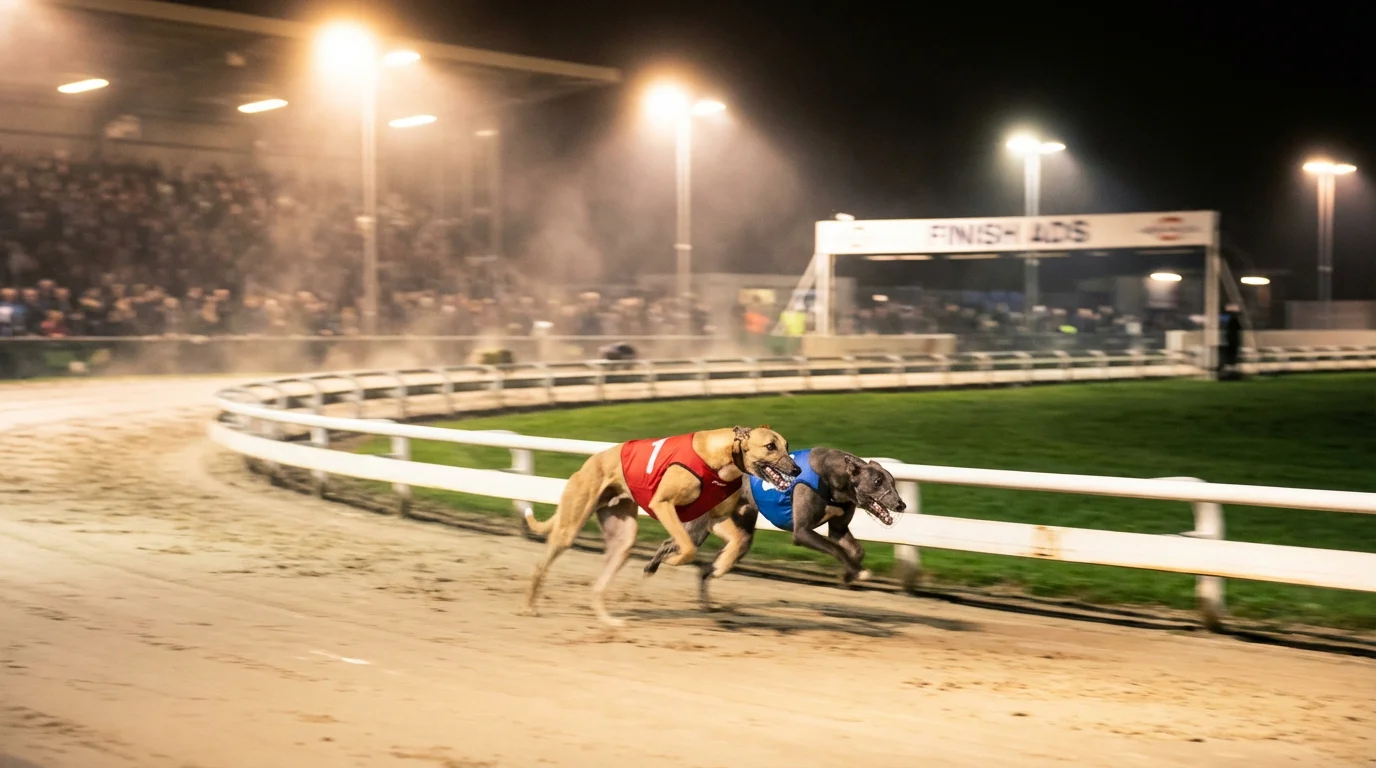
A forecast asks you to name the first two — and get the order right. Unlike a win bet, where you need one correct pick, or an each-way, where finishing second softens the blow, a forecast demands precision: which dog crosses the line first and which finishes second, in exactly that sequence. Get both right and the payout reflects the difficulty. Get one wrong — even if both dogs finish in the top two but in the reverse order — and you lose.
In UK greyhound racing, forecasts are available on virtually every race at every GBGB-licensed track. The bet is settled using the Computer Straight Forecast, a formula-based dividend calculated after the race. This is not a fixed-odds bet — you don’t see a price when you place the wager. Instead, the dividend is determined by the starting prices of the first and second dogs and the number of runners, then published after the result is confirmed.
This means forecast returns can vary enormously. If the 6/4 favourite finishes first and the 3/1 second favourite finishes second, the CSF dividend might be modest — perhaps eight or nine pounds to a one-pound stake. But if a 10/1 outsider wins and another longer-priced dog grabs second, the dividend can run into the hundreds. The unpredictability of the payout is part of the appeal, and part of the risk.
Forecast bets have a minimum stake, typically one pound with most bookmakers and Tote operators. You can place them online, at the track, or in betting shops. The key thing to remember is that order matters absolutely. Trap 3 first and trap 5 second is a completely different bet from trap 5 first and trap 3 second, even though you’ve picked the same two dogs.
For punters who can identify the top two contenders in a race but struggle to separate them, the forecast opens up a middle ground between the simplicity of a win bet and the larger ambition of a tricast. It rewards knowledge of form, trap draw, and running style — all the factors that determine not just who wins, but who runs into second.
Straight Forecast vs Reverse Forecast
One direction or both — and the cost doubles. That’s the essential difference between a straight forecast and a reverse forecast, and it’s a distinction that directly affects your risk and your potential return.
A straight forecast is a single bet: dog A to finish first, dog B to finish second, in that exact order. You pay one unit stake. If the result comes in exactly as predicted, you collect the CSF dividend. If the order is reversed — dog B wins and dog A finishes second — you lose. There’s no partial payout, no consolation. The bet either hits or it doesn’t.
A reverse forecast is two straight forecasts combined into one bet. You’re backing dog A first and dog B second, plus dog B first and dog A second. Both permutations are covered, so if your two selections finish first and second in either order, one of the two bets wins. The cost is two units — effectively two separate straight forecasts on the same slip.
The trade-off is straightforward. A reverse forecast doubles your stake but removes the need to predict the exact finishing order of your two picks. If you’re confident that two specific dogs will fill the top two spots but genuinely uncertain about which one beats the other, the reverse forecast is the logical choice. You’re paying for coverage.
When does a straight forecast make more sense? When the form clearly points to one dog winning and another running into second. A strong front-runner from a favourable trap, paired with a consistent closer who picks up places without winning — that’s a profile where the finishing order is more predictable. In those situations, paying double for the reverse is unnecessary. You have a view on the order, so back it.
It’s worth noting that the reverse forecast always returns less profit per pound staked than a straight forecast that hits. You’ve spent two pounds to win one dividend. If you’d placed a one-pound straight forecast in the correct order, you’d have the same dividend but at half the total cost. The reverse forecast pays for certainty with margin.
One common mistake is treating the reverse forecast as a “safer” version of the straight. It’s not safer — you still need both dogs in the top two. What it eliminates is the order question, nothing more. If one of your selections finishes third, the reverse forecast loses just as completely as the straight. The risk reduction is narrower than it feels.
Combination Forecasts: Covering More Outcomes
Three dogs, six permutations, one bet slip. That’s the basic structure of a combination forecast with three selections, and it’s where forecast betting starts to scale up — in both coverage and cost.
A combination forecast takes three or more selections and covers every possible first-and-second pairing between them. With three dogs (call them A, B, and C), the permutations are: A-B, A-C, B-A, B-C, C-A, C-B. Six straight forecasts. Your unit stake is multiplied by six, so a one-pound combination forecast with three selections costs six pounds.
With four selections, the permutations jump to twelve. Five selections produce twenty. The maths is simple — for any number of selections n, the number of permutations is n multiplied by (n minus 1). The cost escalates quickly, and this is where punters often miscalculate. A “one pound combo forecast” sounds modest until you realise it’s twelve pounds with four dogs or twenty pounds with five.
| Selections | Permutations | Cost at £1 unit |
|---|---|---|
| 2 | 2 (reverse forecast) | £2 |
| 3 | 6 | £6 |
| 4 | 12 | £12 |
| 5 | 20 | £20 |
| 6 (full field) | 30 | £30 |
The appeal of combination forecasts is that you don’t need to identify the exact top two — just ensure they’re somewhere among your selected group. In a race where three dogs look competitive and you can’t confidently eliminate any of them from the first-two positions, a three-dog combination gives you complete coverage of those three at a manageable cost.
But the economics get questionable as you add more selections. A four-dog combination at twelve pounds needs a CSF dividend of at least twelve pounds just to break even — and that’s before you’ve made any profit. In a race with a short-priced favourite, dividends can easily sit below that threshold. You end up winning the bet but losing money, which is the most frustrating outcome in betting.
The discipline with combination forecasts is selection count. Three selections is usually the sweet spot — it provides genuine coverage while keeping costs within a range where most dividends will return a profit. Going to four requires either very strong conviction that the top two will come from your group, or the expectation of a large dividend (which typically means at least one outsider in the mix). Beyond four, you’re generally spending too much relative to likely returns.
Forecast Strategy: Which Races Suit This Bet
Forecasts shine in races where two dogs stand out but the order is unclear. That’s the ideal profile, and it shows up more often than you might expect in UK graded racing.
The first scenario is a race where form analysis clearly separates two dogs from the rest of the field but gives no definitive answer on which of the pair will beat the other. Maybe both have posted similar recent times, both are suited by the distance, and both have favourable trap draws. A win bet forces you to choose one. A forecast — straight or reverse — lets you express the opinion that these two will fill the top spots without needing to separate them.
The second scenario is a race with a strong likely winner but genuine uncertainty about who finishes second. If one dog looks a class above the field, you know it’ll probably win. The value question is: which dog runs into second? If you can narrow the second-place candidate to one or two dogs, a straight forecast (strong dog first, likely runner-up second) or a small combination forecast gives you a play that a simple win bet can’t offer. The win bet on the favourite might be 4/6 — terrible value. But a forecast with the favourite first and a 5/1 shot second could return a CSF dividend of fifteen or twenty pounds.
Races to avoid for forecasts: very open fields where all six dogs are closely matched and any result is plausible. In those races, the number of possible first-second combinations is so large that even a combination forecast struggles to cover enough of them without becoming expensive. The dividend might be large, but the probability of your specific pairing landing is low. Similarly, avoid forecasts in races with a very short-priced favourite and five largely undifferentiated outsiders. The favourite might well win, but second place is essentially a coin toss among the rest — and coin tosses don’t make for good forecast bets.
The best forecast races sit in between: structured enough that form analysis narrows the contenders, but competitive enough that the result isn’t a foregone conclusion. That’s where your ability to read a racecard translates into forecast profit.
Forecast Mistakes — and How to Avoid Them
The most common forecast error is picking a favourite and hoping. Punters will often take the market leader as their “first” in a forecast and then semi-randomly pick a second dog without any real analysis of why that particular runner would finish second. The forecast then becomes a win bet on the favourite with a lottery ticket attached. That’s not strategy — it’s wishful thinking with extra steps.
The second mistake is ignoring trap draw when constructing forecasts. The finishing order in greyhound racing is heavily influenced by early positioning, which is shaped by trap draw and running style. A railer in trap one and a wide runner in trap six might both be talented, but if the race dynamics suggest the railer will get to the first bend ahead and control the rail, the straight forecast should reflect that. Punters who pick their two dogs based purely on recent times without considering how they’ll interact in the race miss this layer of analysis.
Miscounting the cost of combination forecasts is the third trap. It’s remarkably easy to place a “one pound combination” with five dogs and not register that you’ve just committed twenty pounds. Always calculate the total cost before confirming the bet. Write it down if you have to. The per-unit stake is misleading — what matters is total outlay versus realistic dividend range.
Another error: placing forecasts on races where you don’t have a genuine opinion on the finishing order. Forecasts reward analysis. If you haven’t looked at the form, haven’t checked the trap draw, and don’t have a credible view on which dogs will finish where, you’re gambling on randomness. A win bet on a dog you fancy is a simpler and more honest way to play a race you haven’t studied. Forecasts should be reserved for races where you’ve done the work and the work gives you something to say about the top two.
Finally, be realistic about hit rates. Forecast betting is inherently lower-strike than win betting. You will lose more often than you win. The profit comes from the size of winning dividends relative to the cost of losing bets over time. If you can’t tolerate a long run of losers punctuated by occasional big returns, forecasts will frustrate you. They’re a patient punter’s bet — and impatience is the most expensive mistake of all.