UK Greyhound Racing Distances: Sprint, Middle, Stay and Marathon
Best Greyhound Betting Sites – Bet on Greyhounds in 2026
Loading...
Distance Categories Explained
UK greyhound racing divides its races into four distance categories, each demanding different physical attributes and producing different race dynamics. Understanding these categories is fundamental to reading racecards, assessing form, and making informed betting decisions — because a dog that excels at one distance can be entirely wrong at another.
Sprint races cover the shortest distances, typically two bends on most circuits. At Kinsley, the sprint distance is 268 metres. Sprints are fast, sharp, and often decided in the first few seconds. The break from the trap is critical — a slow starter in a sprint race has almost no time to recover lost ground before the race is over. Sprint specialists tend to be explosive, powerful dogs with outstanding early pace and a quick trap-break. They don’t need exceptional stamina because the race is over before endurance becomes a factor.
Middle-distance races are the backbone of UK greyhound racing. Run over four bends, these races are the most common on any card and typically range from 400 to 500 metres depending on the track. Kinsley’s standard middle distance is 462 metres. Middle-distance racing tests a broader range of abilities: early pace matters, but so does the capacity to maintain speed through the bends and sustain effort to the finish line. Most greyhounds race at middle distance, and the grading system is deepest and most competitive at this trip.
Staying races extend to six bends, covering roughly 600 to 700 metres at most tracks. Kinsley offers a staying distance of 650 metres. These races shift the balance towards stamina and tactical awareness. Early pace is less decisive because the race is long enough for closers to make up lost ground. Dogs that fade in the final stages of a middle-distance race often struggle even more over staying trips, while dogs with a strong finishing kick find staying distances give them the time and space to express their late speed.
Marathon races are the longest events, typically covering eight bends or more — 800 metres and beyond. Kinsley’s marathon distance is 844 metres. Marathons are the purest test of endurance in greyhound racing. They appear less frequently on racecards than middle-distance or sprint events, and the fields tend to be smaller because fewer dogs have the stamina to compete effectively over such a distance. For bettors, marathon races offer different dynamics: the pace is slower overall, the field tends to spread out more, and the strongest stayer usually prevails regardless of trap draw or early positioning.
Which Dogs Suit Which Distance
Matching a dog to its optimal distance is one of the most important factors in greyhound racing — and one of the most overlooked by casual bettors. Just as a 100-metre sprinter and a marathon runner in human athletics have different physiques and different training, greyhounds have physical and temperamental characteristics that make them suited to specific distance categories.
Sprint specialists are typically compact, muscular dogs with powerful hindquarters and an explosive first stride. They reach top speed within a few strides out of the trap. Their form at sprint distances is usually characterised by QAw (quick away) or VQAw (very quick away) in the running comments, and their first-half sectional times are significantly faster than their second halves. The trade-off is endurance: many sprint dogs slow markedly in the second half of middle-distance races.
Middle-distance dogs are the generalists — balanced between early pace and finishing stamina. The best middle-distance greyhounds combine a good trap-break with the ability to maintain their speed through all four bends without fading. Their sectional profiles are relatively flat: the difference between first-half and second-half times is smaller than for sprint specialists. These dogs form the largest population in UK racing, and the competition at middle distance is typically the deepest on any card.
Staying dogs are built for endurance. They may not break as fast from the trap, and their early-race positioning might be behind the sprint-oriented runners, but their ability to sustain speed over six bends means they typically finish strongly. In their running comments, you’ll often see RanOn (ran on) in the final stages. Their form at shorter distances may look modest — a stayer forced to race at middle distance might finish fourth or fifth, unable to overcome the early-pace deficit. But at their optimal trip, the same dog can dominate by running down the fading leaders.
Marathon dogs are rare specialists. The pool of dogs that can compete effectively over eight bends is small, and the racing programme reflects this with fewer marathon events. Marathon specialists have exceptional stamina and a running style that conserves energy through the early and middle stages of the race. Their form at shorter distances is often unimpressive, which can create value opportunities when they race at their preferred trip — the market may underrate them based on a form line that includes poor finishes at middle distance, not realising those runs were at the wrong distance entirely.
How Distance Affects Betting
Distance doesn’t just determine which dogs are suited to the race — it shapes the entire betting landscape, from the importance of trap draw to the probability of favourites winning to the type of bets that offer the best value.
In sprint races, trap draw is king. The run from the traps to the first bend is short, and the dog that gets to the bend first has a massive advantage in a two-bend race. Inside traps — particularly traps 1 and 2 — have a measurable edge in sprints because of the shorter distance to the bend. The favourite tends to win more often in sprints than at other distances, because sprint racing is less susceptible to in-running disruption: the race is over so quickly that crowding, checking, and tactical repositioning have less time to affect the outcome. This makes sprint races slightly easier to predict — but also means the odds on fancied runners tend to be shorter, reducing the value available.
Middle-distance races offer a more balanced betting environment. Trap draw matters but doesn’t dominate. Pace dynamics — how the front-runners and closers interact through four bends — create uncertainty that the market can’t always price accurately. Upsets are more common than in sprints, which means the odds on outsiders occasionally represent genuine value. For forecast and tricast bettors, middle-distance races provide more scope for unusual finishing orders because the race is long enough for mid-race interference, pace changes, and late surges to reshape the result.
Staying and marathon races swing the balance towards stamina, which is harder for the market to assess from form figures alone. A stayer’s closing speed might not be obvious from the finishing positions of its recent runs, especially if those runs were at middle distance. This informational gap creates opportunities for bettors who pay attention to sectional times and running comments. Stayers that have been finishing strongly but not winning — “running on” into third or fourth — are often underpriced when they step up to a staying distance where their finishing ability becomes the decisive factor.
The general principle: shorter distances are more predictable but offer less value. Longer distances are less predictable but present more opportunities for informed bettors to find edges.
Kinsley’s Distance Profile
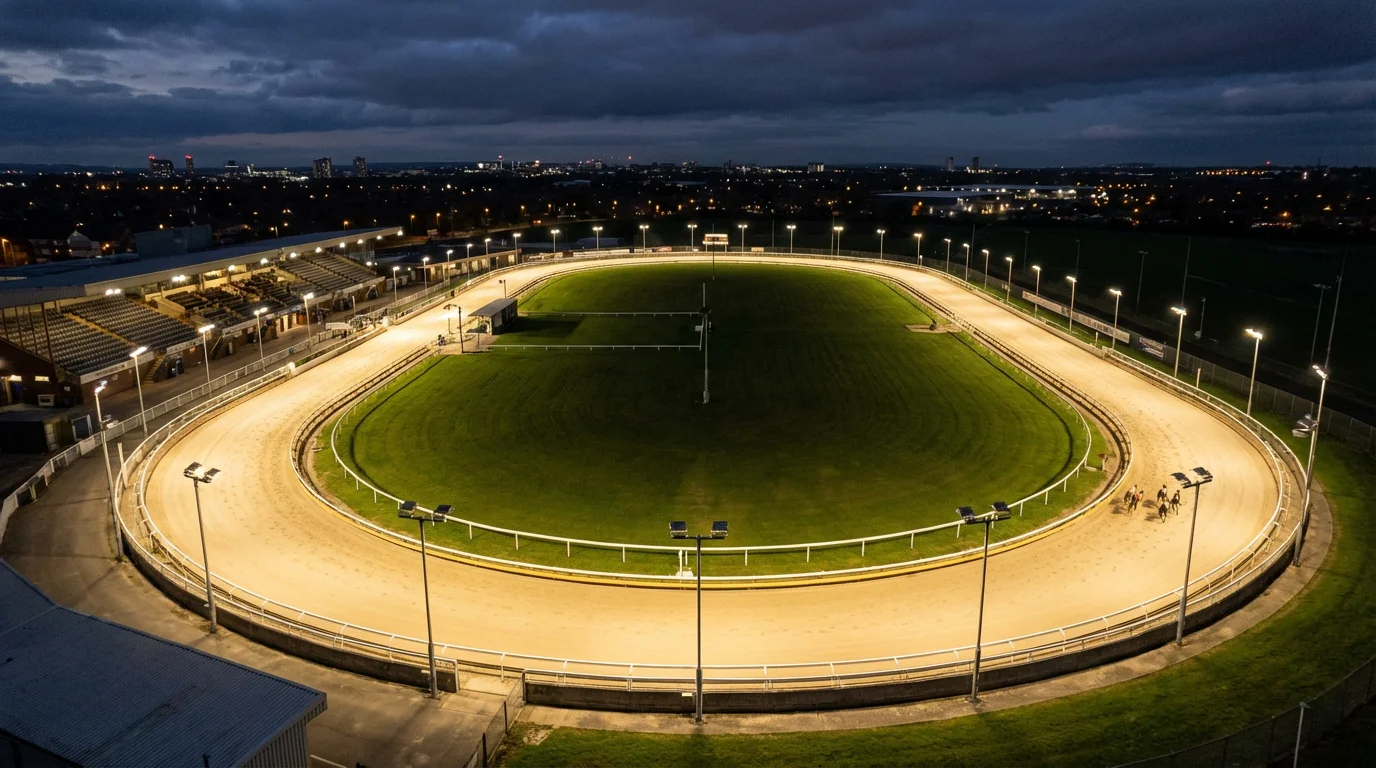
Kinsley Greyhound Stadium operates four racing distances across its 385-metre circumference, each with its own characteristics and competitive dynamics that shape the betting landscape for regular punters at the track.
The 268-metre sprint is the shortest trip on the card. Run over two bends with a short run-in from the traps to the first turn, this distance places an enormous premium on early pace. At Kinsley, the tightness of the bends amplifies the trap-draw advantage — inside traps have a shorter path to the first bend than at wider circuits, and dogs that break fastest from traps 1 or 2 have a structural edge that’s difficult to overcome. Sprint races at Kinsley are the most trap-draw-dependent events on the card, and bettors should weight trap position more heavily in their analysis here than at any other distance.
The 462-metre middle distance is Kinsley’s standard trip and the distance at which the most races are run. Four bends, a full lap of the circuit, and enough distance for the race dynamics to develop beyond the opening trap-break. Kinsley’s tight geometry means that crowding on the first and second bends is common, which makes running comments from previous 462-metre races at this track particularly valuable. Dogs with ClrRun (clear run) in their recent Kinsley form ran without interference and their finishing position is a genuine reflection of ability. Dogs with Crd or BCrd in their form may be better than their results suggest.
The 650-metre staying distance adds two more bends and enough extra distance to separate the stayers from the middle-distance dogs masquerading as stayers. At Kinsley, the staying races tend to produce the most spread-out fields — by the fifth and sixth bends, the gap between the leaders and the backmarkers can be significant. Front-runners that lead for four bends and then tire are exposed over this distance, and closers with genuine stamina reserves come into their own. Each-way betting is often attractive in Kinsley staying races because the eventual second-place dog frequently comes from the back of the field, making the place market harder for the bookmaker to price accurately.
The 844-metre marathon completes Kinsley’s distance range. Marathon races appear less frequently on the card but offer a distinctive betting proposition. The tight circuit means dogs cover the bends eight times, and any dog that loses its footing or gets crowded at any point faces a compounding disadvantage. Marathon form at Kinsley is specialist knowledge — the dogs that win over this trip are often moderate at shorter distances but outstanding when given the room to express their stamina.
Distance and Form Interaction
Distance changes are one of the most significant events in a greyhound’s form record, and they’re often underweighted by bettors who focus on the form figures without checking the distance of each run.
When a dog moves from one distance to another — say, from 462 metres to 650 metres — its form at the old distance becomes a partial guide at best. A dog that was winning at middle distance might lack the stamina to compete over staying trips. Conversely, a dog finishing mid-field at middle distance might thrive at a longer trip where its closing speed has more time to take effect. The form figures carry over, but the relevance of each run changes with the distance shift.
The transition from sprints to middle distance is particularly revealing. A sprint specialist moving up to four bends faces a fundamentally different test. The early pace that dominated over two bends now needs to be sustained for twice as long, and many sprint dogs can’t manage it. Their form at the longer distance shows a clear pattern: fast first splits followed by increasingly slow second splits, and finishing positions that worsen the longer the race goes on. If you see a dog with strong sprint form being entered at middle distance for the first time, check whether its running style — front-running, reliant on early pace — is compatible with the extra distance. Often it isn’t.
The practical lesson for bettors is to flag any distance change in a dog’s recent form and treat the first run at a new distance with appropriate caution. The dog is effectively a debutant at that trip: previous form gives you a general sense of ability, but the specific demands of the new distance introduce uncertainty. Some dogs adapt immediately. Others never adjust. You won’t know which category this dog falls into until you see it race at the new distance, and the odds should reflect that uncertainty. If the market prices the dog as though its old-distance form translates directly, there may be value on the other side — either backing a less-fancied rival or opposing the distance-changer at short odds.
Distance awareness is a quiet edge in greyhound betting. It doesn’t require advanced data analysis or expensive subscriptions. It requires checking one column on the racecard — the distance of each previous run — and asking whether the dog is running at a trip that suits it. That question alone filters out a surprising number of losing selections.