What Is a Trap Challenge Bet in Greyhound Racing?
Best Greyhound Betting Sites – Bet on Greyhounds in 2026
Loading...
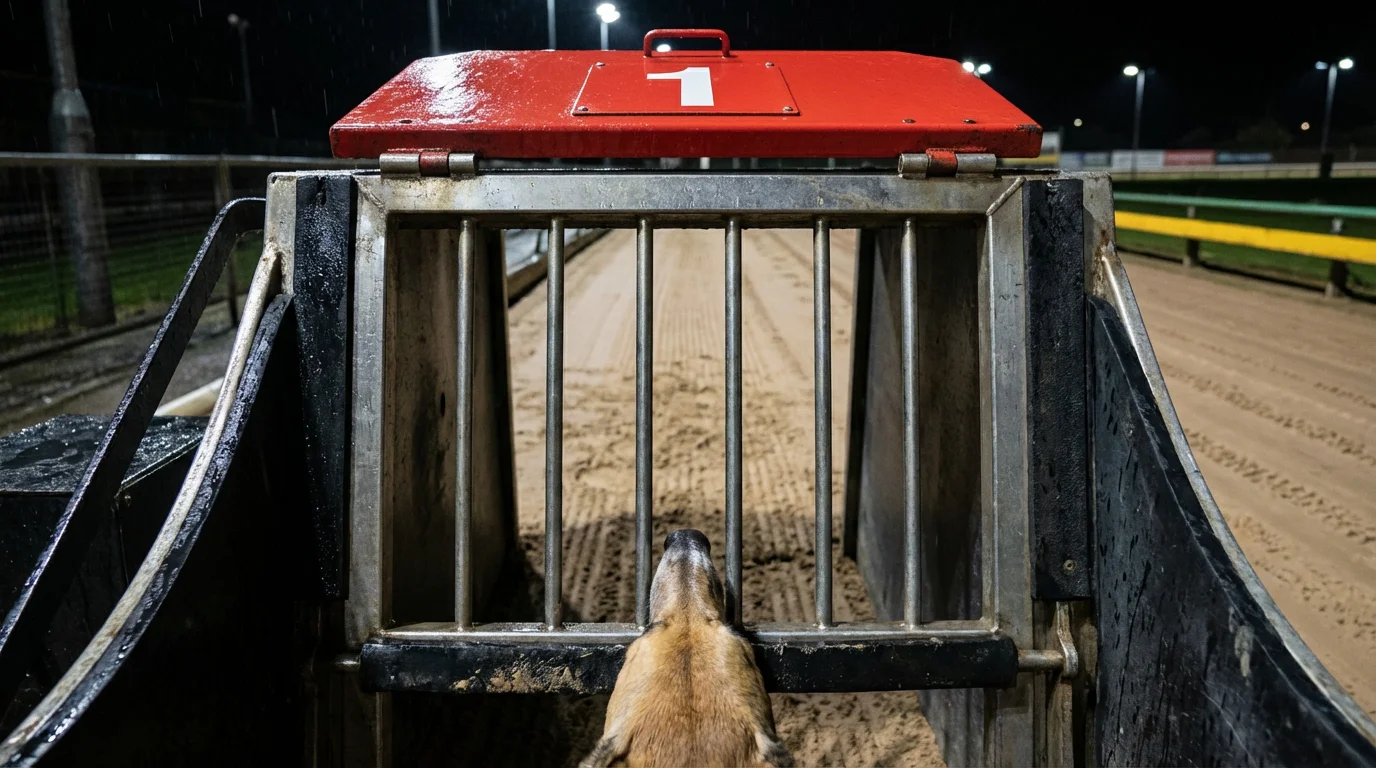
Trap Challenge Explained
A trap challenge is a bet on which trap number will produce the most winners across a full greyhound meeting. Rather than picking individual dogs in individual races, you’re selecting a trap — 1 through 6 — and backing it to come out on top over the course of the entire card. If a meeting has twelve races and you bet on trap 3, you win if trap 3 produces more winners than any other trap across those twelve races.
It’s a fundamentally different kind of bet. You don’t need to know the names of the dogs, their form figures, or their sectional times. You need to have a view — whether informed or instinctive — on which trap position is most likely to produce the highest number of winners at that specific track on that specific evening. The bet strips away the individual race analysis and replaces it with a broader, more structural question: which position has the edge tonight?
Bookmakers offer trap challenge markets for most UK greyhound meetings, and the odds are typically set around 3/1 to 5/1 for each trap, with some variation depending on the bookmaker’s assessment of track bias. The market acknowledges that inside traps (1 and 2) tend to win slightly more often nationally, but the pricing doesn’t always reflect track-specific bias accurately — and that’s where betting value can exist.
Trap challenges are settled by counting the winners per trap across the specified races. If trap 1 and trap 4 both produce three winners and no other trap has more, the settlement depends on the bookmaker’s dead-heat rules — typically, your stake is divided and the bet is settled at half the usual return for each tied trap. Some operators use specific tie-breaking rules for trap challenges, so checking the terms before placing the bet avoids surprises.
The format appeals to punters who enjoy watching a full meeting with a running interest in every race. Instead of sweating individual selections, you’re watching the cumulative score of your chosen trap across the card. There’s a rhythm to it — your trap wins the second race, loses the next three, picks up another in race six — that keeps the evening engaging regardless of whether any single race goes your way.
How to Pick a Trap
Picking a trap for a challenge bet isn’t random, even though it might look that way to outsiders. There are data-driven and situational reasons to favour certain traps over others, and the punters who treat the trap challenge as an analytical exercise rather than a guess tend to make better selections over time.
The starting point is historical trap statistics at the specific track. As discussed in the trap draw article, each GBGB-licensed track has its own trap bias profile, measurable from historical winning percentages. If trap 3 has won 19 percent of races at Kinsley over the past twelve months while trap 6 has won only 14 percent, that’s a structural advantage that should inform your selection. Trap 3 doesn’t win every challenge, but across a season of trap challenge bets, leaning towards the statistically strongest trap gives you a probability edge.
The second factor is the distance mix on the card. Different distances at the same track can produce different trap biases. If tonight’s card is heavy on 268-metre sprints, inside traps have a larger advantage because of the short run to the first bend. If the card features mostly 650-metre staying races, the trap bias is weaker and the middle traps — which tend to produce steady, unimpeded runs — might be a better selection. Check the racecard before placing the bet: count the sprints, middle-distance races, and staying events, and let the distance mix guide your trap choice.
A third approach involves scanning the racecard for the strength of individual dogs by trap. If trap 2 has the race favourite in four of the twelve races — strong dogs that are likely to win their respective races based on form — then trap 2 has a higher-than-average chance of winning the challenge regardless of historical bias. This is a more labour-intensive approach, but it combines structural advantage (trap bias) with situational advantage (tonight’s specific runners).
The least effective approach is picking a trap based on gut feeling, superstition, or favourite colours. Trap challenges offer enough statistical texture to support an informed decision, and defaulting to randomness wastes the analytical opportunity. The data is available. Using it is the minimum viable strategy.
Strategy Across a Meeting
A trap challenge bet is placed before the meeting starts and runs across the full card, so unlike individual race bets, you can’t adjust your selection mid-meeting. What you can do is manage your overall betting strategy around the trap challenge to maximise the evening’s value and entertainment.
One approach: use the trap challenge as your baseline bet and complement it with selective individual race bets. The trap challenge gives you a running interest in every race on the card. On top of that, you pick individual race bets where your form analysis identifies a strong selection — regardless of which trap it’s in. This layered approach means you’re engaged on two levels: the structural bet (trap challenge) and the analytical bet (individual race selections). They’re independent of each other, and a good evening on one can compensate for a bad evening on the other.
Another approach is to use the early races on a card as live intelligence for your other bets. Even though the trap challenge is already placed, watching which traps are winning in the first three or four races tells you something about the track conditions that evening. If inside traps are dominating early, the going might be favouring the rail — useful information for your individual race bets later on the card. If wide traps are performing unexpectedly well, the outside line might be firmer or faster, which adjusts your assessment of runners drawn in traps 5 and 6.
Staking on trap challenges should be treated as a separate budget item. The odds — typically 3/1 to 5/1 — mean the expected return profile is volatile: you’ll lose more often than you win, but the wins return a meaningful multiple of the stake. Sizing the trap challenge bet at a small fraction of your evening’s total budget — say, ten to fifteen percent — keeps it proportional. The trap challenge is an entertainment bet with an analytical edge, not a core profit driver.
One pitfall to avoid: placing multiple trap challenge bets on the same meeting. Backing traps 1, 3, and 5 simultaneously doesn’t improve your chances — it just guarantees you’ll lose on at least two of the three bets, and the combined stake makes the overall value worse. Pick one trap, based on the best available evidence, and accept the outcome. The discipline of single-selection trap challenges is part of what makes the format interesting.
Which Tracks Favour Which Traps
Trap bias varies meaningfully across UK greyhound tracks, and this variation is the raw material for trap challenge betting. The general national pattern — traps 1 through 3 outperforming traps 4 through 6 — holds at most venues but with enough track-specific deviation to matter.
Tight, compact circuits tend to amplify the inside-trap advantage. When the run from the traps to the first bend is short and the bends are sharp, dogs from inside traps reach the preferred racing line sooner and with less ground to cover. Kinsley, with its 385-metre circumference, falls into this category — the inside traps have a demonstrable edge in sprint races, and a modest but real advantage across middle-distance races too. For trap challenge bets at Kinsley, traps 1 through 3 are the statistically supported selections in most conditions.
Wider circuits with longer straights and more gradual bends dilute the inside advantage. At these tracks, the extra distance from the outside traps to the first bend is proportionally smaller, and dogs have more room to find their running line without being immediately compressed by the field. Trap challenge bets at wider venues are less predictable because the bias is smaller, and the result depends more heavily on the specific dogs racing that evening than on the structural position advantage.
Some tracks exhibit unusual bias patterns. A venue where the first bend turns away from the outside traps (a left-handed track with traps positioned to give the outside a natural line into the bend) might show a trap 5 or trap 6 advantage that contradicts the national pattern. These anomalies are rare but real, and they’re discoverable from the historical data. If you bet trap challenges at a track where trap 5 historically overperforms, ignoring that data in favour of the “inside is always best” assumption is a needless handicap.
Seasonal changes in track conditions can shift the bias within a year. As explored in the weather article, wet conditions can make the inside rail heavier, temporarily reversing the typical inside advantage. A trap challenge bet placed on a rainy evening might warrant a different selection than one placed on a dry summer card at the same track. Integrating weather awareness with historical bias data is the most sophisticated level of trap challenge analysis, and it’s where the bet moves from a casual punt to an informed position.
Trap Challenge Odds and Value
The value in trap challenge betting — or the lack of it — comes down to the relationship between the odds offered and the actual probability of each trap winning the challenge. If the bookmaker prices trap 3 at 4/1, they’re implying a 20 percent chance of that trap winning the most races on the card. If your analysis suggests the probability is closer to 25 percent, there’s value. If your analysis agrees with 20 percent or lower, there isn’t.
Estimating the probability accurately is the difficult part. Historical trap win percentages give you the underlying rate at which each trap wins individual races, but the trap challenge is about winning the most races across a meeting — a different question. A trap that wins 18 percent of individual races doesn’t have an 18 percent chance of winning the challenge; the probability depends on the number of races, the distribution of wins across traps, and the variance inherent in small samples.
Consider a twelve-race meeting. If all traps had equal ability (16.7 percent each), the probability of any specific trap winning the challenge outright is relatively low, because ties are common in small samples. The most frequent outcome in a truly equal field is a shared lead — two or three traps tied on two wins each. Dead-heat rules reduce the payout in these scenarios, which erodes the value of the bet even when your trap is among the co-leaders.
The value improves when the bias is strong and the odds don’t fully reflect it. If trap 1 at a specific track wins 21 percent of individual races — meaningfully above the 16.7 percent baseline — its probability of winning a twelve-race challenge is substantially higher than a trap with only 14 percent. If the bookmaker offers the same odds on both, the biased trap is the better bet. The inefficiency arises because bookmakers sometimes use standardised odds across all tracks rather than calibrating precisely for each venue’s bias profile.
Over a season of trap challenge betting, the edge from selecting the statistically strongest trap at each venue is small per bet but cumulative. You won’t win every challenge — the variance in a twelve-race sample is too high for that — but you’ll win more often than random selection would predict, and the odds will compensate you sufficiently for the losses in between. It’s a patient, data-informed approach rather than a get-rich-quick play, and it suits punters who enjoy the full-meeting format and are comfortable with the inherent volatility of the bet type.