Trap Draw in Greyhound Racing: How Position Shapes the Race
Best Greyhound Betting Sites – Bet on Greyhounds in 2026
Loading...
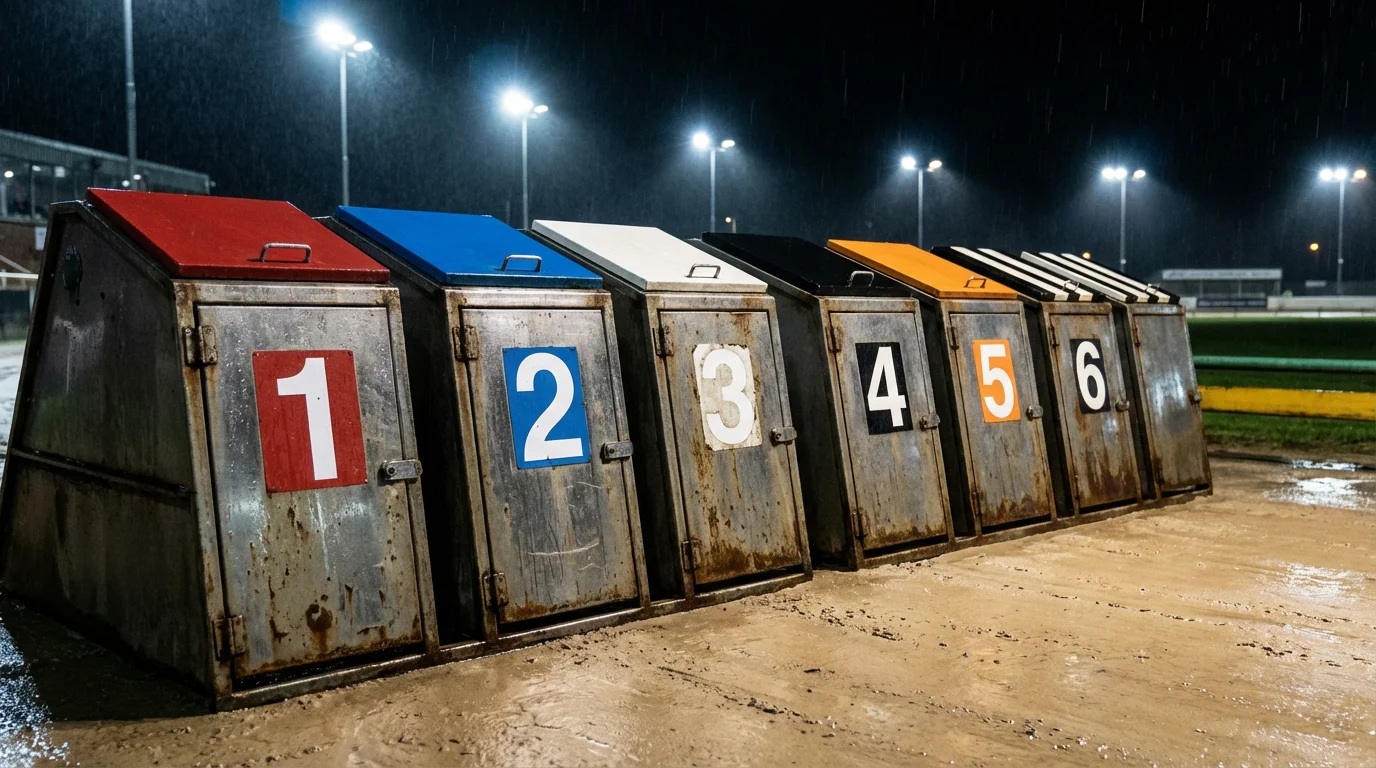
Why Trap Position Matters
In a 30-second race, where you start can decide where you finish. Greyhound racing is fast, compressed, and physically tight — six dogs accelerating from stationary to roughly 40 miles per hour within a few strides, then funnelling into the first bend within seconds. In that opening phase, trap position shapes the entire race. A dog that reaches the first bend on the inside, running its natural line with no traffic to navigate, has a fundamentally different race ahead of it than one that breaks wide, gets boxed in, or is forced to check its stride.
The traps are numbered 1 through 6, left to right when facing the track, with trap 1 on the inside closest to the rail and trap 6 on the outside. The distance from each trap to the first bend varies — trap 1 typically has the shortest run, trap 6 the longest. This means trap 1 needs less early speed to reach the bend in a good position, while trap 6 needs to overcome the extra ground by either breaking faster or taking a wider line that avoids the congestion at the rail.
At some tracks, the run from the traps to the first bend is long enough that all six dogs have time to find their positions naturally. At others — compact circuits like Kinsley, with its 385-metre circumference — the run is shorter, and early positioning is more critical. The tighter the geometry, the more trap draw influences the outcome.
None of this means trap 1 always wins or trap 6 always loses. Running style, early pace, and the specific combination of dogs in the field all interact with trap position to produce the actual race. But trap draw is the starting condition — the variable that’s set before the race begins — and ignoring it is like ignoring weather before a cricket match. It doesn’t determine the result, but it shapes the possibilities.
Seeding: How Traps Are Assigned
Racing managers don’t draw traps randomly. In greyhound racing, trap allocation is a deliberate process called seeding, designed to match each dog’s natural running style with the trap position that suits it best. The goal is competitive fairness — giving every dog in the race a realistic chance of running its preferred line.
The seeding system groups dogs by running style and assigns them accordingly. Railers — dogs that naturally hug the inside of the track through the bends — are placed in traps 1 and 2. These positions give them the shortest route and the best chance of establishing their preferred rail position immediately. Middle runners, who take a line between the inside and outside, go into traps 3 and 4. Wide runners, who drift towards the outside, are placed in traps 5 and 6, where they have room to swing out without cutting across other dogs.
The racing manager determines each dog’s running style from its trial runs and race history. The running comment abbreviations — Rls for rails, Mid for middle, W for wide — feed directly into seeding decisions. A dog that has shown Rls in its last five runs will almost certainly be seeded in trap 1 or 2. A dog that consistently runs wide will get trap 5 or 6.
The system isn’t perfectly rigid. When a race has three railers and only two inside traps, one of the railers will be drawn in trap 3 — a compromise position. Similarly, a race with four wide runners means two of them will be squeezed into middle traps. These mismatches are unavoidable given the six-trap constraint, and they create interesting dynamics: a natural railer drawn in trap 4 might cut sharply left at the first bend, disrupting the dogs inside it. A wide runner in trap 3 might drift right, creating space on the inside but covering extra ground.
For bettors, the seeding information on the racecard is valuable precisely because of these compromises. When every dog is in its natural trap, the race is likely to unfold as form suggests. When dogs are drawn against type, the race dynamics shift in ways that form alone doesn’t predict, and that’s where trap-aware punters find edges.
Trap Bias: Track-by-Track Data
Trap 3 wins most often nationally — but individual tracks tell different stories. Across all GBGB-licensed stadiums, the historical winning percentages by trap position are surprisingly close, but they are not equal, and the small differences have real implications over a large number of bets.
National averages show trap 3 with a slight edge, typically winning around 18 to 19 percent of races compared to a baseline of 16.7 percent (one-sixth, if all traps were perfectly equal). Trap 1 tends to come in slightly above average as well, while trap 6 is usually the lowest across most tracks. The inner traps benefit from the shorter distance to the first bend and the geometrical advantage of the inside line through the turns.
But these averages disguise significant track-by-track variation. At some venues, the run to the first bend is long and wide enough that outside traps suffer no real disadvantage. At others — particularly tighter circuits — the inside traps have a pronounced edge. Kinsley, with its 385-metre circumference, is an example of a track where the compact geometry compresses the field early and makes trap draw more influential than at wider venues.
Track bias can also be distance-specific. A stadium might show no significant trap bias over its standard 462-metre distance but a clear inside-trap advantage over 268-metre sprints, where the run to the first bend is shorter and early positioning is decisive. Checking trap statistics by distance, not just by track, adds another layer of precision to your analysis.
Weather and track maintenance can create temporary bias too. If one section of the track is slower — perhaps waterlogged after rain, or churned up after a busy card — dogs running over that section are at a disadvantage. This kind of session-specific bias doesn’t appear in any annual statistics but can influence results in real time. Watching how the early races on a card play out can sometimes reveal a directional pattern that no pre-race dataset captures.
Websites like GreyhoundStats provide trap win percentages broken down by track and distance. Checking these before placing a bet doesn’t take long, and it’s one of the simplest data-driven edges available in greyhound betting. A dog that’s well-fancied on form but drawn in the lowest-performing trap at a track with known bias is a different proposition to the same dog in the highest-performing trap. The form is the same. The probability isn’t.
How to Use Trap Draw in Your Betting
Trap draw alone doesn’t win bets — but ignoring it loses them. The practical skill is not to bet blindly on inside traps or avoid outside traps, but to assess whether a dog’s trap draw and running style are aligned, and what happens when they’re not.
The first question to ask when looking at any racecard is: is this dog drawn where it wants to be? A railer in trap 1 is in its ideal position. A railer in trap 5 has a problem — it needs to either break fast enough to cross to the rail before the first bend or take the early part of the race in an unfamiliar wide position. Both options carry risk. The dog might manage it, but the probability of a smooth run is lower than if it were drawn inside.
The second question: what’s happening around the dog? Even a perfectly drawn railer in trap 1 can be compromised if the dog in trap 2 is also a railer with faster early pace. Trap draw analysis works best when you look at all six runners together, not in isolation. The interactions between dogs — who has the pace to lead into the bend, who is likely to crowd whom, where the clear running space will be — are shaped by the full trap draw, not just one position.
The most actionable betting scenarios involving trap draw are mismatches and alignments. A dog that’s improving in grade but drawn in a difficult trap might be overpriced because the market sees the form but underestimates the trap disadvantage. Conversely, a dog with modest recent form but a perfect trap draw against a field of poorly drawn runners might offer value at a bigger price than its raw ability would normally command.
There is a temptation to overthink trap draw — to see every trap assignment as either a green light or a red flag. In reality, it’s one factor among several. A genuinely fast dog will overcome a poor trap draw more often than not. A slow dog in an ideal trap is still slow. Trap draw matters most in competitive races where the form is tightly bunched and small positional advantages early in the race can determine the result. In those races, trap draw is the tiebreaker.
Trap Draw Myths and Misconceptions
No, trap 1 doesn’t always have the advantage. This is probably the most persistent myth in casual greyhound betting — the belief that inside traps are inherently superior and should always be favoured. The data tells a more nuanced story.
Trap 1 does win slightly more often than a pure one-in-six probability would predict at most tracks, but the margin is small — usually one or two percentage points above the 16.7 percent baseline. At some tracks, trap 1 actually underperforms, particularly at venues with wide runs to the first bend where inside position confers less advantage. Betting exclusively on trap 1 across all races at all tracks would produce a negative return over time, because the odds rarely compensate for the modest statistical edge.
Another myth: trap 6 is a death sentence. Wide traps do win less often on aggregate, but they still win roughly 14 to 16 percent of the time at most tracks. A strong wide runner with early pace from trap 6 will frequently lead the field into the first bend by virtue of its speed, and the outside position actually gives it clean air — no dog is further outside to cause interference. Some of the most explosive race performances come from dogs that break fast from trap 6 and sweep to the front.
A subtler misconception is that trap draw matters equally in every race. It doesn’t. In sprint races with short runs to the first bend, trap draw is critical because the dogs hit the bend before the field has time to sort itself out. In marathon races over six or eight bends, the influence of the opening trap draw diminishes as the dogs have more time and distance to find their positions. A dog poorly drawn in a 268-metre sprint at Kinsley faces a bigger disadvantage from its trap than the same dog poorly drawn in an 844-metre race at the same track.
The final myth is that trap bias is permanent and unchanging. Track bias can shift over time as racing surfaces are maintained, replaced, or worn differently. A track that historically favoured inside traps might undergo resurfacing or geometry adjustments that level the playing field. Annual statistics give you a baseline, but they should be refreshed regularly — last year’s trap data at a specific venue may not perfectly reflect this year’s conditions.
The bottom line: trap draw is a real factor, not a superstition, but it works through probabilities and context, not guarantees. Treat it as one input in your analysis — weighted more heavily in sprints and at tight tracks, less so in longer races at wider venues — and resist the temptation to turn it into a system.