Virtual Greyhound Racing: How It Works and Is It Worth Betting On?
Best Greyhound Betting Sites – Bet on Greyhounds in 2026
Loading...
What Virtual Greyhounds Are
Virtual greyhound racing is a computer-generated simulation of a greyhound race. There are no real dogs, no real tracks, and no real traps. Every element — the stadium, the runners, the hare, the race itself — is rendered by software, and the result is determined by a random number generator before the animation plays out on screen. The visual presentation is designed to look like a real greyhound race, complete with trap colours, commentary, photo finishes, and starting prices, but the underlying product is a digital lottery dressed in the sport’s familiar clothing.
Virtual races run continuously, typically every two to four minutes, around the clock. There’s no schedule, no meeting card, and no off-season. The races are available whenever the bookmaker’s platform is live, which means twenty-four hours a day, seven days a week. This constant availability is one of the format’s core selling points — and one of its core risks, which we’ll address later.
Each virtual race features six runners, numbered and coloured identically to real greyhound traps: red (1), blue (2), white (3), black (4), orange (5), and black-and-white stripes (6). The runners are assigned names, form figures, and odds that mimic the presentation of a real racecard. Some platforms display simulated trainer names and fabricated recent results. This layer of presentation is cosmetic — it creates the look and feel of a real race — but none of the displayed information has predictive value because the outcome is determined randomly.
Major UK bookmakers — Bet365, William Hill, Coral, Ladbrokes, Paddy Power, Betfred — all offer virtual greyhound products. The software is typically supplied by specialist providers like Inspired Entertainment or Kiron Interactive, who license their products to multiple operators. The visual quality varies between providers: some produce smooth, realistic animations; others look more obviously computer-generated. The mechanics are the same regardless of the visual polish.
RNG vs Real Racing
The fundamental difference between virtual and real greyhound racing is the source of the outcome. In real racing, the result emerges from the interaction of physical dogs with varying abilities, fitness levels, running styles, and reactions to the race environment. The outcome is uncertain but not random — it’s influenced by measurable factors that can be analysed to produce informed betting decisions. In virtual racing, the result is produced by a certified random number generator. The dogs on screen are animations choreographed to match a predetermined result. Nothing about the virtual dogs’ names, form, or visual behaviour contains information that could predict the outcome.
This distinction matters enormously for betting. Real greyhound betting rewards analysis: studying form, assessing trap draw, reading running comments, evaluating trainer records, checking conditions. These activities give informed punters a genuine, measurable edge over the market average. Virtual greyhound betting cannot be improved by analysis because there is nothing to analyse. The displayed form figures are decorative. The odds are set by the software provider to produce a target profit margin over thousands of races, and no combination of skill, knowledge, or pattern recognition can overcome the mathematical structure.
The RNG itself is regulated. UKGC-licensed virtual racing products must use certified random number generators that have been independently tested for fairness and unpredictability. The certification process ensures that each outcome is genuinely independent — the result of race 47 has no statistical relationship to the result of race 48 — and that the overall distribution of results is consistent with the published odds. In practical terms, this means the product is fair in the sense that it does what it claims to do: it produces random results at stated odds. What it doesn’t do, and can never do, is offer an opportunity for skilled betting.
The bookmaker’s margin on virtual racing is typically higher than on real racing. Real greyhound markets operate with an overround of roughly 115 to 125 percent — meaning the implied probabilities from the odds add up to more than 100 percent, with the excess representing the bookmaker’s theoretical margin. Virtual greyhound markets often operate with overrounds of 130 percent or higher, because the constant availability and the absence of any skill element allow providers to charge more without losing customers to more competitive products. Over time, this higher margin guarantees a larger loss rate for virtual bettors compared to real-racing bettors.
Where to Bet on Virtual Greyhounds
Virtual greyhound racing is available through almost every major UK online bookmaker. The product sits alongside real greyhound racing in the sportsbook but is accessed through a separate section, usually labelled “Virtual Sports” or “Virtuals.” Some operators also offer virtual greyhounds on their gaming platform alongside casino products, which reflects the product’s closer kinship with gaming than with sports betting.
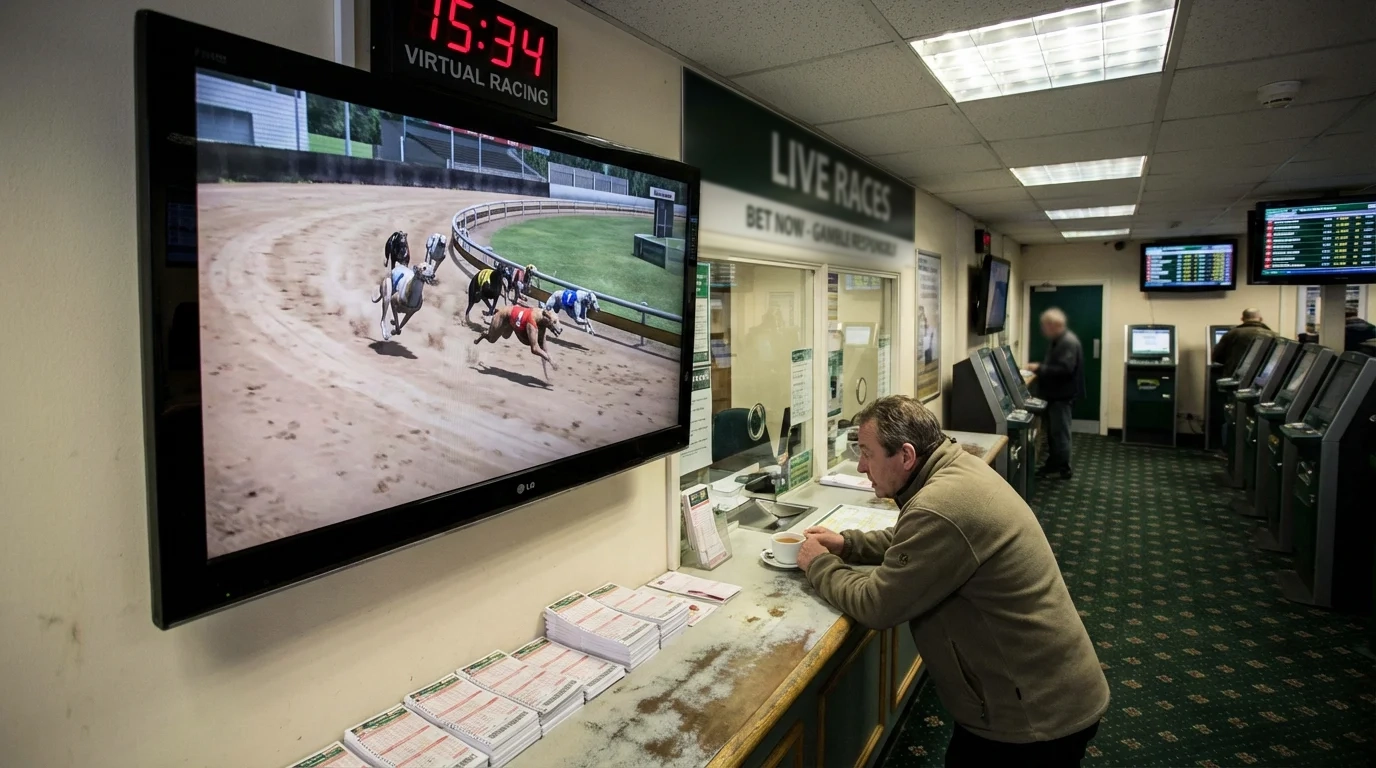
In betting shops, virtual greyhound races are displayed on screens alongside real racing coverage, and customers can bet on them at the counter or through self-service terminals. The presentation in the shop is deliberately similar to real racing — the same screen format, the same trap colours, the same results ticker — which can make it easy to drift from real to virtual racing without fully registering the switch. This blurring of boundaries is by design; it keeps customers engaged between real-racing events.
The bet types available on virtual greyhounds mirror those on real racing: win, each-way, forecast, tricast, and sometimes combinations. The odds are displayed in fractional or decimal format, and the payout mechanics are identical. The familiarity of the betting interface masks the fundamental difference in the product — random versus skill-based — and this is part of why virtual racing has attracted regulatory scrutiny in recent years.
Minimum and maximum stakes follow the same rules as the operator’s real-racing markets. The rapid cycle time of virtual races — one every two to four minutes — means that a bettor placing one-pound stakes on every race can easily bet thirty pounds per hour, or over a hundred pounds across an evening session. The speed of play is significantly faster than real racing (where meetings typically feature twelve races across three hours) and closer to the pace of casino games. This throughput rate is a factor in the responsible gambling considerations that apply specifically to virtual products.
Strategy for Virtual Greyhounds (Or the Lack of It)
There is no strategy for virtual greyhound racing. This needs to be stated plainly, because the visual presentation of the product — with its racecard format, form figures, trap colours, and odds — is specifically designed to create the impression that analysis is possible and meaningful. It isn’t. The form figures are generated by software, not by racing dogs. The odds are set to produce a predetermined margin, not to reflect genuine differences in ability. The trap colours are cosmetic, not functional.
Every “strategy” you might see suggested for virtual greyhounds — backing the favourite, following specific trap patterns, tracking the RNG for hot numbers, using staking systems to overcome the margin — fails the same basic test: the outcome is random, and no method can convert a negative-expectation game into a profitable one over time. Following favourites works in real racing because favourites represent genuinely better dogs; in virtual racing, the favourite is just the selection with the lowest odds assigned by the software. Tracking patterns fails because RNG outcomes are independent events with no sequential relationship.
Staking systems — Martingale (doubling after a loss), Fibonacci, level-stakes rotation — don’t change the expected return; they change the distribution of wins and losses. A Martingale system on virtual greyhounds will produce frequent small wins and occasional catastrophic losses, but the expected value remains negative regardless of the staking pattern. The maths is unforgiving and has been proven across centuries of probability theory. No staking plan overcomes a negative-edge game.
The only rational approach to virtual greyhound betting is to treat it as pure entertainment with a known cost. Decide in advance how much you’re willing to spend on the session, bet at a level that makes the watching experience enjoyable, and stop when the budget is gone. If you derive no entertainment from watching computer-generated dogs run around a computer-generated track, the product offers you nothing. If you enjoy the visual spectacle and the low-stakes flutter, budget for it like any other entertainment expense.
Virtual vs Real: An Honest Comparison
The comparison between virtual and real greyhound racing is not close, and attempting to treat them as equivalent products does a disservice to both the sport and the bettor. They share a visual language — traps, colours, track layout, betting types — but they are fundamentally different activities with different characteristics, different risk profiles, and different relationships to skill.
Real greyhound racing involves living animals with individual characteristics, trained by professionals, competing in regulated events where the outcome depends on genuine athletic performance. The betting markets around real racing are informed by data, analysis, and expertise, and skilled bettors can achieve a long-term edge. The sport has history, culture, community, and a direct connection to the physical world. Attending a meeting at Kinsley or watching a live stream is engaging because the outcome is uncertain and the dogs’ behaviour is authentic.
Virtual greyhound racing involves software producing predetermined outcomes displayed through animations. The betting markets are fixed-margin products with no scope for skill-based advantage. The “races” are infinite in number and available constantly, creating a pace of play that more closely resembles casino gaming than sports betting. The product has no history, no community, and no connection to anything real.
The value proposition differs accordingly. Real racing offers the possibility — not the certainty, but the possibility — of profitable betting for those who invest time in learning the sport. Virtual racing offers a guaranteed negative return moderated only by luck and variance. Real racing has natural pacing — twelve races across an evening, with time between each for reflection and analysis. Virtual racing offers a new bet every three minutes, encouraging rapid, reflexive betting that bypasses deliberation.
If you enjoy greyhound racing as a sport and a betting medium, real racing is unambiguously the better product. It’s more engaging, more intellectually rewarding, more socially connected, and more honest in its relationship between effort and outcome. Virtual racing exists for convenience and gap-filling — something to bet on when no real meetings are scheduled — and within that narrow role it serves a function. But conflating the two products, or substituting virtual for real because it’s always available and requires no preparation, is a step down in quality and a step up in risk.
The healthiest approach is clear boundaries. Real racing is for analysis, strategy, and engagement with the sport. Virtual racing, if used at all, is for small-budget entertainment in the gaps, with strict time and spend limits. Keeping the two separate — in your mind and in your bankroll — prevents the always-available virtual product from cannibalising the time, money, and attention that real greyhound racing deserves.