How Greyhound Betting Works: Every Bet Type, Odds Format & Payout Explained
Best Greyhound Betting Sites – Bet on Greyhounds in 2026
Loading...
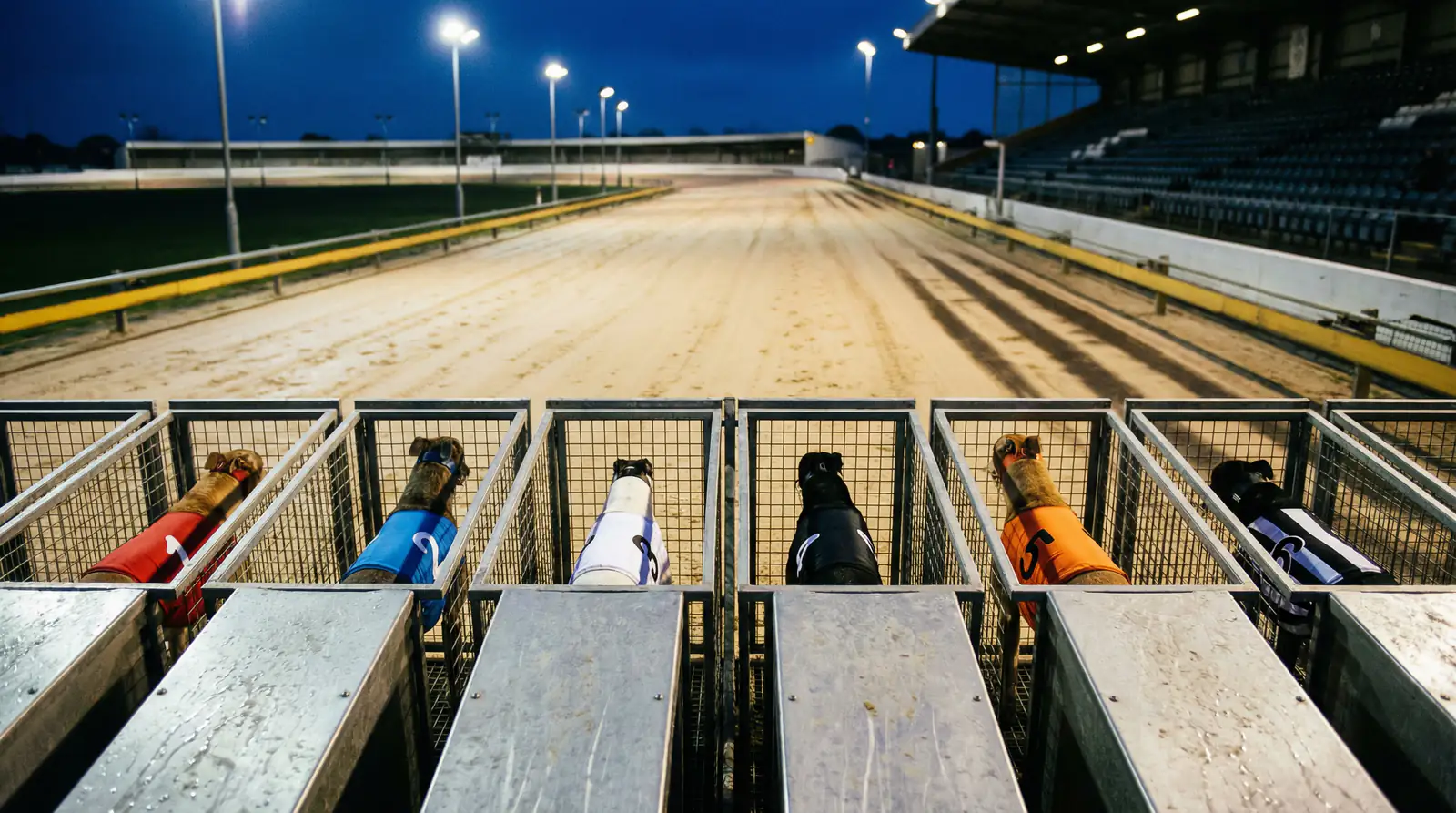
Six Traps, Ten Bet Types — and Most Punters Only Know Two
Walk into any bookmaker on a Tuesday evening and watch the greyhound screens. You will see the same pattern play out at the counter: win bet, win bet, each-way, win bet. Occasionally someone stretches to a forecast. The full range of greyhound bet types — and there are at least ten distinct structures available on a standard six-dog race — goes almost entirely unused by the majority of punters.
Win and each-way aren’t the only game in town. They’re not even always the smartest game in town. A straight forecast on a two-dog race can return multiples of what a win bet offers, and a combination tricast in an open race can turn a modest stake into a genuinely impressive payout. The tools exist. Most bettors simply never pick them up.
This is partly a knowledge problem and partly a confidence problem. Greyhound betting has inherited its structure from horse racing, but the mechanics behave differently in a six-runner field. Horse racing punters are used to fields of twelve or more, where exotic bets involve serious permutation costs. In greyhound racing, the maths compresses. Six dogs means fewer permutations, lower combination costs, and — crucially — a higher baseline probability of hitting the right sequence. A combination tricast covering three dogs in a six-runner field accounts for six of the 120 possible finishing orders. That is a 5% theoretical strike rate before you even look at form. In horse racing, the equivalent figure in a twelve-runner handicap would be laughably small.
Yet most punters still default to win-only. There is a comfort in simplicity, and a win bet is as simple as betting gets: pick the dog, watch it run, collect or don’t. The problem is that simplicity has a cost. In tight, graded races — the kind that make up the bulk of UK greyhound cards — the favourite wins roughly a third of the time. That means two-thirds of the time, your win bet on the market leader is losing. If you are only ever backing one dog to finish first, you are ignoring the structural reality of the sport.
This guide breaks down every bet type available in UK greyhound racing, from the basic win to the exotic jackpot, and explains the odds formats that underpin them all. Each section includes the mechanics, the maths, and — where it matters — the strategic logic behind choosing one bet type over another. If you have only ever placed a win bet on the dogs, that’s fine. But by the end of this, you will understand exactly what you’ve been leaving on the table.
A note before we start: every example in this guide uses UK standard rules. Place terms, each-way fractions, and forecast dividends all follow the conventions used by UK-licensed bookmakers operating under Gambling Commission regulation. If you are betting with an offshore operator, check whether the same rules apply — they often don’t.
Win, Place and Each-Way Bets
The win bet is where everyone starts — and where most stay. You pick a dog, you pick a stake, and if your selection crosses the line first, you collect your stake multiplied by the odds. A £10 win bet at 4/1 returns £50: your £40 profit plus your original £10 stake. If the dog finishes second, third, or anywhere else, you lose your stake entirely. There is no consolation for coming close.
The place bet offers a softer landing. In UK greyhound racing, a standard six-runner race pays out on the first two finishers for place bets. Some bookmakers extend this to three places for handicap or open races with larger fields, but six-runner graded races — which constitute the overwhelming majority of UK cards — pay top two only. The place odds are typically a quarter of the win odds. So if a dog is 8/1 to win, the place price is 2/1. This is not a separate market with its own pricing; it is a fixed mathematical fraction of the win odds.
This brings us to each-way, which is not a single bet but two. An each-way bet at £10 costs £20 total: £10 on the win and £10 on the place. If your dog wins, both legs pay out — you collect the win return plus the place return. If your dog finishes second, you lose the win leg but collect the place return. If it finishes third or worse, you lose both stakes.
Here is where the maths gets interesting and where most punters stop paying attention too soon. Take a dog at 5/1 with a £10 each-way bet. The win leg: £10 at 5/1 returns £60. The place leg: £10 at quarter-odds, which is 5/4, returns £22.50. If the dog wins, your total return is £82.50 from a £20 total stake — a net profit of £62.50. If the dog places second, you lose the £10 win stake but collect £22.50 from the place leg, giving you a net position of +£2.50. You staked £20 and got back £22.50. It is not a fortune, but it is better than the zero you get from a losing win-only bet.
Now consider the same scenario at different odds. At 3/1, the place leg pays 3/4 — your £10 returns £17.50 if the dog places. Against a total stake of £20, a place-only result means a net loss of £2.50. Each-way at short prices often costs more than it protects. At 10/1, the place leg pays 5/2 — your £10 returns £35, meaning a place finish alone delivers a net profit of £15. The longer the odds, the more powerful the each-way structure becomes as a hedging tool.
This creates a practical rule: each-way betting tends to offer genuine mathematical value on dogs at 5/1 or longer. Below that, the place return rarely compensates for the doubled stake. The exception is when you have strong reason to believe a dog will finish in the top two but limited confidence it will win — perhaps a consistent railer drawn in trap one at a tight track, the type of dog that rarely wins outright but almost always hits the frame.
Place-only betting — backing a dog solely to finish in the top two without a win leg — is available with most UK bookmakers but is less commonly offered for greyhounds than for horse racing. When it is available, it can be useful for dogs you rate as near-certain place finishers at reasonable odds. Check whether your bookmaker lists it as a standalone market for greyhound races; not all do.
Forecast and Tricast Bets
Forecast betting asks you to be right twice — and pays accordingly. A straight forecast requires you to name the first and second-place finishers in a race, in the correct order. Get it right and the payout is determined by the computer straight forecast dividend, a figure calculated from the SP odds of both dogs. Get the order wrong — even if your two selections fill the first two places — and you lose.
That ordering requirement is what gives forecasts their bite, and their value. In a six-runner race, there are thirty possible first-and-second combinations. A straight forecast is one bet covering one of those thirty outcomes, so the theoretical baseline probability is roughly 3.3% before form analysis. The payouts reflect this. A forecast combining a 3/1 shot finishing first with a 5/1 shot second might pay anywhere from £25 to £50 for a £1 unit stake, depending on the declared dividend. Forecasts on longer-priced dogs can return significantly more.
The reverse forecast removes the ordering requirement at a cost. Instead of picking dog A first and dog B second, you cover both possible orders: A-B and B-A. This is two bets, so a £1 reverse forecast costs £2. Your two selections still need to fill the first two positions, but the order doesn’t matter. The payout is the declared dividend for whichever combination actually occurred. If A-B was the result, you are paid on the A-B dividend. The B-A leg loses. You cannot combine both dividends.
Combination forecasts expand the principle further. If you select three dogs for a combination forecast, you are covering all six possible first-and-second orderings among those three. That is six bets, so a £1 unit stake costs £6. Select four dogs and you have twelve permutations at £12 total. The permutation maths follows a simple formula: for n selections, the number of forecast permutations is n multiplied by n minus one. Three dogs: 3 x 2 = 6. Four dogs: 4 x 3 = 12. Five dogs: 5 x 4 = 20. At five selections in a six-runner race you are covering every possible first-and-second combination except those involving the one dog you excluded — at this point, you should ask yourself whether you are making a selection or simply admitting you have no opinion.
Tricast betting extends the same logic to three positions. A straight tricast requires the first, second and third-place finishers in exact order. In a six-runner race, there are 120 possible ordering permutations for the top three, so a single straight tricast covers one of those — less than 1% baseline probability. Payouts can be dramatic. Tricast dividends of £100 to £500 for a £1 stake are not unusual, and open races with well-matched fields can produce dividends north of £1,000.
The combination tricast covers all possible orderings of your selected dogs across the first three places. Three selections means six permutations. Four selections means twenty-four. Five means sixty. The costs escalate rapidly, which is why disciplined punters rarely go beyond three or four selections for a combination tricast. At four dogs and a £1 unit, you are spending £24 for a chance at a dividend that might pay £150. The risk-reward ratio is real but requires scrutiny.
Forecast and tricast dividends in UK greyhound racing are declared by the Tote or calculated using the computer straight forecast and computer tricast formulae. These are not odds you can see before the race starts — they are calculated from the SPs of the dogs involved once the race has been run. This means you commit your stake without knowing the exact return. It also means that heavy market support for the winning combination can suppress the dividend. If everyone fancies the same two dogs, the forecast dividend reflects that popularity with a lower payout.
Accumulator, Trap Challenge and Jackpot
Accumulators are where small stakes turn into stories. The principle is straightforward: chain multiple selections across different races into a single bet, with the returns from each winning leg rolling into the stake for the next. A double covers two selections — both must win. A treble covers three. A four-fold, five-fold, and upward follow the same pattern. The odds multiply, and so does the risk.
Take a treble with three selections at 3/1, 4/1, and 2/1. A £5 stake on the first leg returns £20 if it wins. That £20 rolls onto the second leg at 4/1, returning £100 if it wins. That £100 rolls onto the third at 2/1, returning £300. Your total outlay was £5. Your total return if all three land is £300. The combined odds are effectively 59/1. This is the appeal. The reality is that the probability of landing all three legs — even with reasonably short-priced selections — is around 3-4% assuming roughly independent outcomes. The longer the chain, the lower the probability. A six-fold at similar odds has a strike rate below half a percent.
UK bookmakers also offer accumulator variants with insurance. Some refund the stake as a free bet if one leg lets you down. Others offer acca boosts that increase the return by a percentage. These promotions vary between operators and change frequently, so it is worth checking the terms before building your accumulator. Not all bookmakers extend greyhound racing into their acca bonus schemes — many restrict them to football or horse racing.
The trap challenge is a bet type more specific to greyhound racing. You select a single trap number — say trap three — and back it across multiple races. If trap three wins a specified number of consecutive races, you collect. Some versions require your trap to win every race on a card; others set a target like four from six. The odds reflect the difficulty: a trap winning six consecutive races at a track where no single trap has a dominant statistical edge is a low-probability event, and the payouts are priced accordingly. Trap challenge bets appeal to punters who study trap bias data and believe they have identified a positional edge for a particular meeting.
Jackpot and Pick 6 bets ask you to find the winner of six consecutive races. These are pool bets, meaning all stakes go into a shared pot and the dividend is divided among winning ticket holders. If nobody picks all six correctly, the pool typically rolls over. Jackpot pools can accumulate significant sums after several meetings without a winner. The catch is that finding six consecutive winners is brutally difficult — even backing the favourite in every race produces a strike rate well under 1% across six legs. These are entertainment bets, best approached with small stakes and realistic expectations.
How Greyhound Odds Are Set and What They Mean
Odds aren’t predictions — they’re prices, and prices move. Understanding this distinction is fundamental to greyhound betting. When a bookmaker prices a dog at 3/1, they are not saying the dog has a 25% chance of winning. They are saying that 3/1 is the price at which they are willing to take your money on that outcome, given the prices they have set on the other five dogs and the margin they have built into the book. The implied probabilities across all six runners in a greyhound race almost always sum to more than 100% — the excess is the bookmaker’s overround, their built-in profit margin.
In the UK, greyhound odds are most commonly expressed as fractions. The fraction 7/2 means you receive £7 profit for every £2 staked, plus your stake back. So a £10 bet at 7/2 returns £45: £35 profit plus £10 stake. Decimal odds express the same thing differently — 7/2 in fractional is 4.50 in decimal, meaning your £10 returns £45 total. The decimal format includes the stake in the return figure, which can confuse punters switching between formats. If you see a dog at 4.50 in decimal, remember that your profit is 3.50 times your stake, not 4.50 times.
American odds also appear on some platforms, particularly those serving an international audience, but are rare in UK greyhound betting. Positive American odds (e.g., +350) show the profit on a £100 stake. Negative odds (e.g., -200) show how much you need to stake to make £100 profit. For UK greyhound punters, fractional remains the standard and decimal the most common alternative.
The market for a greyhound race forms differently from horse racing. In horse racing, large betting volumes create liquid markets with meaningful price movements hours before the off. Greyhound markets are thinner. Most of the money comes in late — often in the final minutes before the race — which means prices can shift sharply in a short window. A dog that opens at 5/1 in the morning market might be 3/1 by the time the traps open if money has come for it. Conversely, a dog that drifts from 3/1 to 5/1 is often a signal that informed money has moved elsewhere.
This is where the Starting Price becomes important. The SP is the official price at the time the race starts, determined by on-course bookmakers or, increasingly, by the industry SP committee. If you do not take an early price, your bet settles at SP. In greyhound racing, SP can be significantly different from the early prices — sometimes by several points — because the markets are less liquid and more volatile.
Best Odds Guaranteed, commonly abbreviated to BOG, is the mechanism that protects punters from adverse price movements. If you take an early price and the SP is higher, a bookmaker offering BOG will pay you at the better price. If the SP is lower, you keep your early price. It is a one-way ratchet in the bettor’s favour. Not every UK bookmaker offers BOG on greyhound racing — it is more universally available for horse racing — so checking whether your bookmaker extends this to the dogs is a practical step worth taking before you lock in an early price.
The Tote offers an alternative to fixed-odds betting. Tote pools operate on a pari-mutuel basis: all stakes go into a pool, the operator takes a percentage, and the remainder is shared among winning bettors. The dividend is not known until after the race. Tote pools can occasionally offer better value than fixed odds, particularly on less fancied dogs, but they also carry the uncertainty of not knowing your return when you commit your money. For most UK greyhound punters, fixed-odds betting with BOG — where available — provides the better combination of value and certainty.
Ante-Post Betting on Greyhound Derbies
Ante-post bets lock in at the moment you place them. There is no SP safety net and, crucially, no refund if your selection is subsequently withdrawn. This is the defining feature of ante-post betting and the reason it carries both higher reward and higher risk than day-of-race betting.
In greyhound racing, ante-post markets typically open for the sport’s major events: the English Greyhound Derby, the Puppy Derby, the St Leger, and a handful of other prestigious opens. These events attract the best dogs in training and the widest betting interest. Prices are available weeks or even months before the final, and they reflect genuine uncertainty — a dog that looks a strong Derby contender in the early rounds can pick up an injury, lose form, or simply fail to progress through the heats.
The appeal of ante-post is straightforward. Prices are longer before the tournament begins because the outcome is more uncertain. A dog you fancy at 20/1 ante-post might be 6/1 by the time it reaches the semi-finals. If it gets there. The risk is that greyhound injury rates are not negligible, and a pulled muscle in a heat eliminates your selection and your stake in one moment. The all-in rule — which means your dog must run in the final for the bet to stand, regardless of whether it was withdrawn through no fault of its own — makes ante-post greyhound betting a more volatile proposition than its horse racing equivalent, where non-runner no-bet options are sometimes available.
For punters who follow greyhound form closely and have a view on which dogs are peaking at the right time, ante-post can offer genuine value. But it requires a willingness to lose stakes on dogs that never reach the final, and a discipline not to over-commit on any single selection. Treating ante-post as a small, speculative portion of your betting activity — rather than a core strategy — is the approach that experienced greyhound punters tend to favour.
Calculating Returns: The Maths Behind Every Slip
Before you place a bet, know what you stand to win — and what you actually risk. This sounds obvious, but it is remarkable how many punters hand over money without running the numbers first. Each bet type has its own return formula, and getting comfortable with the calculations turns guesswork into informed decision-making.
The win bet is the simplest. Multiply your stake by the fractional odds and add the stake back. At 9/2, a £10 stake returns £55: (10 x 4.5) + 10. In decimal, multiply the stake by the decimal odds directly — £10 at 5.50 returns £55. Same answer, different route.
Each-way requires two separate calculations. The win leg: stake multiplied by win odds plus stake. The place leg: stake multiplied by quarter-odds (for standard six-runner races) plus stake. Add both results together for a winning selection. For a placing-only result, you collect only the place leg return and subtract the total stake. Example: £5 each-way at 8/1 (total stake £10). Win leg: (5 x 8) + 5 = £45. Place leg: 8/1 at quarter-odds is 2/1, so (5 x 2) + 5 = £15. If the dog wins: £45 + £15 = £60 returned. Net profit: £50. If the dog places: £15 returned. Net loss: £10 minus £15 = still a net loss? No — wait. Total stake was £10, return is £15, so net profit is £5. If the dog finishes outside the top two: you lose the full £10.
Forecast returns depend on the declared computer straight forecast dividend, which is calculated after the race using a formula based on the SPs of the first and second-place finishers. You cannot calculate your exact return before the race. What you can do is estimate. If the first-place dog was 4/1 and the second-place dog was 6/1, the CSF dividend typically falls in a range that reflects those prices — but it is not a simple multiplication. The formula accounts for the overround and the specific market construction. As a rough guide, the CSF for a 4/1 winner with a 6/1 second is usually in the region of £35-£55 for a £1 stake, though actual dividends vary.
Tricast dividends follow a similar principle but for three positions. The computer tricast formula produces dividends that are inherently more volatile because three SPs interact. A tricast involving three well-backed dogs might pay £80. The same tricast involving three outsiders could pay £2,000. There is no reliable way to estimate tricast dividends with precision before the race — the range is simply too wide.
Accumulator returns are more predictable because each leg settles at known odds. Multiply the returns sequentially: a £5 double on a 3/1 winner and a 5/1 winner returns £5 x 4 x 6 = £120. A treble adding a 2/1 winner: £120 x 3 = £360. The maths is addictive, which is precisely why accumulators are popular and precisely why they usually lose.
Two deductions are worth understanding. Rule 4 applies when a dog is withdrawn after the market has formed, and the remaining dogs’ odds are adjusted downward by a published scale. If a 2/1 shot is withdrawn, the deduction might be 30p in the pound, meaning your returns on the remaining runners are reduced by 30%. Dead heat rules apply when two or more dogs cannot be separated on the line — your stake is divided by the number of dead-heating runners, and you are paid at full odds on the reduced stake. A £10 win bet at 4/1 in a dead heat of two pays (£10 / 2) x 4 + (£10 / 2) = £25 instead of the full £50.
The Right Bet for the Right Race
Not every race suits every bet type. A six-dog sprint over 268 metres with one clear form standout and five moderate opponents is a win bet race. The favourite’s probability is high, the each-way value is poor because short prices produce thin place returns, and the forecast value is suppressed because the first-place finisher is largely predictable — it is the second-place battle that is open, and that openness compresses the forecast dividend rather than inflating it.
Contrast that with a graded middle-distance race over 480 metres where form is tight, two or three dogs have recent wins, and the trap draw is kind to none of them. This is a forecast race. The finishing order is uncertain but the likely participants in the first two places can be narrowed down. A reverse forecast on your top two, or a combination forecast covering three, captures the value in the uncertainty without requiring you to predict a single outright winner.
Tricast value tends to peak in open races — events where dogs from different tracks and different grading systems are brought together, removing the familiarity that makes graded races somewhat more predictable. Open races produce higher tricast dividends because the form lines are harder to compare and the market is less confident. The flipside is that your own analysis is also less reliable, so tricast bets in open races are best treated as calculated punts rather than confident selections.
Accumulators work best when you have genuine opinions across multiple races on a card and want to increase the return from a small total outlay. They work worst when you are adding legs for the sake of it, chasing bigger numbers rather than backing genuine selections. Three confident picks at reasonable prices, chained into a treble, is a more disciplined approach than a six-fold stitched together from half-formed opinions.
The broader principle is that betting should be a toolkit, not a reflex. Win bets are a tool. Forecasts are a tool. Each-way is a tool. The skill is matching the tool to the situation — reading the race, assessing the form, looking at the trap draw and the market, and then choosing the bet structure that gives you the best expression of your opinion. If you only ever reach for the same tool, you are not betting strategically. You are betting out of habit. And habit, in this game, is expensive.