How to Read Greyhound Racecards & Form Guides: A UK Bettor’s Manual
Best Greyhound Betting Sites – Bet on Greyhounds in 2026
Loading...
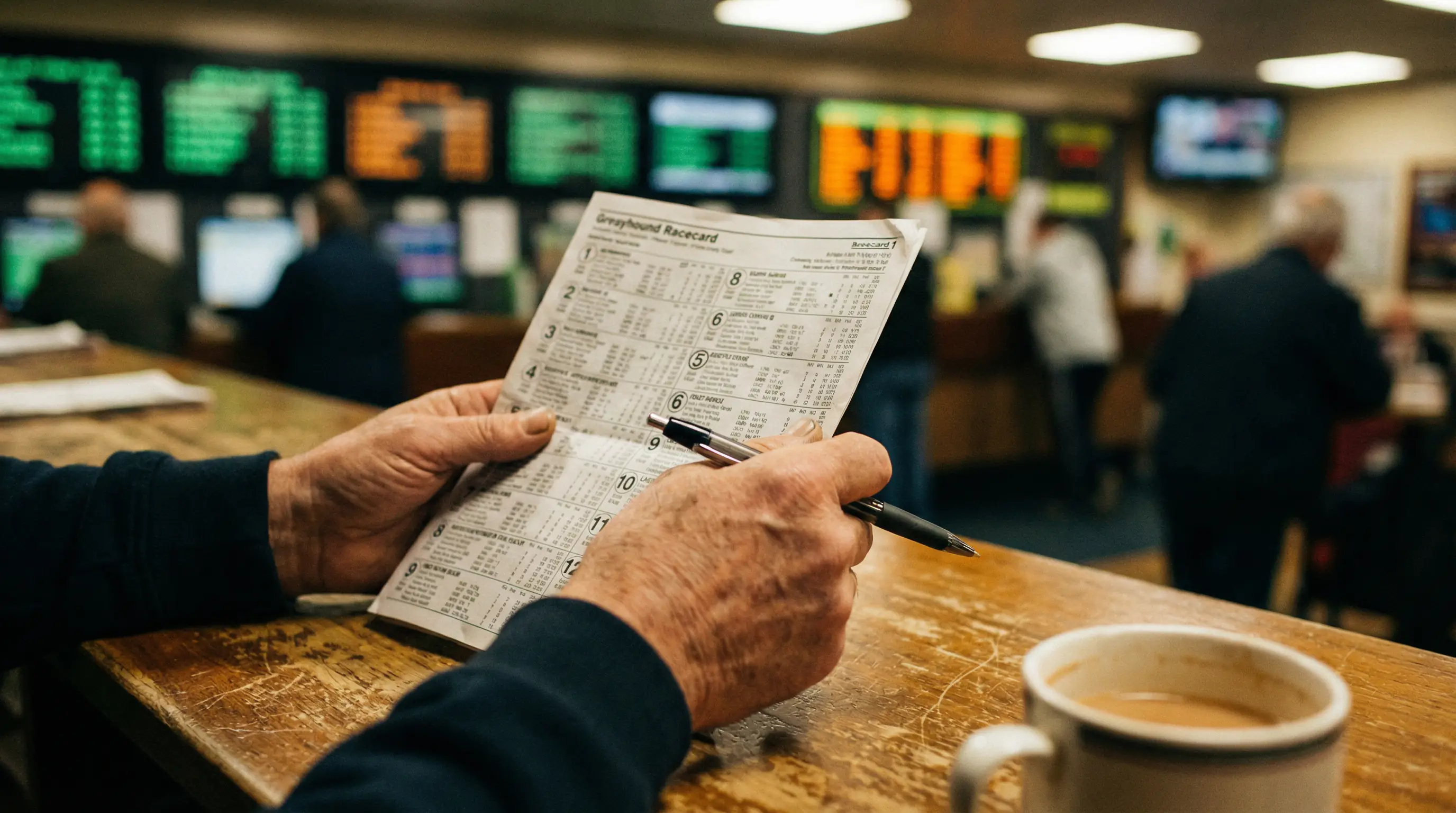
A Racecard Is a Decision Sheet — If You Know How to Read It
Everything you need to make a betting decision is on the racecard — compressed into a few lines per dog. The problem is that those few lines are dense with abbreviations, numbers, and contextual data that mean nothing to a casual viewer and everything to a bettor who knows what they are looking at. A greyhound racecard is not a preview or a programme note. It is a decision sheet, and learning to read it properly is the single most useful skill a greyhound punter can develop.
A standard UK racecard for a greyhound race lists six runners, one per trap. For each dog, you will typically see the following information: trap number and colour, the dog’s name, its sex and colour (for example, “bk d” for black dog or “be b” for brindle bitch), the trainer’s name, the dog’s weight, its form figures from recent races, its best recorded time at the distance, its most recent time at the distance, and in-running comments from its last few outings. Some racecards also include the dog’s sire and dam, its age, and the number of career starts. The precise layout varies between platforms — Sporting Life, the Racing Post greyhound section, and individual bookmaker racecards all arrange the information slightly differently — but the core data is consistent.
Let’s walk through what a typical racecard line looks like in practice. Suppose you see the following for trap 3: the dog’s name, followed by “bk d” indicating a black male, then the trainer’s name, the weight at 32.1kg, form figures reading 2-1-3-1-4, a best time of 16.62 and a last time of 16.78. After that, you might see a comment line reading “EP, Ld1-Crd3, 2nd” — which tells you how the dog ran its most recent race. That single line, once you know how to decode it, gives you the dog’s gender and colour, its physical condition via weight, its recent competitive form, its speed ceiling, its most recent performance level, and a narrative of how its last race unfolded.
The trap number and colour are standardised across all UK tracks. Trap 1 is red, trap 2 blue, trap 3 white, trap 4 black, trap 5 orange, and trap 6 is black and white striped. These colours correspond to the jackets worn by the dogs and are consistent regardless of the track or meeting. They matter because trap position is not random — dogs are seeded into traps based on their running style, which we will return to later.
Weight is listed in kilograms and is recorded at the weigh-in before the race. A dog’s racing weight typically fluctuates within a narrow band, and significant changes — more than half a kilogram either way from its usual racing weight — can be a signal. Weight gain might suggest a dog is not fully fit. Weight loss might indicate sharpness, or it might indicate a health issue. Like everything on the racecard, weight is a data point, not an answer. It gains meaning when placed alongside other information.
The trainer’s name is more than a label. Greyhound trainers operate under GBGB licences, and their strike rates at individual tracks vary dramatically. We will return to trainer form in detail later, but note it here as one of the most underused data points on the racecard.
Form Figures and What They Mean
Form isn’t just about recent wins — it’s about patterns. The form figures on a greyhound racecard show the dog’s finishing positions from its most recent races, typically the last five or six outings, read from left to right with the oldest run first and the most recent last. A form line of 1-3-2-1-5 tells you the dog won two starts ago, placed third and second in the runs before that, and finished fifth in its last race. The sequence matters because it shows trajectory — is the dog improving, declining, or inconsistent?
Reading form in greyhound racing differs from horse racing in one important respect: the sample sizes are smaller and the turnover is faster. A greyhound might race twice a week, so a form line covering five runs could represent just two and a half weeks of racing. This compressed timeline means form can change rapidly. A dog that looked impressive three runs ago might have lost its edge by the time you are looking at the racecard. Conversely, a dog showing a run of poor form might have had valid excuses — trouble in running, poor trap draws, or a switch in distance that didn’t suit — and could bounce back quickly once conditions improve.
Numbers alone do not tell the full story. A dog showing form of 6-5-4-3-2 has finished last or near-last in its oldest recorded run but has improved steadily with each outing. That is a dog moving in the right direction, and its current grade may not yet reflect its improving ability. A dog with form of 1-1-1-3-6 has won three of its last five but has sharply declined in its two most recent races. That decline might be temporary — an off night followed by a bad draw — or it might signal the dog has been over-raced or graded up to a level where it cannot compete.
The letter codes mixed in with the numbers provide additional context. An “F” in the form line means the dog fell during the race. A “T” indicates a trial run rather than a competitive race. “S” or “Sp” can indicate a slip — where a dog stumbles out of the traps. Some platforms show “D” for disqualified. These modifiers change how you interpret the surrounding numbers. A form line reading 2-1-F-3-1 looks inconsistent until you account for the fall: the dog was performing well, had an accident mid-sequence, and then returned to competitive form. The fall itself tells you nothing about ability — only about luck.
Form at distance versus form at track is another distinction that separates sharp punters from casual ones. A dog’s form figures on the racecard usually include all recent runs regardless of venue or distance. If a dog has been running over 480 metres at Nottingham and is now stepping back to 268 metres at a different track, its recent form might be misleading. The dog could have been consistently placing over the longer trip but may lack the raw early pace needed to compete in a sprint. Checking whether the dog’s form was achieved at a similar distance — and ideally at the same track — adds a layer of reliability to your assessment.
One more subtlety: form figures at different grades are not directly comparable. A dog winning at A6 grade is beating weaker opposition than a dog finishing third at A2. The finishing position is the same data point — a number between 1 and 6 — but the competitive context behind it is different. A form line of 3-3-4-2-3 at A2 might represent stronger performance than 1-1-1-2-1 at A8. This is where the grading system, the trainer’s record, and the times all converge. Form figures open the conversation. They do not close it.
Greyhound Racing Abbreviations Decoded
SAw doesn’t mean the dog saw something interesting. It means Slow Away — the dog was late leaving the trap, losing ground at the start. In a sport where races last less than thirty seconds and margins are measured in fractions of a length, a slow start can be the difference between first and fourth. The abbreviations used in UK greyhound racing in-running comments are a compressed language that tells you exactly how a race unfolded for each dog, and knowing what they mean transforms a line of cryptic letters into a narrative.
The start-related abbreviations are among the most important because early pace shapes everything that follows. QAw means Quick Away — the dog broke sharply from the trap and gained an early positional advantage. EP stands for Early Pace, indicating the dog showed speed in the initial phase of the race. These are positive signals for sprint races where the first bend often decides the outcome. MsDis or MsdBrk means the dog missed the break, similar to SAw but sometimes implying a more severe delay. SlAw is a variant spelling of Slow Away used on some platforms.
Positional abbreviations tell you where the dog was during the race. Ld means Led — the dog was at the front at a specific point. ALd means Always Led, indicating the dog led from trap to line with no interruption. This is a strong marker. A dog that has ALd in multiple recent comments is a front-runner by nature, and its performance depends heavily on getting a clean break and an uncontested lead. Disp means Disputed the lead — the dog was racing alongside the leader, usually on the bend or approaching it. SnLd means Soon Led, indicating the dog moved to the front quickly after the start without necessarily leading from the first stride.
The trouble-in-running abbreviations are where many punters find excuses — and sometimes legitimately. Crd means Crowded, indicating the dog was squeezed for room by other runners. Bmp means Bumped, a physical contact event that disrupted the dog’s stride. BCrd or BCkd means Badly Crowded or Badly Checked — a more severe interference that significantly affected the dog’s chances. FcdToCk means Forced to Check, where the dog had to alter its stride or direction to avoid another runner. ChlRls means Challenged on the rails, a positional battle along the inside running line. SAw and Crd appearing together in a comment line — “SAw, Crd1” — tells you the dog was slow out, then got crowded on the first bend, a combination that effectively ended its chances before the race was half over.
Running-style abbreviations help you build a profile of how a dog races. RanOn means the dog finished strongly, making up ground in the closing stages — a useful indicator for stayers and middle-distance dogs. EvCh means Every Chance, which sounds positive but actually indicates the dog had a clear run and no excuses, yet still didn’t win. It is the racing equivalent of “had its opportunity and couldn’t take it.” FinWl means Finished Well, similar to RanOn. Drn means the dog was driven, pushed along by the pace of the race without necessarily leading.
Distance margins are expressed in their own shorthand: sh (short head), hd (head), nk (neck), then numerical lengths — 1, 1½, 2, and so on. A result line reading “1st, 2½l” means the dog won by two and a half lengths. These margins matter because they indicate dominance or vulnerability. A dog that has won its last three races by short heads is getting the job done but with no margin for error. A dog winning by three lengths is in a different class to its competition — or will be, until the grading system moves it up.
One final abbreviation worth noting: NR means Non-Runner. The dog was withdrawn before the race, the entry doesn’t count as a run, and it should be mentally set aside when reading the form sequence.
Sectional Times and What “Best” vs “Last” Means
Best time tells you ceiling. Last time tells you today. These two numbers sit side by side on most racecards and are among the most misunderstood data points in greyhound betting. The best time is the fastest the dog has ever been recorded at the race distance — its peak performance. The last time is the clock from its most recent run at that distance. The gap between them tells a story about the dog’s current condition relative to its known ability.
A dog with a best time of 16.52 and a last time of 16.54 is running very close to its peak. That is a dog in form, producing consistent times, and likely well suited to its current grade. A dog with a best of 16.52 and a last of 16.89 has a problem. That 0.37-second gap is substantial in greyhound racing, where races are often decided by margins of 0.05 to 0.15 seconds. The question is whether the slow recent time was caused by trouble in running — check the in-running comments — or whether it reflects genuine decline. If the dog ran clear and still clocked 16.89, it may simply not be as fast as it once was. If it was badly crowded on the first bend and never recovered, the time is misleading.
Sectional times add another dimension. At tracks where sectional timing is available, you can see how fast the dog ran to specific points — typically the first bend and the third bend, splitting the race into early pace, middle, and finish. Sectional data reveals running style more precisely than in-running comments. A dog that posts a fast time to the first bend but fades in the closing sectional is a confirmed front-runner with limited stamina. A dog that runs a moderate first sectional but produces a fast closing split is a closer — a dog that settles early and finishes strongly.
These running-style profiles have direct betting implications. Front-runners are more dependent on trap draw and a clean break because their advantage comes from controlling the race from the front. If a confirmed front-runner is drawn in trap 6 at a tight track where the first bend is close to the traps, it faces a longer path to the lead and more traffic to navigate. A closer is less affected by trap draw because it doesn’t need to lead early — it needs space in the closing stages, which is more a function of how the race develops than where the dog starts.
Comparing times across different tracks requires caution. A time of 29.50 over 480 metres at one track is not equivalent to 29.50 over 480 metres at another. Track circumference, bend radius, running surface condition, and hare type all influence recorded times. A compact track with tight bends — like Kinsley at 385 metres — naturally produces different time patterns than a spacious track like Towcester at 420 metres. Dogs transferring between tracks often show time adjustments in their first few runs at the new venue as they adapt to the geometry.
Weather and track condition further complicate time analysis. A wet track runs slower. A dry, firm surface produces faster times. The “going” — described as hard, standard, or wet on most UK greyhound racecards — adjusts expectations. A time of 16.70 on a wet night might represent the same effort as 16.55 on a dry one. Experienced form readers mentally adjust times based on conditions rather than taking them at face value. Some statistical platforms track adjusted times or provide going corrections, but this is less standardised in greyhound racing than in horse racing.
The practical advice is straightforward: use best time to gauge ability, use last time to gauge form, and use the gap between them to decide whether a dog is near its peak or well below it. Always check the in-running comments before drawing conclusions from the clock. A fast time achieved with a clear run means more than a fast time achieved in a slowly-run race where the dog inherited the lead by default.
Trainer, Trap and Going — The Context Around the Numbers
Numbers without context are noise. A dog’s form figures, times, and in-running comments provide the raw data, but three contextual factors — trainer, trap draw, and going — determine how that data translates into performance on the night. Ignoring any one of them is like reading half a sentence and guessing the rest.
Trainer form at the specific track is one of the most reliable secondary indicators available to greyhound bettors. Unlike horse racing, where trainers are widely profiled and their statistics are front-page information, greyhound trainer data often goes unnoticed. Yet the patterns are real. Some trainers consistently produce results at particular venues because they understand the track’s characteristics — its bend geometry, its surface behaviour in different weather, and its grading patterns. A trainer with a 22% strike rate at a given track over the past twelve months is performing well above the baseline average of roughly 16-17% (one winner per six runners). That edge compounds over time. Platforms such as greyhoundstats.co.uk provide trainer-by-track strike rates, and checking this data before a race adds a dimension that most casual punters overlook entirely.
Trap draw is not random in UK greyhound racing. Dogs are seeded into traps by the racing manager based on their running style. Railers — dogs that naturally run close to the inside rail — are typically drawn in traps 1 and 2. Wide runners are placed in traps 5 and 6. Middle runners go in traps 3 and 4. The purpose of seeding is to reduce early-race interference by separating dogs that would otherwise compete for the same running line on the first bend.
The betting implication is significant. A natural railer drawn in trap 1 at a tight track has a structural advantage: it has the shortest run to the first bend and can establish its preferred position quickly. The same dog drawn in trap 5 faces a longer run and potential crowding as it tries to cut across the field to reach the rail. This mismatch between running style and trap position is one of the most common sources of value in greyhound betting. If a dog with strong form has been moved to an unfavourable trap — perhaps because the racing manager has recategorised its running style, or because trap availability forced a suboptimal draw — the market may not fully account for the disadvantage. Equally, a dog with moderate form drawn in its ideal trap can outperform its price.
Going conditions — the state of the track surface on race night — are reported as hard, standard, or wet on UK racecards. Some tracks also use intermediate descriptions. The going affects both absolute times and relative performance. Heavier dogs tend to handle wet conditions better. Front-runners can struggle on soft ground because the deceleration into bends is more pronounced, giving closers a better chance to make up ground. Sprint races are less affected by going than staying races because the total distance — and therefore the cumulative effect of surface drag — is shorter.
Weather also has indirect effects that won’t appear on the racecard. Rain during a meeting can change the going between races, meaning conditions listed at the start of the evening may not reflect reality by the eighth race. Wind direction matters at some tracks, and temperature affects both the dogs and the surface. Checking the weather forecast for the track’s location before a meeting is a small effort with a meaningful return.
Putting It Together: Building a Race Assessment
Reading form is step one. Forming an opinion is step two. The gap between those two steps is where most punters either develop an edge or fall back on guesswork. Having all the racecard data decoded — form figures, abbreviations, times, trainer stats, trap draw, going — means nothing if you don’t have a structured way to process it. What follows is not a magic formula. It is a workflow, a repeatable sequence of questions that turns racecard data into a considered view on each race.
Start by scanning all six runners. Don’t fixate on the favourite immediately. Read every dog’s form line, last time, and most recent in-running comment. The purpose of this first pass is to eliminate — to identify the dogs that clearly don’t fit the race conditions. A dog returning from a long break with no recent trials, a dog dropping in distance for the first time with no sprint form, a dog that has been badly crowded in three consecutive runs and may now be running with a confidence deficit. These are the dogs you can set aside, not because they cannot win, but because the probability is low enough that your time is better spent analysing the realistic contenders.
Second, identify the form standouts. Look for dogs with consistent recent placing — two or three runs in the first three positions — combined with times close to their best. A dog showing improving form (positions getting better, times getting faster) across its last three runs is in the kind of trajectory you want to back. Compare the form standouts against each other. Which has the better time? Which has the more favourable in-running profile — fewer incidents of trouble, more evidence of clean runs?
Third, check the trap and running-style fit. Take your form standouts and look at their trap draws for tonight’s race. Is a confirmed railer drawn in trap 1 or 2? That is a positive alignment. Is a wide runner drawn in trap 5 or 6? Also positive. Is a railer in trap 4 or a wide runner in trap 2? Those are mismatches, and mismatches suppress performance. This is the step where a second-choice dog on form alone can become a first-choice selection because the trap draw favours it while working against the more fancied runner.
Fourth, assess the trainer factor. Check whether the trainers of your shortlisted dogs have strong records at this track. A trainer with a 20%+ strike rate at the venue, sending a dog that is in form and well drawn, is a confluence of positive signals. A dog with strong form but a trainer who rarely wins at this track might be slightly less reliable than the numbers suggest. This is a secondary factor — it should adjust your confidence rather than override it — but it is a real one.
Fifth, compare times in context. Look at the best and last times for your contenders, adjusted for going. If tonight’s track is wet and one of your selections has demonstrated consistent times on soft ground while the other has only been tested on firm going, that is a meaningful distinction. Also check whether the times were achieved in trouble-free runs or whether they were flattered by slow early pace and a late lead change. A fast time set by a dog that led throughout in an uncontested race is less indicative of true ability than the same time set while recovering from early crowding.
Finally, make a selection and choose your bet type. If one dog stands clearly above the rest on form, trap draw, trainer, and times, a win bet may be appropriate. If two dogs are closely matched and hard to separate, a reverse forecast captures both outcomes. If the race looks open with three genuine contenders, an each-way bet on the value pick or a combination forecast might be the sharper approach. The race assessment should dictate the bet structure, not the other way around.
From Racecard to Betting Slip: The Jump Most Punters Skip
The racecard tells you what happened. Your job is to decide what happens next. That transition — from historical data to a forward-looking opinion — is where racecard reading becomes betting, and it is the step that most punters either rush through or skip entirely. They see a dog that won last time, they back it to win again, and they call that form analysis. It isn’t. It is pattern-matching at the most superficial level, and it is the reason the favourite in UK greyhound racing wins only about a third of the time.
Genuine racecard reading builds conviction. When you have worked through the form figures, understood the in-running comments, checked the trap draw against the running style, compared the times in context, and assessed the trainer, you arrive at a selection with a reason behind it. That reason might not always be right — greyhound racing involves six animals running at high speed around bends, and unpredictable things happen — but it gives you something that blind backing doesn’t: the ability to learn from the outcome. If your selection loses, you can go back to your reasoning and ask where the analysis broke down. Was the trouble-in-running excuse more significant than you thought? Did the going change between your assessment and the race? Did the trap draw disadvantage prove decisive? Each losing bet, when backed by real analysis, teaches you something about how the sport works at this track, at this distance, under these conditions.
The racecard is a tool, not an answer. It contains all the raw material you need, but it doesn’t do the thinking for you. The dogs don’t read their own form — they run on instinct, fitness, and whatever the first bend brings them. Your advantage as a bettor is not that you can predict with certainty, because nobody can. Your advantage is that you can assess probability more accurately than the casual punter who glances at the favourite’s name and reaches for their wallet. In a market where the majority of participants do minimal research, even moderate analytical effort creates an edge.
If this guide has done its job, you now know what every element of a greyhound racecard means, how to interpret the data it contains, and how to structure a race assessment that goes beyond the surface. The next step is practice. Pick a meeting, pull up the racecards, work through the process for each race, and make your selections before the off. Track your reasoning and your results. Over time, you will develop an intuition for which data points matter most at which tracks and which form patterns reliably translate into race-day performance. That intuition doesn’t replace the racecard — it enhances your ability to read it.