Kinsley Greyhound Results: The Complete Track Guide, Betting Breakdown & Form Playbook
 Available in US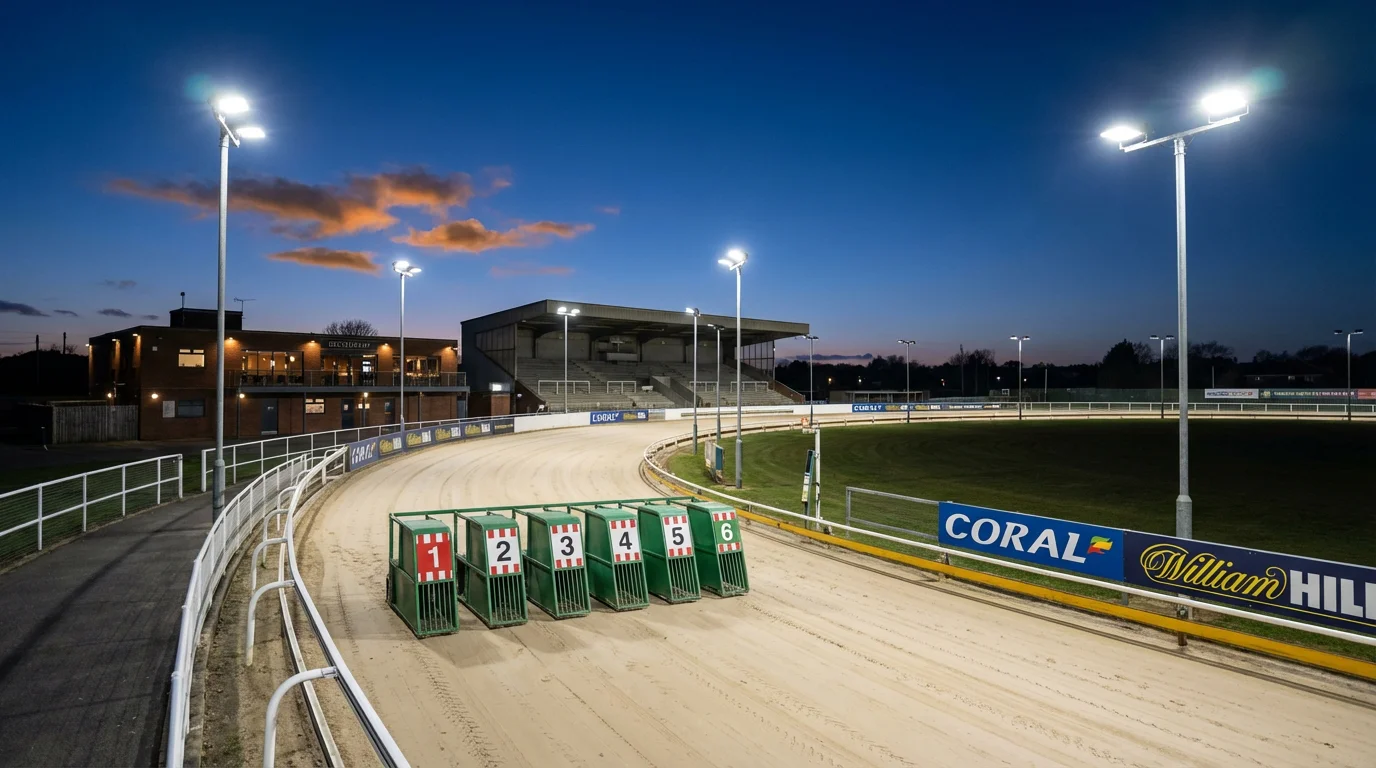
Track specs, trap bias analysis, every bet type explained, form-reading techniques, and a punter's playbook for West Yorkshire's most distinctive 385-metre circuit.
Contents
Kinsley Greyhound Stadium — Not Just Another Oval
Kinsley sits between Leeds and Doncaster, and it runs differently to both. That is not a throwaway marketing line — it is a statement about geometry. With a circumference of just 385 metres, this West Yorkshire track is one of the tightest licensed circuits in Britain, and every dimension of the racing here reflects that fact. The bends are sharper. The straights are shorter. The field compresses earlier. If you have spent any time studying greyhound results from larger venues like Nottingham or Romford, you will need to recalibrate almost everything when you look at a Kinsley racecard.
The stadium sits on Wakefield Road in the village of Kinsley, near Pontefract — a former mining community that has been watching dogs run since 1939. It is regulated by the Greyhound Board of Great Britain, holds a current GBGB licence, and stages racing four times a week through its Arena Racing Company contract, which was renewed for a five-year extension running from January 2025. ARC meetings take place on Monday, Wednesday, Friday and Sunday evenings, with the schedule giving online and betting-shop punters a near-constant supply of races to follow and wager on.
Distances at Kinsley currently stand at 268, 462, 650 and 844 metres. The hare is an outside Swaffham McGee — a modern lure system that replaced the original inside Sumner used during the track's independent years. For anyone unfamiliar with the distinction, the outside hare runs along the outer rail rather than the inner, which subtly changes how dogs approach bends and can influence running lines, particularly for wide runners in traps 5 and 6.
Capacity at the stadium is around 3,000, with parking for 300 vehicles. There is the Jubilee Restaurant seating 150, a snack bar, and the Spycatcher Executive Suite for hospitality. None of this is why you are reading this guide, though. You are here because you want to understand the results that come out of this track and, ideally, to bet on them with more intelligence than the average punter scrolling through an app at lunchtime.
What makes Kinsley genuinely different — and worth a dedicated guide — is the combination of that compact circuit, the specific trap dynamics it produces, and a competitive grading structure that keeps races tight. The track has historically recorded one of the lowest favourite win rates in UK graded racing. That statistic tells you everything about the kind of venue this is: unpredictable enough to punish lazy betting, but patterned enough to reward anyone willing to read form and think about trap position before placing a stake.
Kinsley Track Specs
- Circumference: 385 metres
- Distances: 268m, 462m, 650m, 844m
- Hare: Outside Swaffham McGee
- Race days: Monday, Wednesday, Friday, Sunday (ARC)
- Capacity: 3,000 spectators
- Location: 96 Wakefield Road, Kinsley, Pontefract, WF9 5EH
- Regulation: GBGB licensed
How Kinsley Earned Its GBGB Licence
For sixty years, Kinsley ran as a flapping track. The term sounds dismissive, but in greyhound racing it simply means an independent venue operating outside the jurisdiction of the then-National Greyhound Racing Club. There was nothing inherently substandard about it — flapping tracks had their own culture, their own regulars, their own Derby-style competitions. Kinsley's version, the Kinsley Greyhound Derby, offered prize money of £20,000, which at the time eclipsed many events on the regulated circuit. Twelve bookmakers stood on course. A computer totalisator processed bets. A vet attended meetings. The facilities were closer to NGRC standard than most independents ever got.
The shift came in 1985 when John Curran and Keith Murrell took over and invested seriously in upgrading the facilities. Distances were reconfigured, an inside Sumner hare was installed, and the social club operated all week. Forty-eight kennels stood on site, and the Jubilee restaurant offered 160 covers. By any reasonable measure, Kinsley had the infrastructure of a regulated track without the paperwork.
It was not until January 2000 that the application for an NGRC licence was finally submitted and granted. Craig Hunt was brought in as Racing Manager, distances were reset to 275, 450, 485 and 656 metres, and the first licensed meeting took place on 15 January 2000. In the years that followed, distances changed twice more before settling on the current 268, 462, 650 and 844 metre configuration, and the outside Swaffham McGee hare replaced the original inside system. The track earned recognition in 2008 when it was voted Best NGRC Greyhound Stadium in the North by the British Greyhound Racing Board. In 2010, it was allocated the Television Trophy — won that year by Midway Skipper — and in 2011 the Gymcrack, a prestigious puppy competition for greyhounds between fifteen months and two years old, transferred to Kinsley from Hall Green Stadium. The first running at Kinsley was won by Nick Colton's Taranis Rex, who broke the track record in the process.
The Gymcrack has since moved on to Owlerton Stadium, where it regained Category 1 status in 2024, but Kinsley's place in the competition's history is secure. The ARC deal signed in 2018 — and extended from January 2025 — ensures that the track continues to stage regular licensed meetings and remains part of the national greyhound betting calendar.
Knowing a track's history is context. Knowing how to read what the track produces is where the edge starts.
Reading Kinsley Greyhound Results Like a Punter
A result sheet is a story compressed into abbreviations. If you cannot read it fluently, you are betting blind — which, at a track like Kinsley where margins are thin and favourites lose more often than the national average, is roughly equivalent to picking numbers on a roulette wheel and calling it strategy.
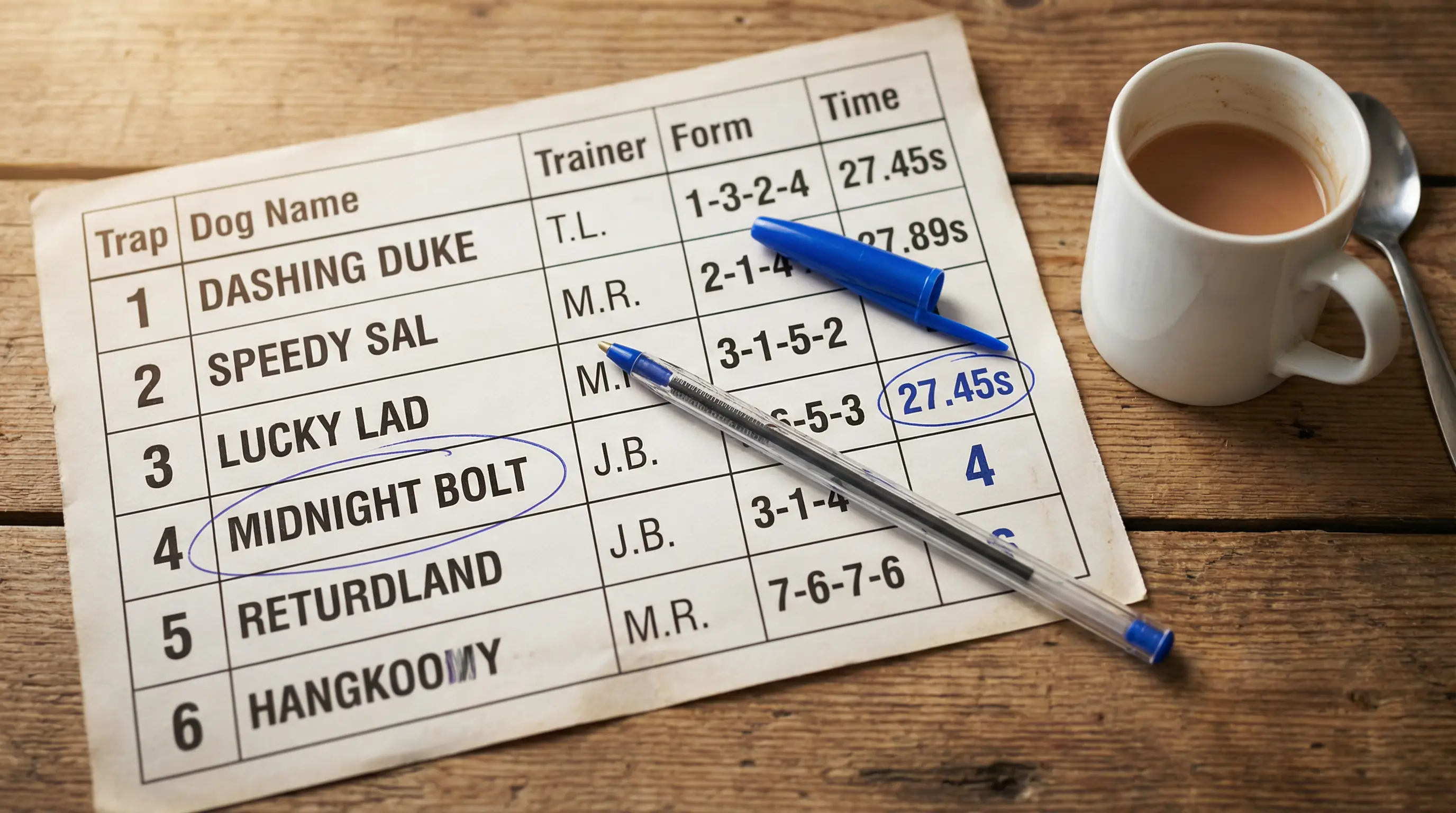
A standard Kinsley result line will show you the following: trap number, dog name, finishing position, distance behind the winner (or ahead, if they won), the run time, and a set of in-running comments that describe what the dog did during the race. These in-running comments are where most of the useful information lives, and they are written in a shorthand that can look impenetrable until you learn the vocabulary.
The most common abbreviations you will encounter on Kinsley result sheets are these. SAw means slow away — the dog was sluggish out of the trap and lost ground early. QAw is the opposite: quick away, a clean break. EP stands for early pace, meaning the dog showed speed in the opening section of the race. Ld means led — the dog was in front at some point. ALd means always led, which is about as dominant as a performance gets in a six-dog race. FcdToCk means forced to check — the dog had to adjust its running because of interference, usually on a bend. EvCh means every chance, which is the racing equivalent of saying the dog had a clear run and no excuses for not winning.
Finishing margins tell you how close the race was. Sh (short head) is almost nothing. Nk is a neck, roughly half a length. 1 is a full length, scaling up from there. At Kinsley, where the field bunches on the tight circuit, short-head and neck margins are common. A three-length winning margin at Kinsley is a demolition.
Two time figures matter most. The run time is the dog's overall time for the race distance. The sectional time — where available — breaks this down into segments, usually measuring how quickly the dog reached the first bend and how it performed through the middle and final sections. At Kinsley, the sectional to the first bend is particularly important because of the tight circumference; dogs that get to the first bend in front have a disproportionate advantage because overtaking on Kinsley's bends is harder than at wider tracks.
SP (Starting Price) — the final odds on a greyhound at the moment the traps open. SP is determined by the on-course bookmakers and represents the market's last assessment of each dog's chances. If you take SP rather than an early price, you accept whatever the market settles at — which can be shorter or longer than the odds available earlier.
When reviewing Kinsley results, the most productive habit is to read the in-running comments alongside the time figures, not separately. A dog that recorded 27.40 seconds over 462 metres with "SAw, RanOn" tells a different story from one that ran 27.40 with "QAw, Ld-3, Fdd". The first dog broke slowly, closed ground late, and may be improving. The second led for three bends then faded — a potential concern if it draws an inside trap next time and gets pressured early. The numbers alone do not tell you this. The commentary does.
One more detail: the "Best" and "Last" times on racecards. "Best" is the fastest time the dog has recorded at that distance — not necessarily at Kinsley. "Last" is from its most recent run, which may have been at a different track. Comparing "Last" directly against Kinsley times without checking the venue is misleading. Always confirm where the run took place.
What Kinsley Times Actually Tell You
At 385 metres, Kinsley times don't translate one-to-one to bigger circuits. This is the single most common analytical mistake punters make when assessing dogs that have raced at Kinsley and another track — or when comparing two dogs from different venues that are about to meet at Kinsley for the first time.
The reason is straightforward. A smaller circumference means tighter bends, and tighter bends mean dogs lose more speed through the turns. A greyhound that posts 27.20 over 462 metres at Kinsley is not running slower than one that posted 27.20 over a similar trip at, say, Nottingham's 437-metre circuit. It is running through sharper geometry, losing more momentum on each of the four bends, and doing more physical work to maintain the same clock time. The two figures are not directly comparable. Kinsley times should be assessed in the context of Kinsley times — against the track's own recent averages and against the dog's own previous performances at this venue.
What constitutes a fast time at each Kinsley distance depends on the grade and conditions, but as a rough benchmark: over 268 metres, anything under 16.10 seconds is sharp for graded racing; over 462 metres, sub-27.30 is moving well; over 650 metres, low-39s are competitive; and over 844 metres, a time in the low-53s represents a quality run. These are not records — they are performance thresholds that suggest a dog is at or near peak form for Kinsley's specific configuration.
Track surface and weather both affect recorded times significantly. Kinsley's sand-based surface absorbs rain differently from composite surfaces at other venues. A heavy downpour can add a full second or more to standard times over 462 metres, and the effect is even more pronounced at longer distances. Checking the going report — fast, normal, slow, or heavy — before comparing times across meetings is essential. A dog that ran 28.10 on heavy going may well be faster on a dry track than one that posted 27.60 on fast going. The conditions column on the racecard is not decoration; it is data.
Kinsley has recorded one of the lowest favourite win rates in UK graded racing — approximately 31.6% based on recent seasonal data. At most GBGB tracks, the figure hovers between 33% and 36%.
That statistic is not a curiosity. It is a direct consequence of the 385-metre circumference. Tight bends produce more crowding, more checking, more disruption to running lines — and all of that works against the dog at the top of the market, which is usually the one expected to lead from the front. At wider tracks, a clear early leader can build an unassailable gap. At Kinsley, there is less straight to exploit and more bend to negotiate, and that arithmetic tilts the odds away from short-priced favourites more often than the market anticipates.
Trap Talk: Does Position Matter at Kinsley?
At wider tracks, trap bias fades. At Kinsley, it sharpens. This is not opinion — it is physics. When six greyhounds break from traps on a 385-metre circuit, they reach the first bend sooner and with less separation than at a 400-metre or 430-metre track. The distance from traps to the first turn is shorter. The bend itself is tighter. And the available racing room through that bend is more compressed. All of which means that the trap a dog is drawn in has a larger influence on the outcome here than at most other UK venues.
The GBGB grading and seeding system allocates traps based on running style. Traps 1 and 2 are assigned to railers — dogs that hug the inside rail and prefer to race close to the bend. Traps 5 and 6 go to wide runners, greyhounds that naturally drift outward through bends and need room on the outside. Traps 3 and 4 are the middle seeds, typically allocated to dogs with a less pronounced preference for either rail. This system is not unique to Kinsley, but its effects are amplified here because of the track geometry.
A strong railer in trap 1 at Kinsley gets to the first bend on the shortest possible running line. If that dog also has early pace — shown by QAw or EP in its recent form — it can establish a lead into the first bend and hold the rail through all four turns. On a tight circuit, that is a significant structural advantage. Conversely, a wide runner in trap 6 with early pace faces a different challenge: it covers more ground through every bend but has the space to run freely without being boxed in. At Kinsley, the trade-off between shorter distance (inside) and cleaner running (outside) is more acute than at bigger tracks.
Where trap draw becomes genuinely decisive is in the middle seeds. A dog drawn in trap 3 or 4 at Kinsley can find itself squeezed from both sides going into the first bend. If it does not have the speed to get to the turn ahead of its neighbours, it risks being forced to check — losing two or three lengths in a race where the total winning margin might be half a length. This is one reason why the favourite win rate at Kinsley is so low. Favourites drawn in traps 3 and 4 face more traffic than favourites drawn on the rails or wide, and traffic at Kinsley is harder to recover from because there is less straight to make up ground.
Data from recent grading cycles at Kinsley shows that trap 1 tends to outperform market expectations slightly, particularly over 268 and 462 metres, while trap 6 performs well at the longer 650-metre distance. Traps 3 and 4 are where value is most commonly lost — not because the dogs are worse, but because middle draws at this track geometry produce more interference and less room to recover.
None of this means you should blindly back trap 1 or avoid trap 4. It means that when assessing a Kinsley racecard, the trap draw deserves more weight than it would at Romford, Monmore or Nottingham. A dog stepping up in grade with a favourable inside draw at Kinsley is a fundamentally different proposition from the same dog in an awkward middle trap.
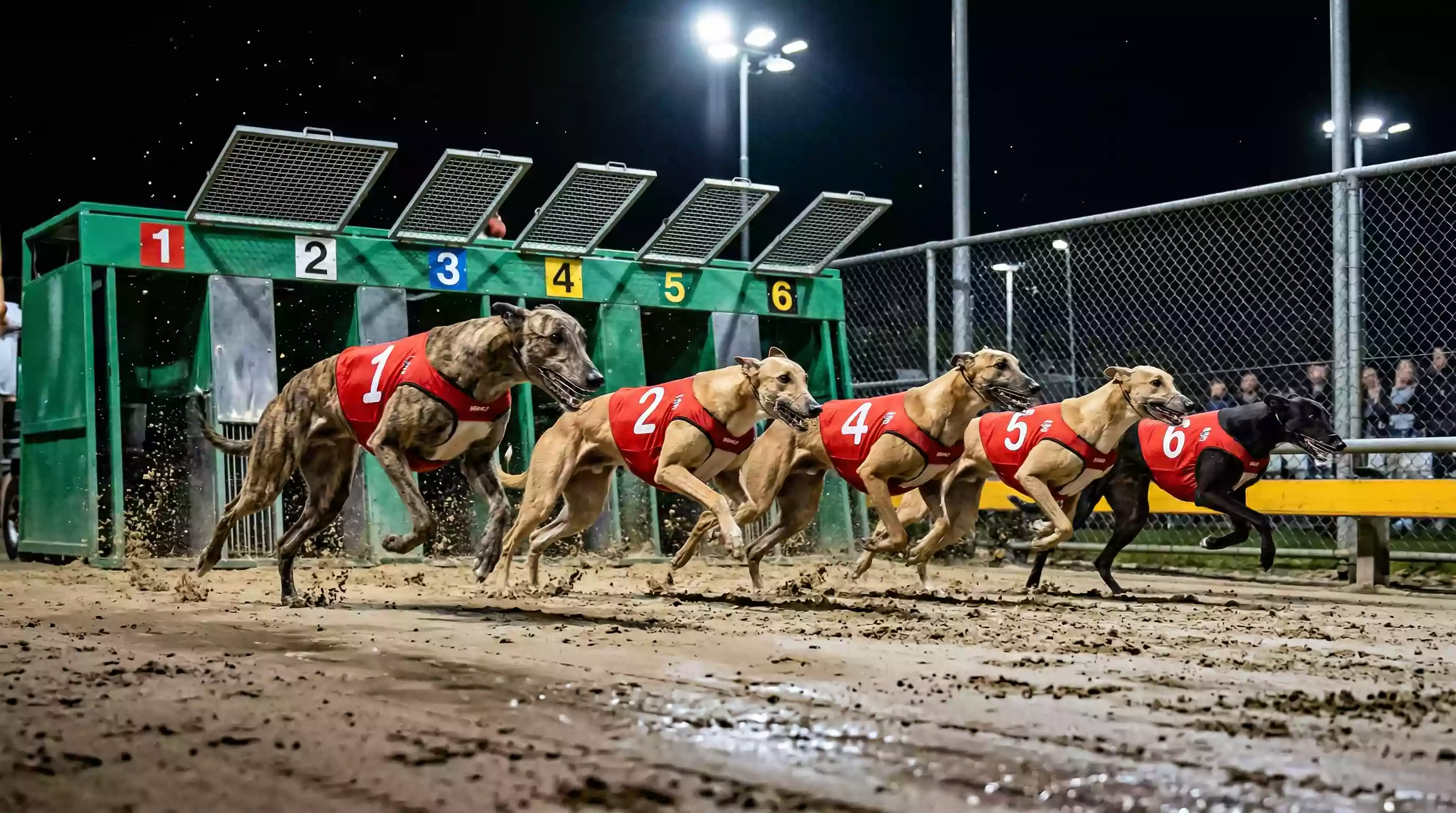
Kinsley's 385m circumference compresses the field — trap draw matters more here than at most UK tracks.
Betting at Kinsley: Every Bet Type You Can Place
Six traps, six dogs, and at least ten different ways to back them. Most punters know two — the win bet and the each-way. That is like knowing how to use the accelerator and the brake but ignoring the gears. The full range of greyhound bet types gives you far more flexibility in how you express an opinion on a race, and at a track like Kinsley where results are less predictable than average, the exotic bets can often represent better value than a simple win selection.
The win bet is the simplest: pick a dog, back it to finish first. If it wins, you collect. If it finishes second or worse, you lose your stake. The place bet asks only that the dog finishes in the top two in a standard six-runner greyhound race. Place odds are lower than win odds — typically a quarter of the win price — but the strike rate is obviously higher.
An each-way bet is two bets in one: a win bet and a place bet on the same dog at the same stake. So a £5 each-way bet costs £10 total — £5 on the win and £5 on the place. If the dog wins, both legs pay out. If it finishes second, you lose the win stake but collect on the place. The place terms in greyhound racing are almost universally one-quarter of the win odds for the first two finishers. Each-way betting is particularly interesting at Kinsley because of the track's tendency to produce upsets: backing a 6/1 or 8/1 shot each-way in a competitive race can return a profit on the place leg alone even if the dog does not win.
The straight forecast requires you to name the first and second finisher in correct order. The reverse forecast covers both possible orders but costs twice the stake. A combination forecast extends this to three or more selections in any order for the first two places — three dogs means six permutations, four dogs means twelve. The tricast demands the first three in exact order; the combination tricast covers all permutations. Pick three dogs for a combination tricast and you have six permutations; pick four and you have twenty-four. Tricast dividends at Kinsley regularly reach three figures from modest stakes.
The accumulator links win bets across multiple races, with returns from each leg rolling onto the next. All selections must win. A four-fold on a Monday Kinsley card can turn £2 into a significant return, but the probability drops sharply with each added leg. Other bet types include the trap challenge (backing a single trap number across every race), the jackpot (picking the winner of six consecutive races), and various bookmaker-specific specials.
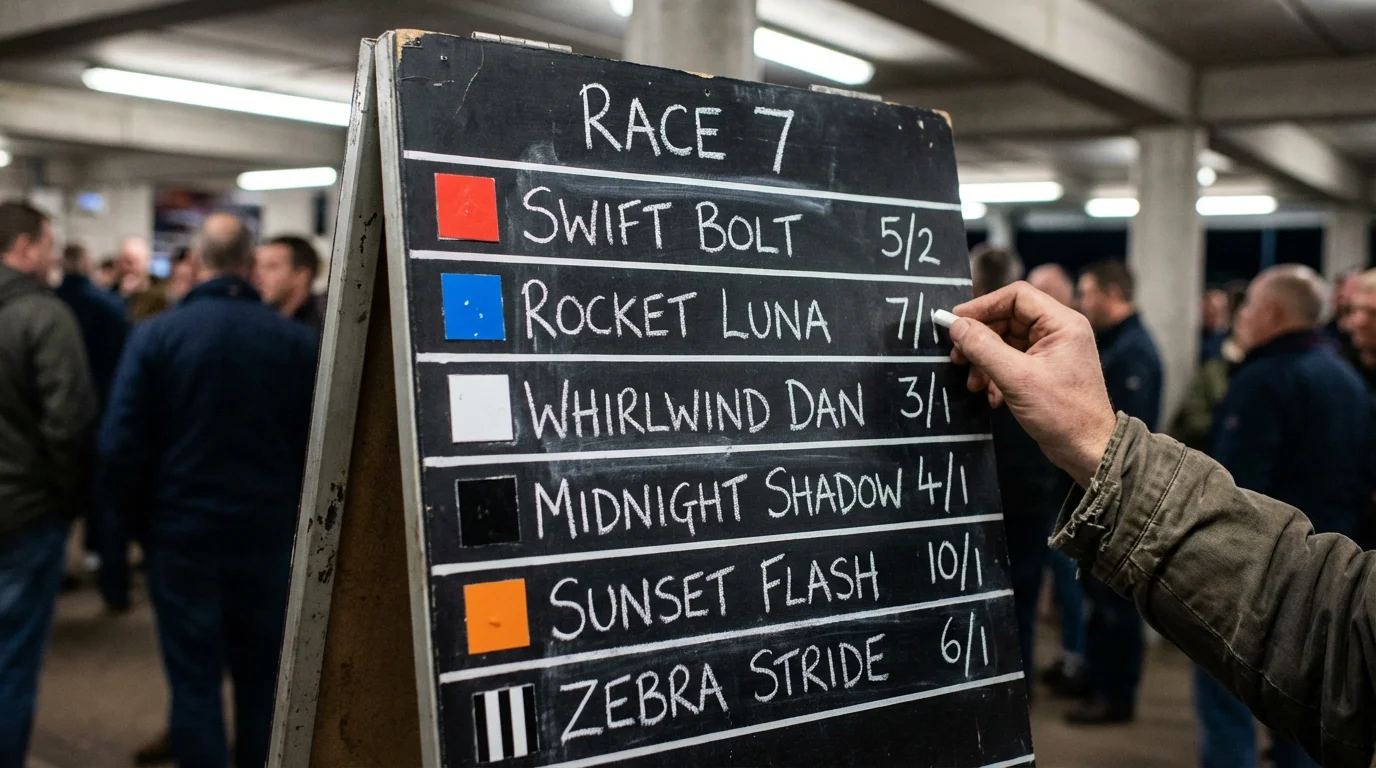
Win / Place
The foundation bets. Back a dog to finish first (win) or in the top two (place). Straightforward, low complexity, suitable for every level of punter.
Each-Way
Two bets in one — win and place — at a single stake. Pays on both legs if the dog wins; returns the place portion if it finishes second. Quarter-odds place terms.
Forecast / Tricast
Name the first two (forecast) or first three (tricast) in exact order. Straight, reverse and combination options available. Higher risk, higher dividends.
Accumulator
Link multiple win bets across separate races. Returns compound with each leg. All selections must win. Best used sparingly and with small stakes.
Win Bet Example
Selection: Trap 3 at 5/1
Stake: £10
Return if wins: £60 (£50 profit + £10 stake)
Each-Way Maths: When the Place Pays More Than You Think
The place leg of an each-way bet is often underestimated. Many punters think of it as a consolation — a partial return when the main bet fails. In reality, the place component can be the most profitable part of an each-way strategy, especially at Kinsley where longer-priced dogs hit the frame regularly.
The arithmetic is simple but worth walking through. In greyhound racing, place terms are almost always one-quarter of the win odds for the first two places. If you back a dog each-way at 8/1 with a £5 stake, your total outlay is £10 — £5 win and £5 place. If the dog wins, the win leg returns £45 (£40 profit plus £5 stake) and the place leg returns £15 (8/1 divided by 4 is 2/1, so £10 profit plus £5 stake). Total return: £60 from a £10 bet. If the dog finishes second, you lose the £5 win stake but collect £15 on the place leg. Net profit: £5.
Now consider the same bet at 12/1. Place odds become 3/1 (12 divided by 4). A £5 place leg returns £20 (£15 profit plus £5 stake). You lose the £5 win stake, so your net profit on a second-place finish is £10 from a £10 total outlay. That is a 100% return on a dog that did not even win.
This is where Kinsley's low favourite strike rate becomes directly relevant. At a track where the market leader wins roughly 32% of the time, the second-favourite and third-favourite finish in the frame more often than the odds imply. If you are selectively backing 6/1 or 8/1 shots each-way in six-runner races where the favourite is vulnerable — because of an awkward trap draw, a step up in grade, or recent form that does not match the price — the place leg hits frequently enough to sustain a profitable approach over a meaningful sample.
One caveat: some bookmakers occasionally offer one-fifth odds rather than one-quarter on selected greyhound races, which reduces the place payout. At 8/1, fifth-odds give 8/5 instead of 2/1. Always check the terms before placing an each-way bet — the difference compounds over time.
How Greyhound Odds Work — Fractional, Decimal and SP
Odds are a price, and like any price, they can be good or bad value. Understanding how greyhound odds are formed, what format they come in, and when to take them is fundamental to betting at Kinsley — or anywhere else — with any degree of competence.
Fractional odds are the traditional British format. When you see 7/2, it means: for every £2 you stake, you receive £7 in profit if the bet wins, plus your stake back. So a £10 bet at 7/2 returns £45 — £35 profit plus your £10 stake. The first number is always the potential profit; the second is the stake unit. Odds of 5/1 mean £5 profit for every £1 staked. Odds of 4/5 mean you stake £5 to win £4 — the dog is odds-on, meaning the market considers it more likely than not to win.
Decimal odds express the total return per unit staked, including the stake. Fractional 7/2 converts to decimal 4.50. You multiply your stake by the decimal figure to get the total return: £10 at 4.50 = £45. Most online bookmakers let you toggle between fractional and decimal in your account settings. There is no mathematical difference — it is purely a display preference. Decimal odds are more common in Europe and on betting exchanges; fractional odds remain the default for most UK punters at the dogs.
The Starting Price, or SP, is the official odds at the moment the traps open. It is determined by on-course bookmakers at the track — or, for meetings without on-course bookmakers, calculated by an industry formula. If you bet at SP, you accept whatever the final price is. This can work for you if money comes in late for a rival dog, pushing your selection's odds out. It can work against you if your dog's odds shorten after you place the bet — because at SP, you get the shorter price.
Early Price betting means taking odds before the SP is formed — sometimes hours before the race. You lock in a price you consider value before the market moves, but risk the dog drifting to a bigger price by the off. This is where Best Odds Guaranteed becomes essential.
Best Odds Guaranteed — commonly abbreviated as BOG — works simply: if you take an early price and the SP is bigger, the bookmaker pays the higher SP. If the SP is shorter, you keep your original price. It eliminates the main downside of early-price betting. Not every bookmaker offers BOG on every greyhound meeting, and the terms vary, so checking availability before the race is essential. For regular Kinsley punters, using a bookmaker with consistent BOG on greyhound racing is one of the simplest value gains available.
The Tote operates a pool-based system where all stakes go into a pool and winnings are divided among winners after a deduction. Tote odds are not fixed until the pool closes. Dividends can occasionally exceed fixed-odds returns on forecasts and tricasts, but for most Kinsley punters, fixed-odds betting with BOG is the more predictable and strategically manageable option.
Odds shorten as money comes in — early price does not always mean best price. Check BOG availability before committing.
Form, Fitness, and the Five Things That Win Races
Five factors decide most greyhound races before the traps open. You can debate which matters most — and the answer shifts depending on the track, the distance, and the grade — but these five cover the ground. At Kinsley, where the tight circuit amplifies some factors and mutes others, understanding how each one applies locally is what separates a punter with an opinion from a punter with an edge.
Recent form is the starting point. The last three to five runs tell you whether a dog is improving, peaking, or declining. Look at finishing positions, but look harder at the in-running comments and the times. A dog that finished fourth but was "FcdToCk" at the first bend — forced to check — may have been running better than its position suggests. A dog that won by three lengths last time but had "EvCh, ALd" — every chance, always led — might have had an easy race that flatters its form. Context is everything, and at Kinsley, first-bend trouble is the context that matters most.
Track-specific performance is the second factor, and at Kinsley it carries extra weight. Some dogs handle the 385-metre circumference naturally; others struggle with the tight bends no matter how well they run at bigger tracks. A dog's record specifically at Kinsley — times, positions, running comments — is a better predictor of its next Kinsley performance than its overall form across multiple venues. The greyhound statistics sites allow you to filter results by track, and at Kinsley this filter is not optional. It is essential.
Trap draw and running style — covered in detail above — deserve reiteration here. A dog with three consecutive wins from trap 1 that is drawn in trap 4 is not the same proposition. The form figure says "111"; the trap draw says "proceed with caution." Always cross-reference recent form with the trap drawn for the race you are assessing.
Weather and going constitute the fourth factor. Kinsley's sand track responds to rainfall in ways that affect different dogs differently. Some greyhounds prefer fast going and lose their edge when the track is wet. Others are indifferent or even improve on slower surfaces because the reduced pace suits their stamina profile. Going reports are published on racecards and are available from the GBGB and track sources before each meeting. If the going has changed significantly from a dog's last run — from fast to slow, or vice versa — that alone can explain a form reversal.
Trainer form is the fifth factor and the one that recreational punters most often ignore. Greyhound trainers manage the fitness, race schedule, and preparation of every dog in their kennel. A trainer in form — with a high recent strike rate — is usually reading the track well, grading their dogs intelligently, and managing race entries shrewdly. A trainer out of form may be dealing with a virus in the kennel, transitioning dogs between distances, or simply going through a quiet spell. Trainer data is available through sites like GreyhoundStats, and checking it takes thirty seconds. Not checking it is thirty seconds of laziness that costs money.
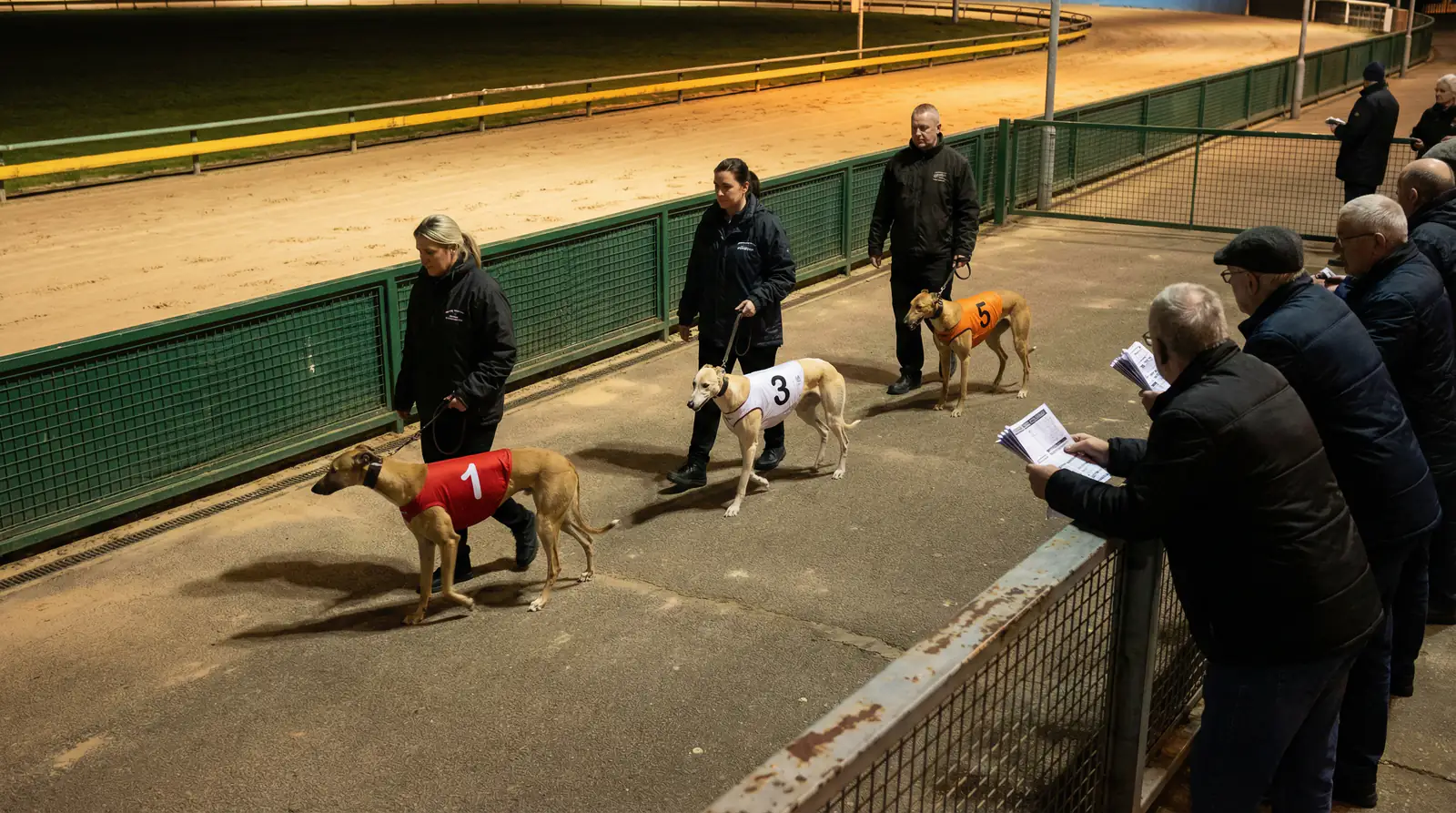
Pre-Bet Checklist: Kinsley
- Recent form — last 3-5 runs, with in-running comments checked
- Track time — dog's specific record at Kinsley, not just overall form
- Trap draw — does the allocated trap suit the dog's running style?
- Going — check the current going report against the dog's preferences
- Trainer record — current strike rate at Kinsley specifically
- Distance preference — is the dog proven at this trip on this track?
Trainer Form at Kinsley: Who to Follow
Not all trainers read Kinsley the same way. Some are specialists at the track — they know which of their dogs suit the 385-metre bends, they time their entries to hit the right grade, and they understand when to step a dog up or drop it back. Others have a broader portfolio across multiple tracks and treat Kinsley as one venue among many. Both approaches can produce winners, but knowing which trainers are currently running hot at Kinsley specifically gives you a meaningful informational edge.
The most efficient way to check trainer form at Kinsley is through GreyhoundStats, which provides track-by-track breakdowns of trainer performance including win percentages, profit/loss to starting price, and recent strike rates. You can filter by time period, distance, and grade. What you are looking for is not the trainer with the most runners — that usually just reflects kennel size — but the trainer with the best conversion rate of runners to winners over the most recent meaningful sample, which in greyhound racing means roughly the last three to six months.
Trainer form at a specific track matters more in greyhound racing than in most other sports because trainers control so many variables. They decide when a dog races, at which track, over which distance, and from which grade. A shrewd trainer will place a dog at Kinsley when the draw is favourable and the grade is right, then switch to a different track when conditions change. The result is that their Kinsley runners tend to be well-suited to the track on the nights they appear. The converse is also true: a trainer sending a dog to Kinsley as a late substitution or schedule filler is not making the same deliberate placement.
One pattern worth noting is that certain kennels consistently perform well over Kinsley's sprint distance of 268 metres, while others specialise in the 462-metre standard trip. If you find yourself regularly betting on one distance, tracking which trainers excel at that specific trip is more useful than following overall trainer statistics. The 268-metre sprint at Kinsley is heavily influenced by trap speed and early pace — trainers who prepare fast-starting dogs tend to dominate that distance disproportionately.
Where to Watch and Bet on Kinsley Races Online
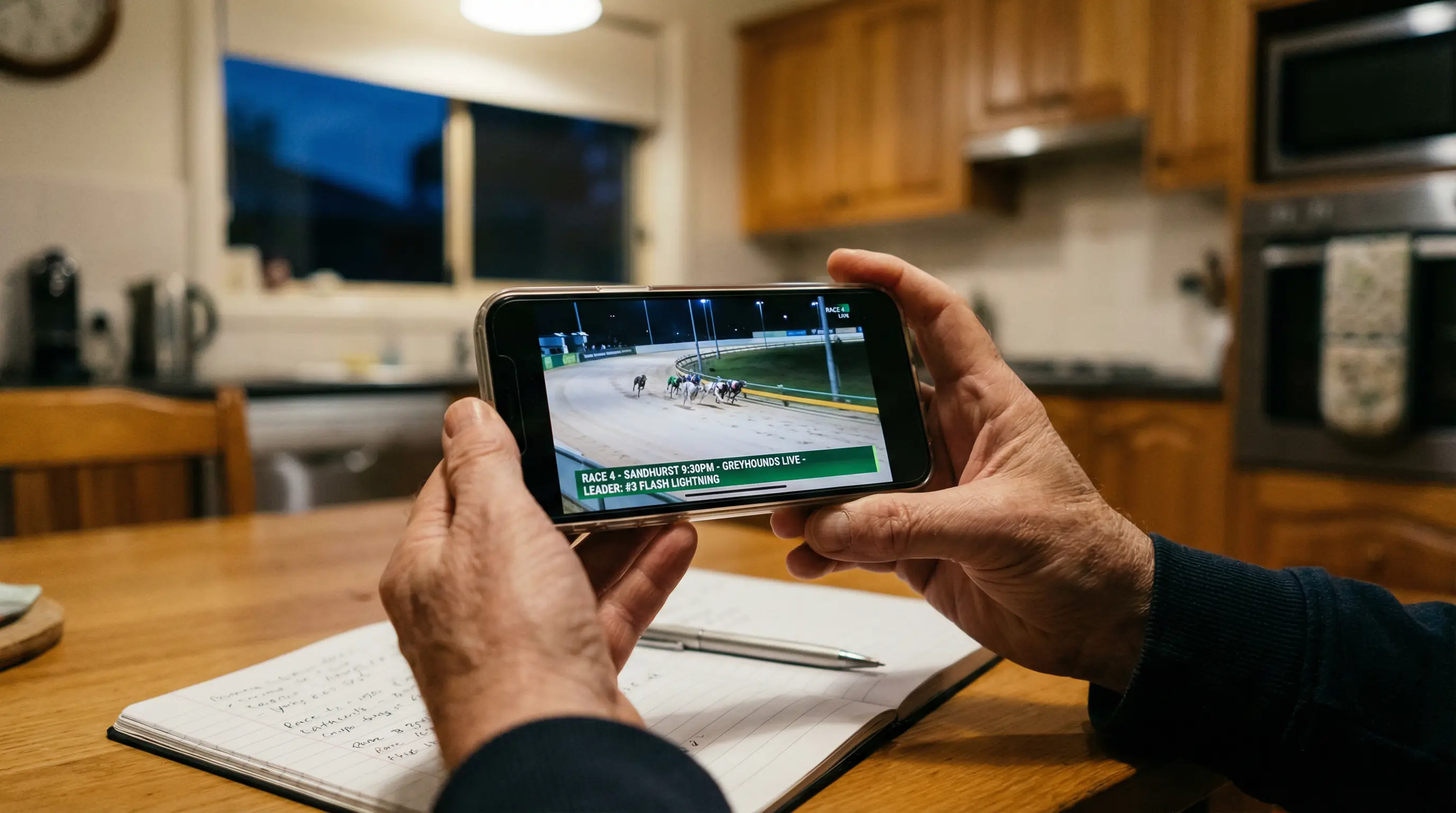
Kinsley races are broadcast through Arena Racing Company, and most major UK bookmakers carry them. If you have an account with any of the larger licensed operators — the ones you would recognise from high street shops and television advertising — the chances are that Kinsley races will be available to stream live through their platform or app.
The requirement for live streaming is generally a funded account, and some bookmakers ask that you have placed a bet on the meeting. The minimum bet to activate a stream is typically £1 or less. Once activated, you can watch every race on the card — useful not only for races you have backed but for studying running lines and track conditions before later bets.
Sky Sports Racing broadcasts selected greyhound meetings, including some from ARC-contracted tracks. SIS (Sports Information Services) provides the data feed and streaming infrastructure for the majority of licensed greyhound meetings, and Kinsley's fixtures come through this system.
For punters who attend the track in person, Kinsley offers on-course betting through the tote and with any bookmakers standing at the meeting. Saturday evening meetings are open to spectators, and Sunday afternoon fixtures offer free entry. The experience of watching live at a compact track like Kinsley is different from watching remotely — you can see the dogs in the parade ring, assess their physical condition, and watch how they handle the pre-race routine, all of which is information that does not come through on a screen.
One distinction worth making clearly: virtual greyhound racing is a separate product entirely. Virtual races use computer-generated imagery and random number algorithms to simulate greyhound racing. They have no connection to real dogs, real tracks, or real form. Some bookmakers display virtual greyhounds alongside real Kinsley races in their app interface, and it is easy to bet on a virtual race thinking it is a live one. Always check whether the race is a real ARC fixture or a virtual event before placing a stake.
Responsible Betting: Limits, Tools, and When to Stop
The difference between betting for entertainment and betting as a problem is a line you cross before you notice it. That sentence is not meant to be preachy — it is meant to be accurate. Greyhound racing, with its rapid-fire schedule of races every fifteen minutes across multiple tracks, creates more opportunities to bet in an evening than most sports offer in a week. The speed and frequency can be exhilarating when things are going well and financially destructive when they are not.
In the UK, all licensed greyhound racing — including every ARC meeting at Kinsley — operates under the regulatory oversight of the Gambling Commission. The GBGB's Rules of Racing, updated for 2026 as of 1 January, incorporate the welfare and integrity standards required by UK law, including the Welfare of Racing Greyhounds Regulations 2010 and the Animal Welfare Act 2006. For bettors, the regulatory framework means that every licensed bookmaker offering Kinsley odds must comply with the Gambling Commission's licence conditions, which include requirements for responsible gambling tools.
Every licensed UK bookmaker is required to offer deposit limits, loss limits, session time limits, and cooling-off periods. These tools exist because the industry is legally required to provide them, and because they work. Setting a deposit limit before a Kinsley session is the simplest form of bankroll management available.
If betting is causing financial, emotional or relationship problems, the next step is self-exclusion. GamStop is the national self-exclusion scheme for online gambling in Great Britain. Registering with GamStop blocks you from all licensed online gambling sites for a minimum of six months. It is free, confidential, and — importantly — it covers every UKGC-licensed operator, so there is no loophole of switching to a different bookmaker.
For support and advice, GambleAware provides free information, resources and treatment referrals. The National Gambling Helpline is available 24 hours a day. If you are spending more time thinking about your next bet than about the form that should inform it, that is a signal worth paying attention to.
FAQ
How do I read a greyhound racecard and what do the abbreviations mean?
A greyhound racecard shows each dog's trap number, name, trainer, form figures, best and last times, and predicted odds. Form figures represent finishing positions in recent races, read left to right with the most recent on the right. Abbreviations in the results column describe in-running behaviour: SAw (slow away), QAw (quick away), EP (early pace), Ld (led), ALd (always led), FcdToCk (forced to check), MsdBrk (missed break), RanOn (finished strongly), and EvCh (every chance). Finishing margins use sh (short head), nk (neck), and numerical lengths. The key habit is reading in-running comments alongside the time figures, not separately. A dog that ran 27.40 with "SAw, RanOn" tells a different story from one that ran 27.40 with "QAw, Ld-3, Fdd." The numbers alone do not reveal this — the commentary does.
Does trap position affect the outcome, and is there a bias at Kinsley?
Yes, and the bias is more pronounced at Kinsley than at many UK tracks. The 385-metre circumference creates tighter bends and a shorter run to the first turn, giving inside traps — particularly trap 1 — a structural advantage. Dogs with early pace from trap 1 reach the first bend on the shortest running line and can dominate from there. Traps 3 and 4 tend to be most disadvantaged because middle-drawn dogs face crowding from both sides into the first bend. Trap 6 performs well for wide runners with early speed, especially at longer distances. The GBGB seeding system places railers inside and wide runners outside, but this does not eliminate the geometric advantage of inside draws on compact tracks. When analysing a Kinsley racecard, give trap draw more weight than you would at larger circuits.
How do greyhound betting odds work, and what does Best Odds Guaranteed mean?
Greyhound odds represent the potential return on a winning bet. In fractional format (the UK standard), 5/1 means £5 profit per £1 staked — a £10 bet returns £60. Decimal odds express total return per unit: 5/1 fractional equals 6.00 decimal. Odds are set by bookmakers and adjust as money comes in. The Starting Price (SP) is the final odds at trap time. Best Odds Guaranteed (BOG) is a promotion where, if you take an early price and the SP is bigger, the bookmaker pays the higher SP; if the SP is shorter, you keep your early price. It eliminates the main risk of betting early. Not every bookmaker offers BOG on every greyhound meeting, so checking availability before the race matters. For regular Kinsley punters, using a bookmaker with consistent BOG on greyhound racing is one of the simplest ways to improve long-term returns.
The Last Bend: Why Kinsley Rewards the Patient Punter
Kinsley is not a track that favours lazy favourites. If this guide has communicated one thing clearly, it should be that. The 385-metre circumference, the tight bends, the compressed racing, the historically low favourite strike rate — all of it adds up to a venue where the bettor who has done the preparation has a genuine advantage over the one who glances at the odds and picks the shortest price.
That is not a criticism of Kinsley. It is, arguably, what makes the track interesting. At bigger circuits, the best dog often wins because there is enough room for talent to express itself without interference. At Kinsley, the geometry introduces variables that no amount of raw ability can fully control. A fast dog in the wrong trap gets checked. A slower dog on the rail gets a clean run and holds on. The form says one thing; the track says another. And that gap between expectation and reality is where value lives for anyone paying attention.
The approach that works here is not complicated, but it is disciplined. Read the form, but filter it for Kinsley-specific data. Check the trap draw against the dog's running style. Look at the going. Check who trains the dog and what their recent record is at this track. Run through the pre-bet checklist not because it is a ritual, but because each item on it addresses a variable that genuinely moves outcomes at this venue. Then — and only then — compare your assessment with the odds the market is offering.
Greyhound racing in the UK enters 2026 celebrating a centenary — one hundred years since the first regulated meeting in Manchester. The GBGB's open race calendar for the year features 50 Category One competitions across the country, and the sport continues to draw punters who value speed, unpredictability and the honest simplicity of six dogs chasing a mechanical hare. Kinsley is one of 18 active GBGB-licensed stadiums, and it remains one of the most distinctive. The track asks more of its bettors than most, and it pays back those who answer the question properly.
There are no shortcuts at the first bend, and there are no shortcuts in the form book. That is the deal Kinsley offers. Take it seriously, and the results make more sense. Take them seriously enough, and they start to make money.
