How Greyhound Grading Works in the UK
 Available in US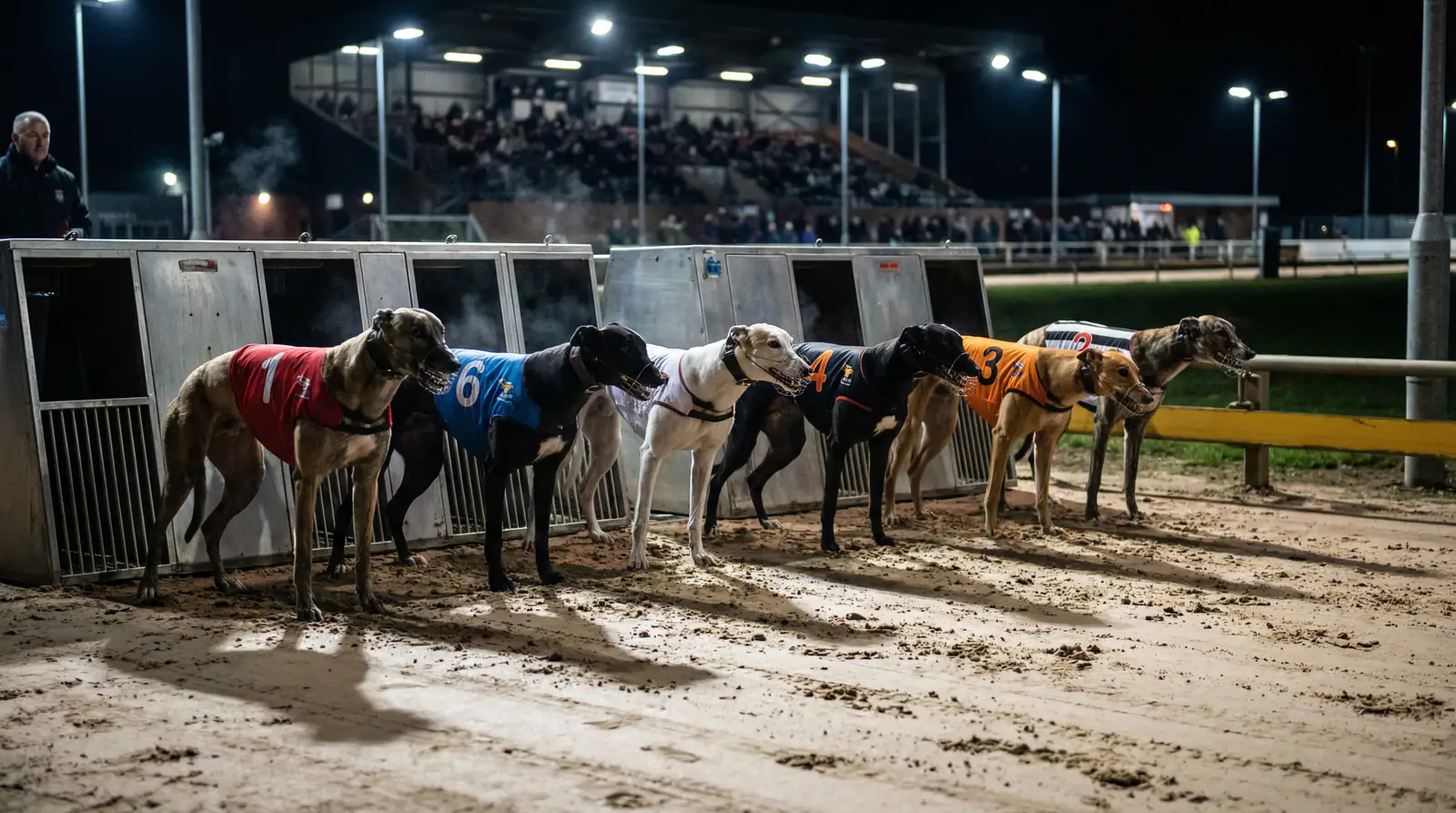
The Grading System: Structure and Purpose
Grading exists to make races fair. Without it, the fastest greyhound at a track would win every week, fields would be lopsided, and betting markets would offer no value on anything but the obvious class. The grading system prevents this by grouping dogs of similar ability, ensuring that every race on a card is competitive, and giving bettors a structured framework for assessing form.
In UK greyhound racing, each dog is assigned a grade based on its recent performance at a specific track. The grade consists of a letter prefix — indicating the race distance category — followed by a number indicating the quality tier. A1 is the top grade for middle-distance runners. A2 sits just below, A3 below that, and so on down to A10 or A11 depending on the track. The same structure applies to sprints (D1 through D4 or lower), stayers (S1 downward), and hurdle races (H grades).
The numbering is track-specific. An A3 at Kinsley is not the same standard as an A3 at Romford or Nottingham. Each track’s racing manager maintains the grading independently, calibrated to the quality of dogs in that stadium’s racing pool. A dog graded A3 at a smaller track might struggle in A5 at a larger venue with a deeper talent pool. This locality is critical for anyone analysing form across tracks — grades don’t travel.
Understand greyhound grading in the UK on the kinsleygreyhound homepage.
The depth of the grading ladder varies by track size and the number of dogs in the racing pool. A large track might run grades from A1 down to A10 with distinct performance bands at each level. A smaller track might compress the same range into fewer grades. Kinsley, with its four main racing distances (268m, 462m, 650m, and 844m), maintains its own grading tiers across each distance category, so a dog might be graded differently at 268 metres than at 462.
The core principle across all tracks is the same: the higher the grade number, the slower the dogs. Grade 1 is elite. Grade 8 or 9 is modest. The system is dynamic — dogs move between grades as their form changes — and it’s this movement that creates some of the most interesting betting situations in the sport.
How Dogs Move Between Grades
Win and you go up. Lose consistently and you go down. That’s the simplified version, and the actual mechanism isn’t much more complex — though the racing manager’s discretion adds a layer that pure numbers can’t capture.
After each race, the racing manager reviews the result and updates the grades of the runners. A dog that wins convincingly — by a clear margin, in a fast time — is typically promoted one grade for its next outing. A dog that finishes well behind the field in multiple consecutive races may be dropped a grade. The speed of movement depends on the margin of performance. A narrow winner might stay in the same grade or move up only after a second win. A dog that wins by five lengths in a time well below the grade standard might jump two grades in one move.
Demotion follows a similar logic but tends to be slower. Racing managers generally give dogs more chances to prove themselves before dropping them, partly because grading is meant to be fair and partly because a single poor run can be explained by interference, a bad trap draw, or going conditions. A dog that finishes last three times in succession is a clear candidate for demotion. A dog that finishes fourth twice might stay where it is if the running comments show it was competitive — crowded, checked, or unlucky.
The racing manager’s role is central and somewhat subjective. The GBGB provides guidelines, but individual tracks have latitude in how strictly they apply promotion and demotion rules. An experienced racing manager reads not just results but the context around them — the same way a football manager assesses a player on more than just goals scored. This human element means grading isn’t purely mechanical, and dogs sometimes sit in grades that feel slightly generous or slightly harsh based on raw numbers alone.
For bettors, the transition periods are the most interesting. A dog being promoted is stepping up in class, about to face faster opposition. A dog being demoted is dropping down, theoretically meeting weaker rivals. Neither situation is as simple as “promoted dog will lose, demoted dog will win” — but grade changes are significant events that shift the competitive balance and should always be factored into form analysis.
Open Races vs Graded Races
Open races are the prestige tier. While graded racing is the engine of the weekly schedule — the bread and butter of every track’s card — open races represent the sport’s showcase events, drawing the best dogs from multiple venues to compete for larger prizes and higher recognition.
Open races are classified OR1, OR2, and OR3, with OR1 being the highest level. To compete in open events, a dog typically needs to have demonstrated top-grade form at its home track. The entry process involves trainers nominating their dogs, and the organising track selecting a competitive field based on recent form and performance ratings. Unlike graded races, where the six runners are drawn from the same track’s pool, open races bring together dogs from different stadiums — each with different track characteristics, grading standards, and competition levels.
The prize money in open racing is significantly higher than in graded events. A standard graded race at a mid-tier track might offer eighty to one hundred pounds to the winner. An OR1 event at the same track could offer several hundred pounds, and the major national competitions — the English Greyhound Derby, the St Leger, the Puppy Derby — carry prize funds ranging from tens of thousands to well over a hundred thousand pounds. The English Greyhound Derby, for instance, offers £175,000 to the winner alone. The financial incentive drives trainers to target these events with their best dogs, which in turn raises the quality of the fields.
From a betting perspective, open races present a different challenge to graded races. The form is harder to compare because the dogs come from different tracks with different grading standards and time profiles. A dog graded A1 at a fast track might have recorded times that would be unremarkable at a slower venue, and vice versa. Bettors need to adjust for track characteristics when assessing open race fields — a task that requires more research than graded-race analysis but can also produce value when the market misprices dogs from less fashionable venues.
The major events also offer ante-post betting — wagering on the outright winner before the heats begin. Ante-post markets on the English Greyhound Derby, for instance, open weeks before the first round, and the odds on individual dogs can shift dramatically as heats are run and the field narrows. This is a different betting discipline entirely, with its own risks (non-runners, injuries, withdrawal without refund) and its own rewards (locking in early value before the market adjusts).
What Grading Means for Bettors
A dog dropping a grade is not always a good bet. This is one of the most common misconceptions in greyhound betting, and it costs punters money with reliable regularity.
The logic seems sound on the surface: a dog that was competing in A4 drops to A5, where it should face slower opposition. Surely that makes it a strong bet? Sometimes, yes. If the demotion is due to a run of unlucky results — interference, poor trap draws, off-going — and the dog’s underlying ability hasn’t changed, then the drop in grade represents genuine opportunity. The dog is better than its recent results suggest, and the market may not fully adjust for the softer competition.
But demotion is often a reflection of declining form, not bad luck. Greyhounds are athletes with relatively short racing careers, and their performance curves aren’t linear. A dog that’s dropped from A3 to A5 over three months might be showing signs of age, fitness decline, or loss of competitive edge. Moving it to a lower grade doesn’t restore its earlier form — it just places it among slower dogs while its own speed continues to fall. Backing a declining dog at short odds in a lower grade because “it used to be A3” is a reliable way to lose.
Promoted dogs face the opposite challenge. A dog stepping up from A6 to A5 after a win is meeting faster rivals and needs to find more speed or tactical awareness to compete. Some dogs thrive on promotion — the faster pace suits their running style, or they benefit from cleaner racing among higher-quality fields. Others hit a ceiling and bounce back down after a couple of below-par runs in the higher grade.
The practical approach is to assess each grade change on its merits. Look at the running comments from the races that triggered the change. Was the demotion caused by interference, or did the dog have clear runs and still finish poorly? Did the promotion come from a dominant win or a scrappy dead-heat victory? The context around the grade change matters more than the direction of the change itself.
One specific value angle: dogs that win their first race after a grade drop tend to be overbet by the market. The “class dropper” narrative attracts money, which shortens the odds. If the dog is genuinely declining, the short price offers no value. Look instead at dogs that were recently promoted, struggled in their first run at the higher grade (especially if the running comments show interference), and are now returning to the same race. The market often overreacts to one poor run in a new grade, and the odds can be generous on a dog that simply needs a clean run to prove it belongs.
The Trial Process: How New Dogs Get Their Grade
Every racing greyhound starts with trial runs. Before a dog can compete in an official race at any GBGB-licensed track, it must complete a series of timed trials (usually two, per Timeform) that the racing manager uses to assess its ability, running style, and appropriate grade.
The standard requirement is two satisfactory trials at the track where the dog will be based (as specified in GBGB Rule 48), though the racing manager may require additional trials at their discretion. These trials take place under race conditions — the dog runs from a trap, chases the mechanical hare, and is timed over the full distance. However, trials are not competitive in the same way as races: the dog may run alone or in a small group, and the emphasis is on assessment rather than winning.
During the trials, the racing manager evaluates several factors. Raw speed is the most obvious — the time recorded over the distance determines the general grade bracket. But the racing manager also watches for running style: does the dog rail naturally, run middle, or swing wide? Does it break quickly from the trap or does it need time to find its stride? Is it a front-runner that leads from the start, or a closer that makes ground late? These observations inform not just the initial grade but also the trap assignments in future races.
Once the trials are complete and the racing manager is satisfied, the dog is assigned a grade and entered into the racing schedule. The initial grade is conservative — racing managers tend to place new dogs slightly lower than their trial times might suggest, allowing a margin for the step up from trial conditions to competitive racing. A dog that trialled at A4-level times might be entered in A5, with the expectation that it will be promoted after its first win.
See how grading is regulated by GBGB in GBGB regulation.
For bettors, debut runners present a unique challenge. There’s limited form to analyse — trial times are published, but they don’t carry the context of competitive racing. A dog that trials at 28.50 seconds might run 29.20 under race pressure, or it might run 28.30 when the competitive instinct kicks in. First-time racers are inherently uncertain, and the odds often reflect this with wider prices. Some punters specialise in debut runners, tracking trial times and trainer records to identify newcomers with above-average potential. It’s a niche within greyhound betting — high-risk, but occasionally high-reward when a genuinely fast dog goes under the radar in its first official race.
The trial system also applies when a dog transfers between tracks. If a greyhound moves from one GBGB-licensed stadium to another, it typically needs to complete fresh trials at the new venue before being graded there. Previous grades from the old track are informative but not directly transferable, because track conditions, distances, and grading standards differ. A dog that was A3 at Romford might trial at A4 standard at Kinsley, and the new racing manager grades accordingly. For bettors, a dog’s first race at a new track is another uncertainty event — similar to a debut, but with the added variable of an unfamiliar circuit.
