
Greyhound Racing Weather and Track Conditions: How Going Affects Form
 Available in US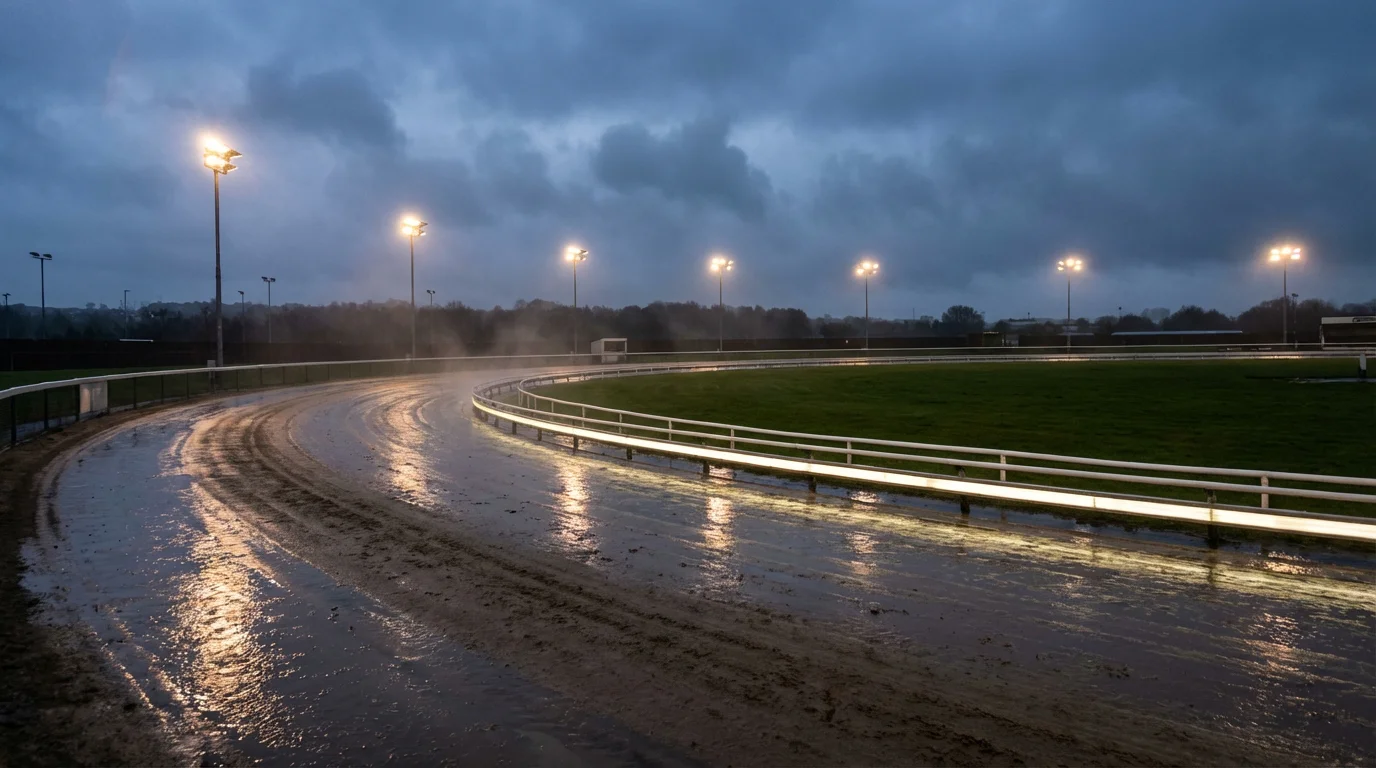
How Weather Changes a Greyhound Race
Rain doesn’t just make the sand wet — it changes which dog wins. Every GBGB-licensed greyhound track in the UK uses a sand surface, and sand behaves differently depending on its moisture content, temperature, and compaction. These variations directly affect running times, grip, energy expenditure, and the relative advantages of different running styles. A dog that dominates on a dry, fast surface can struggle on the same track after a downpour, and vice versa.
The mechanics are straightforward. Dry sand is loose and firm underfoot, offering good traction and allowing dogs to maintain speed through the bends. In hot weather, the sand dries further and becomes hard-packed, producing the fastest times of the year. Track records are almost exclusively set on warm, dry evenings when the surface is at its quickest.
Wet sand is heavier. Rain saturates the surface, increasing the drag on each stride. Dogs expend more energy per stride on a wet track, which slows overall times and changes the competitive balance. The effect is cumulative over the course of a race — slight at the start, more pronounced by the third or fourth bend — which means wet conditions favour dogs with stamina reserves over those that rely purely on early speed.
Heavy or prolonged rain can also cause localised waterlogging, particularly on sections of the track that drain poorly. If the inside of the track holds more water than the outside — which is common, since the inside receives less sunlight and more wear from the running rail — then the going can differ across the width of the track within a single race. Dogs running the rail might be slogging through deeper sand while dogs running wide find a firmer line. This uneven surface can reverse the typical inside-trap advantage, creating an in-meeting bias that doesn’t show up in any historical data set.
Check how weather affects Kinsley racing on the kinsleygreyhound homepage.
Wind is the less-discussed weather factor, but it matters. A strong headwind on the home straight slows the field by a measurable amount, particularly over longer distances where dogs are running into the wind for an extended period. A tailwind has the opposite effect, producing faster-than-normal times that can mislead bettors who don’t account for conditions. Crosswinds are largely neutral but can affect lighter dogs more than heavier ones, particularly on exposed circuits.
Wet vs Dry: What Different Conditions Favour
Stayers gain in the wet. Sprinters lose grip. That’s the general rule, and while it doesn’t hold in every individual race, it’s backed by enough pattern across UK greyhound racing to be a useful betting framework.
On dry, fast-going sand, front-runners and sprinters thrive. These dogs rely on explosive early speed to establish position at the first bend and then maintain their advantage through the race. Dry conditions suit this profile because the firm surface rewards powerful acceleration — each stride translates efficiently into speed. A quick-break dog from an inside trap on a dry track at Kinsley is often the most likely winner, and the market prices generally reflect this.
Wet conditions shift the balance towards dogs with endurance. The heavier surface punishes early-speed dogs in the closing stages of a race, as the energy cost of driving through wet sand accumulates. Dogs that typically lead for two bends and then fade are even more vulnerable on a wet track. Meanwhile, stayers — dogs that build pace gradually and finish strongly — find that the wet surface levels the playing field in the early stages and gives them a chance to run down front-runners who are tiring more quickly than usual.
The effect is most visible in middle-distance and staying races. In very short sprints — Kinsley’s 268 metres, for instance — the race is over so quickly that the going has less time to influence the outcome. The dog that breaks fastest still has a major advantage, wet or dry, because there simply aren’t enough bends for the slower-surface stamina effect to kick in. Over 462 metres or longer, though, the wet-versus-dry distinction becomes meaningful.
There’s a more specific pattern within the wet-ground effect: railers suffer disproportionately on waterlogged tracks. The inside of the track tends to accumulate more water, as noted above, so dogs running the rail are often running on the heaviest going. If the racecard shows a strong railer from trap 1 and the track report indicates heavy conditions, that dog’s natural line might be its biggest liability. The wide runner in trap 5 or 6, normally at a disadvantage in terms of distance covered, might actually be running on a firmer surface line — an unconventional edge that the odds rarely account for.
Reading Track Conditions Before Betting
Check the weather before you check the form. This sounds backwards, but it’s efficient. If conditions are markedly different from the norm — heavy rain, a heatwave, strong wind — the weather becomes a filter that changes how you should interpret the form. There’s no point spending twenty minutes analysing a racecard only to realise at the last minute that the track is waterlogged and half your selections are front-runners.
Track condition reports aren’t as formalised in greyhound racing as they are in horse racing, where the going is officially described on a standardised scale. Greyhound tracks don’t publish “good to firm” or “heavy” classifications. Instead, you need to infer conditions from weather forecasts, recent racing data, and occasionally from social media posts or live commentary from the track.
A practical approach: check the local weather forecast for the track location on race day. Kinsley sits in West Yorkshire between Leeds and Doncaster. If the Met Office shows persistent rain across that area through the afternoon and into the evening, you can reasonably assume the surface will be slower than standard. If it’s been dry for a week and temperatures are above average, the track is likely fast.
A second data point comes from the early races on a card. If the first two or three races produce times that are noticeably slower than the dogs’ recent form suggests, the going is probably on the heavy side. If times are faster than expected, conditions are in favour. This real-time adjustment is particularly useful for punters who bet during a meeting rather than placing all their bets before the first race. Watching how the card unfolds gives you live intelligence that pre-race analysis can’t provide.
Some of the greyhound data platforms — Timeform, Sporting Life, GreyhoundStats — display running times from the current meeting as results come in. Comparing these to historical averages for the same grade and distance at the same track gives you a rough going index. It’s not scientific, but it’s better than guessing, and it takes only a few minutes of attention during the early part of a card.
Seasonal Patterns in UK Greyhound Racing
Winter racing at Kinsley is a different proposition to summer. UK greyhound racing runs year-round, through every season and every weather pattern the British climate can produce. The track surfaces respond to these seasonal shifts in predictable ways, and the smart bettor adjusts accordingly.
Summer months produce the fastest racing. Longer daylight hours, higher temperatures, and less rainfall mean the sand dries out and firms up. Track records are almost always set between May and September, when the surface is at its hardest and fastest. Dogs that rely on raw speed perform at their peak in summer conditions, and early-pace runners from favourable traps win more often when the going is quick.
Winter slows everything down. Shorter days, lower temperatures, persistent rain, and occasional frost make the surface heavier and slower. Times across the board increase — sometimes by several tenths of a second at middle distances, which in greyhound racing represents multiple lengths. Dogs with stamina become relatively more competitive, and the finishing order in winter racing can differ significantly from the same field on a summer card.
The transitional months — October through November, and March through April — are the trickiest to assess. Conditions can vary dramatically from one meeting to the next, or even within a single evening as weather moves through. An October evening might start on firm going after a dry spell and end on soft going if rain arrives during the card. Bettors who place all their bets before the meeting starts are taking on more weather risk during these months than at any other time of year.
There’s a direct implication for form analysis: a dog’s times from July tell you something different to its times from January. A time of 28.50 seconds over 462 metres in midsummer on fast going is not the same performance as 28.50 seconds in December on heavy ground. The December run might actually represent a stronger performance, because the dog had to work harder through heavier sand to achieve the same clock. Bettors who compare times without adjusting for seasonal conditions are comparing apples to oranges.
Adjusting Your Betting in Changing Conditions
Conditions change mid-meeting — and your approach should too. This is most relevant during evening meetings that span three to four hours, where weather can shift meaningfully between the first and last races. A card that starts in dry conditions and ends in rain, or one that begins cold and damp before drying out as the evening warms up, presents a moving target for bettors.
The simplest adjustment is to watch the times from the early races. If the opening races are running faster than form suggests, the track is riding quick and front-runners and sprinters deserve more attention. If early times are slow, stayers and finishers are worth a longer look. This isn’t a complex calculation — it’s pattern recognition applied in real time, and it’s one of the practical advantages that in-play bettors and trackside punters have over those who place all their bets in advance.
The second adjustment involves trap bias. If early races show that inside traps are performing unusually well or poorly — perhaps the rail is heavy, or the inside is running particularly fast — you can weight your selections accordingly for later races. This within-meeting bias doesn’t appear in any pre-race dataset, but it’s observable live and can be a genuine edge.
See how weather links to track conditions in track guide.
A final consideration: don’t overfit to conditions. Weather is one factor among many. A genuinely fast dog in a weak field will win regardless of rain. A genuinely slow dog in a strong field won’t be saved by dry conditions. Use track conditions as a tiebreaker in competitive races — the kind of races where three or four dogs have similar form and the deciding factor is who handles the going best. In less competitive races, where form separation is clear, conditions matter less and the better dog is still the better bet.
The punters who handle weather best are the ones who build it into their routine without obsessing over it. Check the forecast. Watch the early races. Adjust where the data supports adjustment. Then trust your form analysis for the rest. Weather rewards preparation and punishes rigidity, which makes it a lot like greyhound betting itself.
