
Greyhound Starting Price vs Early Price: Which Should You Take?
 Available in US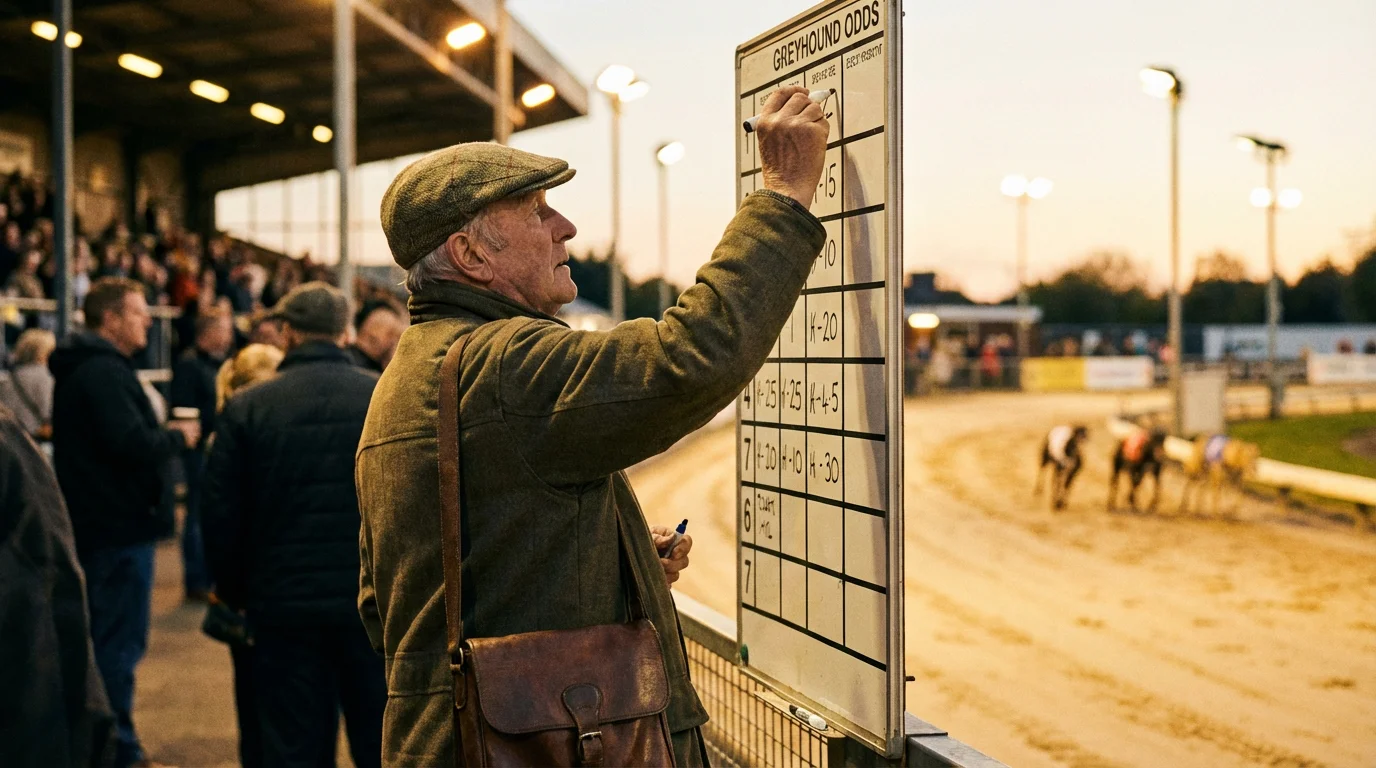
What Is Starting Price and How Is It Calculated?
SP is the price at the moment the traps open. It represents the final odds on each dog in the race, calculated from the state of the betting market just before the start. In greyhound racing, the Starting Price is derived from the on-course bookmakers’ boards and reflects the weight of money across all six runners at the point the race begins.
The process works like this: on-course bookmakers at the track adjust their odds throughout the minutes leading up to a race based on the bets they receive. A dog attracting heavy money will see its odds shorten; a dog receiving little interest will drift to bigger prices. An industry-appointed official records the prices displayed by on-course bookmakers at the off, and the Starting Price for each runner is determined from those figures. For most UK greyhound races, the SP is the official settlement price for punters who haven’t taken a fixed early price.
There’s a distinction worth drawing between SP and exchange prices. Betting exchanges, where punters bet against each other rather than against a bookmaker, produce their own market prices that are independent of the on-course SP. Exchange prices can differ from SP, sometimes significantly, because the exchange market operates with different participants and different incentive structures. A dog might be 3/1 SP but 7/2 on the exchange, or vice versa. Punters who use exchanges are playing in a separate market, and comparing exchange odds to SP is not always straightforward.
For the majority of UK greyhound bettors using traditional bookmakers, SP is the default settlement price when no fixed odds are taken. If you walk into a betting shop, fill in a slip, and don’t specify a price, your bet is settled at SP. Online, most bookmakers show the current available odds and let you take a fixed price, but the option to select SP is always there.
Understand pricing at Kinsley on the kinsleygreyhound homepage.
The practical significance of SP is that it’s unknown until the moment the race starts. You can estimate it from the morning or afternoon prices, but the actual SP can move substantially from those early numbers. A dog that opens at 5/1 in the morning might be 3/1 SP if money floods in during the afternoon, or 8/1 if the market pushes out. That uncertainty is the central tension in the early-price-versus-SP decision.
Early Prices: Risks and Rewards
Taking an early price is a bet on the market, not just the dog. When you accept the odds currently displayed by a bookmaker hours before a race, you’re committing to those odds regardless of what happens to the market between now and the off. If the price shortens after you’ve bet, you’ve secured a better deal than SP. If it drifts, you’ve locked in a worse one.
The primary reward of taking an early price is capturing value before the market corrects. In greyhound racing, early prices are published from the morning for evening meetings. At this stage, the prices are set by bookmaker traders using form analysis, historical data, and market models. These prices are good but not perfect — they’re estimates, and they can underestimate or overestimate a dog’s true chance. If your own analysis tells you a dog priced at 5/1 should be closer to 3/1 based on form, trap draw, and conditions, the early 5/1 is value. Taking it immediately captures that edge.
The risk is the opposite scenario. If the market agrees with your assessment and other punters also back the dog, the price shortens towards 3/1 — confirming your view but making no difference to your already-placed bet. That’s fine. The dangerous scenario is when the market disagrees: the dog drifts from 5/1 to 7/1 or 8/1. Maybe there’s information you missed — a poor trial, a kennel change, a fitness concern. Or maybe the market is just moving for no fundamental reason, driven by casual money on other runners. In either case, you’re left holding a 5/1 price on a dog that the wider market now considers a 7/1 or 8/1 shot.
Without Best Odds Guaranteed, this drift is a locked-in loss of value. Your bet settles at 5/1 even though SP is 8/1. With BOG, the bookmaker upgrades you to the better price automatically, eliminating the drift risk entirely. This is why the early-price decision cannot be separated from the BOG question — the two are intertwined, and the rational approach depends on whether BOG is available.
A useful rule of thumb: if you have a strong, researched opinion on a dog and BOG is in play, take the early price. If BOG is not available, the decision requires more caution — take early only when you’re confident the price represents genuine value and are comfortable holding it even if the SP moves against you.
Best Odds Guaranteed as a Safety Net
BOG eliminates the early-price gamble. With Best Odds Guaranteed active, the question of whether to take an early price or wait for SP becomes essentially one-directional. You can take the early price knowing that if SP turns out higher, you’ll be paid at the higher price. If SP is lower, you keep the early price. The downside is removed.
This changes the optimal strategy completely. Without BOG, there’s a genuine dilemma: take the current price (which might be better or worse than SP) or gamble on SP (which is unknowable). With BOG, the dilemma vanishes. The correct play is almost always to take the early price, because you can only benefit from the SP comparison, never lose from it.
The value of BOG compounds over time. On any single bet, the difference between the early price and SP might be negligible — a half-point here, a point there. But across hundreds of bets over a racing season, those incremental improvements add up. Studies of historical greyhound market data suggest that BOG adds somewhere in the range of three to eight percent to overall returns, depending on the punter’s betting profile. For anyone betting regularly on greyhounds, that’s a structural advantage that costs nothing to access.
There’s a behavioural benefit too. BOG removes the anxiety of watching prices move after you’ve committed. Without it, you might check the market after placing a bet, see the price drifting, and feel regret or second-guess your selection. With BOG, market movement after your bet is either neutral (price shortens) or positive (price drifts and you get the upgrade). This psychological comfort might sound trivial, but it promotes clearer decision-making and reduces the temptation to hedge, cancel, or chase losses based on market noise.
The one caveat: BOG doesn’t apply to all bet types at all bookmakers. Singles and each-way bets are almost always covered, but forecasts, tricasts, and accumulators typically are not. If your greyhound betting involves these multi-selection bets, BOG won’t help — and the early-price-versus-SP decision reverts to the more complex calculus described above.
When to Take the Price and When to Wait
If you have an opinion, act on it. If you don’t, the SP isn’t your friend. This is the core decision framework for timing your greyhound bets, and it applies whether BOG is available or not.
When your form analysis produces a clear selection — a dog that’s well drawn, in good recent form, suited by the distance and conditions, and trained by someone with a strong record at the track — take the price. Early. As soon as your analysis is complete. The longer you wait, the more chance other punters reach the same conclusion and shorten the odds. If BOG is active, you have zero downside risk from the timing. If BOG isn’t available, you’re still better off capturing the price when you believe it represents value, because waiting for SP on a dog you fancy is waiting for a price that’s likely to be worse, not better.
When you’re uncertain — when the form is ambiguous, the trap draw is awkward, or you can’t separate two or three dogs in the race — waiting is fine, but SP isn’t necessarily the answer. SP reflects the collective wisdom of the market at the off, which is useful information but not infallible. In many greyhound races, particularly at smaller meetings, the on-course market is thin and the SP can be influenced by a small number of large bets. Relying on SP as a proxy for the “correct” price gives it more credit than it deserves.
A middle-ground approach for uncertain races: wait until closer to the off and take the prevailing fixed price at that point, rather than selecting SP. This gives you the benefit of any late information (non-runners, market movements, going updates) while still locking in a known price. Combined with BOG, this approach gives you both late intelligence and upside protection.
The discipline is simple: bet when you know something, and pass when you don’t. The timing of the bet should flow from the strength of your opinion, not from a generic strategy of “always take early” or “always take SP.” Each race is a separate decision, and the right timing depends on how confident your analysis has made you.
Market Movements and What They Signal
A price shortening isn’t always smart money. Market movements in greyhound racing can signal genuine information, casual betting patterns, or bookmaker liability management. Telling the difference isn’t always possible, but understanding the types of movement helps you interpret what the market is doing and decide whether it should change your view.
A “steam move” is a rapid, significant shortening of a dog’s odds, typically driven by a large volume of money arriving in a short period. In horse racing, steam moves sometimes indicate informed money — people with inside knowledge backing a horse they know is ready to win. In greyhound racing, steam moves exist but are less reliable as information signals. The greyhound betting market is smaller, and a single large bet from one punter can move the price without reflecting any special knowledge. A dog might shorten from 5/1 to 3/1 because one person put a hundred pounds on it, not because anyone in the kennel thinks it’s a certainty.
A “drift” — the price moving outwards, from shorter to longer — can mean several things. The dog might have attracted less money than the bookmaker expected. A rival might be drawing heavy support, pushing the rest of the field out. There might be late information — a poor warm-up, an unfavourable going report — that’s causing bettors to shy away. Or the early price might simply have been too short, and the market is correcting. Not all drifts are bad news, and not all shortenings are good news. Context matters.
See how odds move in real time in how betting odds move.
One pattern worth noting: if a dog’s price shortens early in the day and then drifts back towards the off, it often signals that the initial shortening was driven by early-morning money from a limited number of bettors, and the broader market didn’t agree. This “shortening then drifting” pattern is more common in greyhound racing than in horse racing because the pools are thinner and early prices are more volatile.
The practical takeaway: market movements are information, not instructions. If a dog you’ve backed shortens after your bet, that’s mildly reassuring but doesn’t change anything — your bet is already placed. If a dog you’re considering drifts significantly, it’s worth pausing to ask why. Is there late information you’ve missed? Or is the market simply reacting to casual money elsewhere? If your form analysis is sound and you can’t find a concrete reason for the drift, the bigger price might actually represent better value, not a warning.
The most common mistake is to let market movements override your own analysis entirely. If you’ve done thorough form work and identified a selection, the price movement in the hours before the race should refine your position, not replace it. Punters who chase every steam move and abandon every drifter are letting other people’s money make their decisions — and other people’s money is, on average, no smarter than yours.
