
Understanding Greyhound Form Figures and Recent Results
 Available in US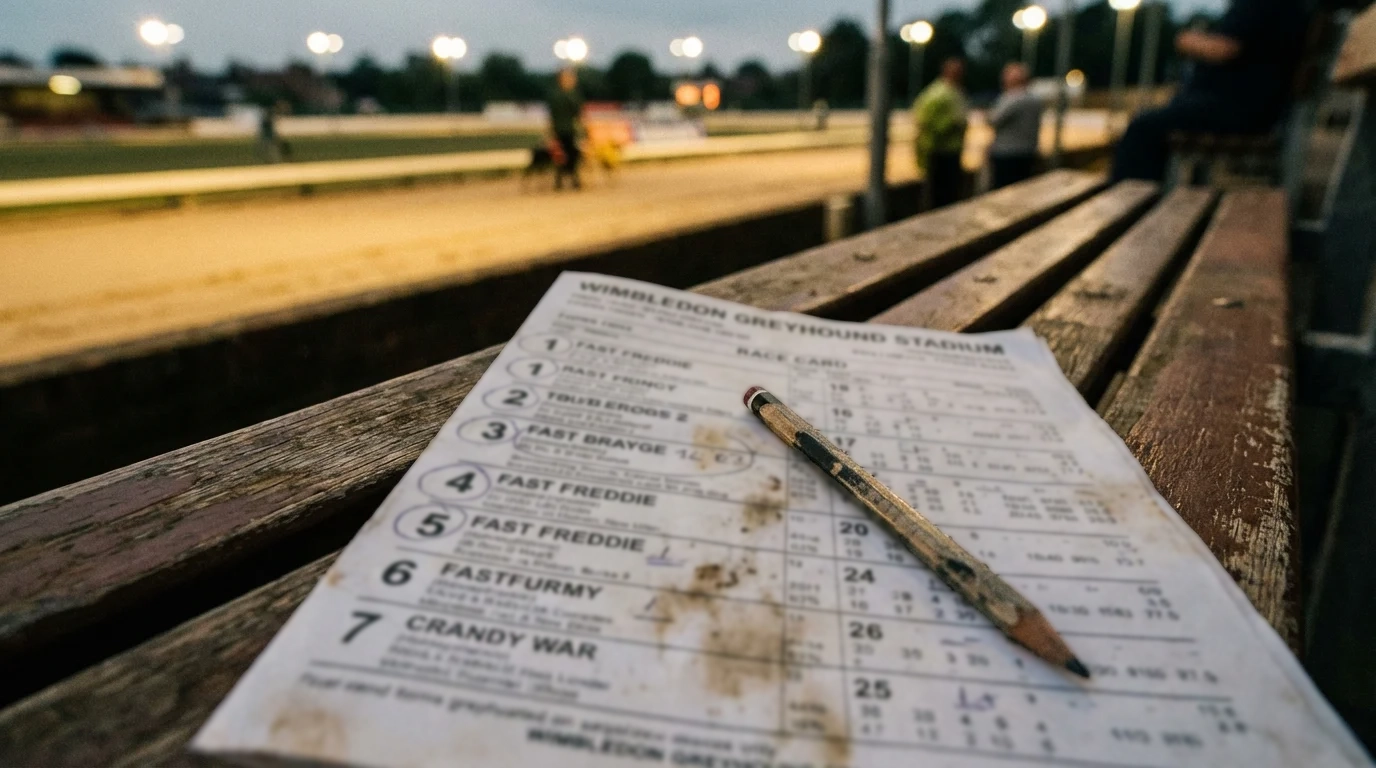
What Form Numbers Mean
Form figures in greyhound racing are a compressed record of a dog’s recent race finishes, displayed as a sequence of numbers that read from left to right — oldest run first, most recent run last. A form line of 3-1-2-4-1 tells you the dog finished third, then first, then second, then fourth, then first in its last five races. It’s a snapshot of trajectory: where the dog has been, and implicitly, where it might be heading.
The numbers 1 through 6 correspond to finishing positions. A “1” means the dog won. A “6” means it finished last in a six-runner field. Between those extremes, each number carries its own signal. Consistent low numbers — 1s, 2s, 3s — indicate a competitive dog. Consistent 5s and 6s suggest a dog struggling at its current grade. Mixed figures — 1-5-2-6-1 — point to inconsistency, which could mean the dog is sensitive to trap draw, conditions, or the quality of opposition.
Some form displays include additional symbols. A “0” or a dash can indicate a non-finish — the dog was pulled up, fell, or was involved in a void race. An “F” sometimes appears for a faller, and “R” for a refused-to-race. These non-standard results are important: a dog with an “F” in its form had a disruptive experience that may affect its confidence or willingness in subsequent races. A “0” warrants investigation — what went wrong?
The depth of form shown varies by platform. Most racecards display the last six runs. Form databases like Timeform and GreyhoundStats may show ten, twenty, or the dog’s full career record. For day-to-day betting purposes, the last five or six runs are the most relevant — they capture the dog’s current form cycle, which in greyhound racing is short. A dog that was winning four months ago might be a completely different proposition today.
One critical point: form figures tell you what happened, not why. A “5” could mean the dog ran badly. It could also mean the dog was badly crowded on the first bend and never recovered, or that it was slow away from a trap it doesn’t suit. The finishing position alone doesn’t distinguish between a poor performance and an unlucky one. For that, you need the running comments — the abbreviations that describe how the race unfolded. Form figures and running comments together give you the full picture; form figures alone give you an incomplete one.
Master form figures at Kinsley on the kinsleygreyhound homepage.
Reading the Last Five Runs
The last five runs are where most form analysis begins, and reading them properly means looking for patterns rather than individual results. A single race tells you very little. Five races tell you a story.
Start by scanning for trend. Is the form improving (positions getting lower), declining (positions getting higher), or stable? A dog showing 4-3-3-2-1 is on a clear upward trajectory — each run is at least as good as the last, and the most recent run is a win. This pattern suggests the dog is in peak form and the trainer has found the right conditions. A dog showing 1-2-3-4-5 is heading the other direction, and backing it on the basis that “it was winning recently” ignores the trend.
Next, look for consistency. A form line of 2-2-3-2-2 might not look exciting — no wins — but it describes a dog that consistently finishes in the first three. In the right race, at the right odds, this kind of consistency is more bankable than a dog showing 1-6-1-5-1, which wins one in three but is unpredictable in between. Consistent place-formers are particularly useful for each-way betting, where the place return matters as much as the win.
Then check for outliers. If the form reads 2-1-1-6-1, that sixth-place finish in the fourth run demands investigation. Was it a different track? A different distance? Did the running comments show interference? One bad run in an otherwise strong sequence is often explainable and doesn’t necessarily diminish the dog’s prospects. But if there’s no obvious excuse — the dog had a clear run and simply performed poorly — the outlier might indicate an underlying issue that could resurface.
Finally, consider the context of each run. A “1” in a weak A8 race is not the same as a “3” in a competitive A3 race. Form figures don’t carry grade information by themselves, so you need to cross-reference with the grade and distance of each race. A dog that was finishing third in A4 company and has now been dropped to A6 is potentially well-handicapped. A dog that was winning in A8 and has been promoted to A5 might be out of its depth. The numbers need context.
Form Across Different Tracks
Greyhound form does not travel seamlessly between tracks. A dog that races brilliantly at one venue may struggle at another, and understanding why is essential for anyone betting on meetings across multiple stadiums.
The primary variable is track geometry. Each GBGB-licensed track has a different circumference, bend radius, and distance from the traps to the first bend. Kinsley’s 385-metre circumference produces tight bends and short runs to the first turn. Nottingham has a wider circuit with more gradual bends. Towcester, until its closure and reopening, offered unique undulating terrain. A dog that excels on wide, sweeping bends may struggle with tight turns, and vice versa. The form figures might show a dog winning at Nottingham and finishing last at Kinsley — not because the dog’s ability changed, but because the track demands different physical and tactical attributes.
Track surface is another factor. All UK greyhound tracks use sand, but the composition, drainage, and maintenance vary between venues. A fast track with hard-packed sand produces quicker times and suits speedier dogs. A heavier, deeper surface slows times and favours dogs with stamina. A time of 28.50 seconds over a middle distance at one track is not directly comparable to 28.50 at another, because the surfaces are different.
Grading standards compound the issue. As covered in the grading article, an A3 at one track is not equivalent to A3 at another. The talent pool at each venue determines the competition level within each grade. A dog graded A3 at a major track with deep fields is a different calibre of runner to an A3 at a smaller venue with fewer dogs. Form figures that look identical might represent very different levels of performance.
The practical takeaway is straightforward: weight home-track form more heavily than away form. A dog’s record at the venue it races most frequently is the most reliable guide to its likely performance there. Away runs — particularly first-time runs at a new track — carry more uncertainty and should be assessed with appropriate caution. If a dog is making its debut at Kinsley after racing exclusively at Romford, treat its Romford form as indicative rather than definitive. It might transfer perfectly. It might not.
Form vs Class
There’s a tension in greyhound form analysis between what the numbers show and what the grade context implies. A dog with a form line of 1-1-1-2-1 looks like a machine — but if those wins came in A9, the lowest competitive grade, the form is impressive only within that class. Promote that dog to A6 and the 1-1-1-2-1 might quickly become 4-5-6-5-4.
Class — the grade a dog competes in — determines the quality of opposition it faces. Winning in a lower grade proves the dog is better than modest opponents, but it doesn’t prove it can handle faster, more tactically sophisticated rivals at a higher level. The form figures carry the result but not the difficulty rating. A “3” in an open race against the best dogs at the track is a significantly better performance than a “1” in the lowest grade, but the form figures alone can’t tell you that.
This is where bettors get caught. A dog is promoted after a sequence of wins in lower grades, and the form line looks outstanding. The market prices it short because the recent record is full of ones and twos. But the promotion means the dog is now racing against faster animals, and the form earned at a lower level doesn’t guarantee the same results at the new one. Backing short-priced recent winners that have just been promoted is one of the most common losing strategies in greyhound betting.
The reverse is also true. A dog with a form line of 4-5-3-4-5 in A3 company might be perfectly capable of winning in A5 if it’s dropped. The poor-looking form line disguises the fact that the dog was competing against much faster opposition, and in a lower grade, its ability would place it at or near the front of the field. These class drops produce some of the best value bets in greyhound racing — but only when the poor form was genuinely caused by the higher grade, not by declining ability.
The discipline is to always check the grade alongside the form figures. Every form database shows the grade of each race in the dog’s history. Reading “3-4-5” without knowing whether those results were in A2 or A8 is reading with one eye closed. The numbers gain their meaning from the context, and the grade is the most important piece of that context.
Practical Form Assessment: Putting It All Together
Reading form is not a single skill — it’s a sequence of questions applied to each runner on the racecard. Practised form readers move through these questions quickly, but the process is deliberate and structured. Here’s what it looks like in practice.
Question one: what’s the recent trend? Scan the last five form figures for direction — improving, declining, or stable. This takes three seconds and gives you an immediate frame for the dog’s current cycle.
Question two: what happened in each run? Check the running comments for each of the last five races. Was the form achieved on clear runs or disrupted by interference? Were the good results from ideal trap draws and the bad results from poor ones? The comments add the “why” to the “what” of the form figures.
Question three: what grade and distance were those runs? Cross-reference the form with the grade and distance of each race. A dog moving up in grade is being tested. A dog moving down is expected to improve. A dog switching distance — from sprints to middle distance, or vice versa — is an unknown quantity at the new trip.
Question four: is the dog suited by today’s conditions? Check the trap draw against the dog’s running style. Check the weather against the dog’s surface preferences if you have that data. Check whether the dog has run at this track before and, if so, how it performed. These are the situational factors that the form figures can’t capture but that influence the outcome.
Apply form figures when reading racecards in read racecards.
Question five: does the price reflect all of the above? This is the final filter. A dog with strong form, good running comments, appropriate grade placement, and a favourable draw might still be a poor bet if the odds are too short. Value exists when the probability implied by the odds is lower than the probability your analysis suggests. If everything points to a dog having a 30 percent chance of winning but the market prices it at 40 percent (implied by the odds), that’s a value bet. If the market prices it at 25 percent, it’s not — regardless of how good the form looks.
This five-question process doesn’t take long once it becomes habitual. For a six-dog race, a competent form reader can assess the full field in ten to fifteen minutes. The payoff is a structured, evidence-based approach to selection that replaces gut feeling with informed judgement. The form figures are the starting point, not the conclusion. What you do with them — the questions you ask, the context you apply, the value assessment you make — is what separates recreational punting from disciplined betting.
