
How Greyhound Betting Odds Move Before a Race
 Available in US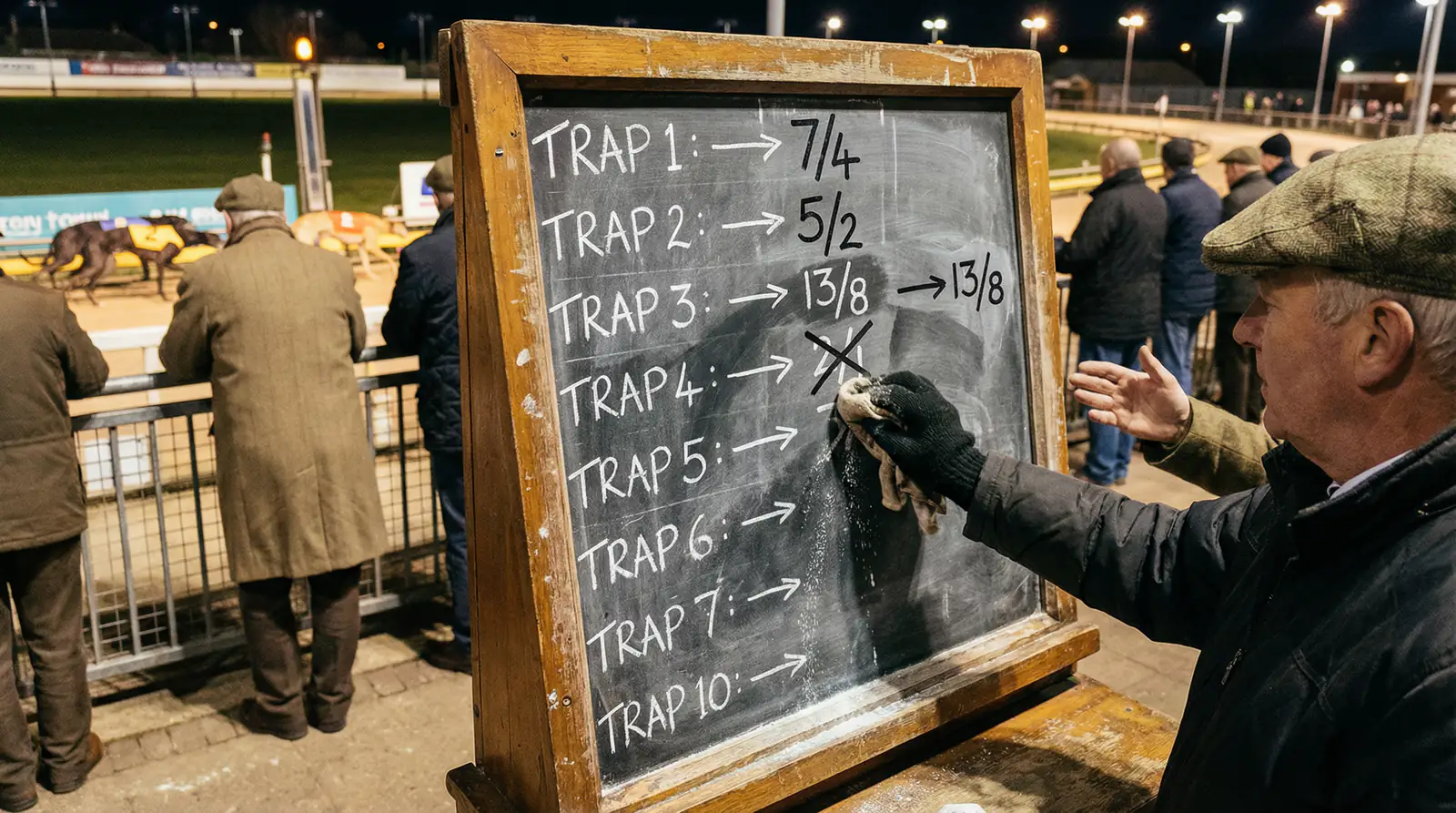
How Greyhound Betting Markets Form
Greyhound betting markets don’t appear fully formed. They’re built in stages, starting from the moment the racecard is published and evolving continuously until the traps open. Understanding this formation process — who sets the initial prices, what influences them, and how they change — gives you a framework for interpreting the numbers on your screen rather than taking them at face value.
The process begins with the bookmaker’s trading team. For evening greyhound meetings, initial prices are typically set in the morning based on the traders’ assessment of each dog’s chance. This assessment incorporates form figures, trap draw, grade, recent times, trainer record, and the competitive profile of the full field. The traders are experienced — many are former racing professionals or long-standing odds compilers — and their initial prices are generally in the right range. They’re not perfect, and they’re not meant to be: the opening prices are the starting point of a market, not its conclusion.
Once the prices are published, punters begin to bet. Money flows into certain selections and away from others, and this flow is the engine of market movement. A bookmaker’s odds are not static predictions; they’re dynamic indicators that adjust in real time to balance the book. When a dog attracts heavy betting, the bookmaker shortens its odds (reducing the potential payout per pound staked) to limit their exposure. When a dog attracts little interest, its odds drift outward (increasing the potential payout) to attract money and balance the risk.
The on-course market at the track operates in parallel. On-course bookmakers at GBGB venues display their own odds on boards at the trackside, and these prices respond to the bets placed by trackside punters. The on-course market is typically smaller in volume than the online market, but it carries disproportionate influence because it ultimately determines the Starting Price — the official price at the off that settles all SP bets.
By the time the race is a few minutes from the off, the online prices, the on-course prices, and any exchange market prices have all converged towards a consensus. The final prices represent the aggregate view of the betting public — informed punters, casual bettors, and the bookmakers’ own assessments combined. Whether that consensus is correct on any individual race is another matter entirely.
Understand how betting odds move on the kinsleygreyhound homepage.
Why Odds Shorten or Drift
The mechanics are simple: odds shorten when money comes in, and drift when it doesn’t. But the reasons behind the money flow are varied, and not every shortening or drift carries the same information value.
Odds shorten for several reasons. The most informative: genuine knowledge. Someone close to the kennel — a trainer, an owner, an informed associate — knows the dog is in excellent condition, has trialled well, and is expected to run its best race. That person, or people they’ve spoken to, backs the dog, and the weight of money forces the price down. This is the “informed money” that the market tries to detect, and it’s the type of shortening that carries the most predictive value.
A less informative cause of shortening: public money on obvious form. The dog with the best recent results and the lowest trap number attracts casual bettors who don’t look further than the headline form. Their money shortens the price, but the shortening reflects popularity rather than private information. The dog might well win — it’s the favourite for a reason — but the odds have been compressed by volume rather than insight, and the value may already be gone.
Odds drift when a dog fails to attract expected support. This can happen because bettors have identified form concerns (a declining trend, a poor trap draw, a change in conditions), because money has flooded towards a rival, or because late information (a poor parade, a kennel report) has reduced confidence. Like shortenings, drifts can be informative or misleading. A drift caused by knowledgeable defection is a warning sign. A drift caused by casual money landing on another dog for no analytical reason is just noise.
The volume of greyhound betting is lower than horse racing, which means individual large bets have a proportionally bigger impact on the market. A single hundred-pound bet on a 5/1 shot might move it to 4/1 at a smaller meeting, while the same bet in a horse racing market might barely register. This sensitivity to individual bets makes greyhound market movements more volatile and sometimes less reliable as information signals than their horse racing equivalents.
Steam Moves Explained
A steam move is a sudden, sharp contraction in a dog’s odds — a price collapse that happens in minutes rather than hours. The term comes from horse racing, where significant market moves are colloquially described as a horse “steaming in,” but the phenomenon occurs in greyhound markets too, particularly in higher-profile meetings and open races.
The classic steam move pattern: a dog opens at 6/1 in the morning, trades around that price through the day, and then in the final twenty minutes before the race drops rapidly to 3/1 or shorter. The speed and scale of the move distinguish it from gradual drift. Something has triggered a concentrated burst of money on that selection, and the market is responding by cutting the price aggressively.
In horse racing folklore, steam moves are associated with insider knowledge — stable money, jockey confidence, a whisper from the training ground. In greyhound racing, the picture is murkier. Some steam moves do reflect genuine inside information: a trainer’s connections backing a dog they know is in peak condition for a specific race. But the greyhound market is thin enough that a steam move can also be triggered by a single large bettor acting on their own analysis, by a tipping service publishing a selection to its subscribers, or by a cascade effect where early bettors cause a shortening that attracts more money from observers who interpret the move as a signal.
The reliability of steam moves as predictive indicators is mixed. Academic and industry analysis of greyhound markets suggests that selections experiencing late steam moves do win more often than their initial odds implied, but not enough to produce a profit at the shortened price after accounting for the market overround. In other words: the market is right to shorten these dogs, but the shortening typically goes far enough that the value has evaporated by the time you could act on the signal. By the time you see the steam move, the profitable price is gone.
For practical purposes, steam moves are most useful as information inputs rather than betting triggers. A dog steaming from 6/1 to 3/1 tells you that significant money has arrived, which might reflect genuine confidence. If you’d already identified that dog from your own analysis, the steam move confirms your view. If you hadn’t considered it, the move prompts you to look more closely. But chasing steam moves — backing a dog purely because its price is falling — is a reactive approach that consistently fails to produce positive returns.
Reading the Market for Information
The betting market is an information aggregation system. Every pound staked represents someone’s opinion about the outcome, and the odds at any moment represent the weighted average of all those opinions. Reading the market — extracting useful information from price movements — is a skill that supplements your own form analysis rather than replacing it.
The first thing to watch is relative movement. In a six-runner race, if one dog shortens significantly while the others remain stable, money is arriving for that specific selection. If two dogs shorten while the others drift, money is divided between two fancied runners. If the entire market is shifting — favourites shortening, outsiders drifting — the market is simply crystallising around the expected form. The most informative scenario is when one dog moves against the rest of the market: shortening while another expected favourite drifts. This crossover suggests a specific re-evaluation, not just general market formation.
The second signal is the timing of the movement. Early-morning moves, which happen when the first prices are published, tend to reflect the views of professional bettors and value seekers who want to lock in prices before the market adjusts. Afternoon moves are a mix of informed and casual money. Late moves — in the final ten to fifteen minutes — carry the most weight as potential information signals, because late bettors are acting on the most current assessment and sometimes on trackside observation of the dogs’ parade behaviour.
Comparing online prices to exchange prices adds a further dimension. The Betfair Exchange, where punters bet against each other at self-set odds, operates with different participants and incentives to the traditional bookmaker market. A dog that’s 4/1 with bookmakers but 5/1 on the exchange might be overbet in the bookmaker market relative to the exchange consensus. Discrepancies between the two markets sometimes highlight dogs where the bookmaker price has been pushed down by casual money rather than informed analysis.
The limitation of market reading in greyhound racing is the thinness of the market. In horse racing, major race markets involve millions of pounds and thousands of participants, making the price a robust signal. Greyhound markets, particularly at smaller meetings, involve much less money and fewer participants. A market that can be moved by a single large bet is a noisy signal — the movement might reflect knowledge, or it might reflect one person’s uninformed hunch. Treat greyhound market information as one input among several, not as the defining indicator.
Acting on Price Movement
Watching the market and acting on it are two different skills. The market provides information. Your response to that information depends on your own analysis, your confidence level, and your betting strategy.
If a dog you’ve already selected on form begins to shorten, the market is confirming your view. This is reassuring but doesn’t require any action — your bet is either already placed at the earlier price (which is now better than the current one) or you need to decide whether the shortened price still offers value. A dog you assessed at 5/1 that’s now 3/1 might no longer be worth backing, even if the market agrees it should win. The question is always value relative to the price, not just agreement about the likely outcome.
If a dog you’ve selected begins to drift, the market is offering a different opinion. This is uncomfortable but potentially profitable. If the drift is caused by late information you weren’t aware of — a poor parade, a reported fitness concern — it might be wise to reconsider. If the drift appears to be market noise — money arriving for a rival for no obvious reason — your original assessment might still be correct, and the drifting price represents better value than the one you initially assessed. The key question is: has anything changed about the dog, or has something changed about the market? The first is a reason to reassess. The second might be a reason to bet with more enthusiasm.
Compare starting vs early price when odds are moving in starting vs early price.
For punters who don’t take early prices and rely on SP, market movements before the race are still informative even though they don’t affect the price you’ll receive. Watching the market tells you what the betting public thinks, which calibrates your own view. If you fancy a dog at 4/1 and it drifts to 6/1, you should ask why. If you fancy a dog at 6/1 and it shortens to 3/1, you know the market agrees but the SP you’ll receive might be less generous than you’d like.
The discipline is to let the market inform your decisions without letting it make them. Your analysis should lead; the market should validate, challenge, or refine. Punters who form their own views, then check the market for confirmation or contradiction, make better decisions than those who watch the market first and try to construct analytical justification after the fact. The market is a tool. The analysis is the foundation.
