
Major Greyhound Races in the UK: Derby, St Leger, Puppy Derby
 Available in US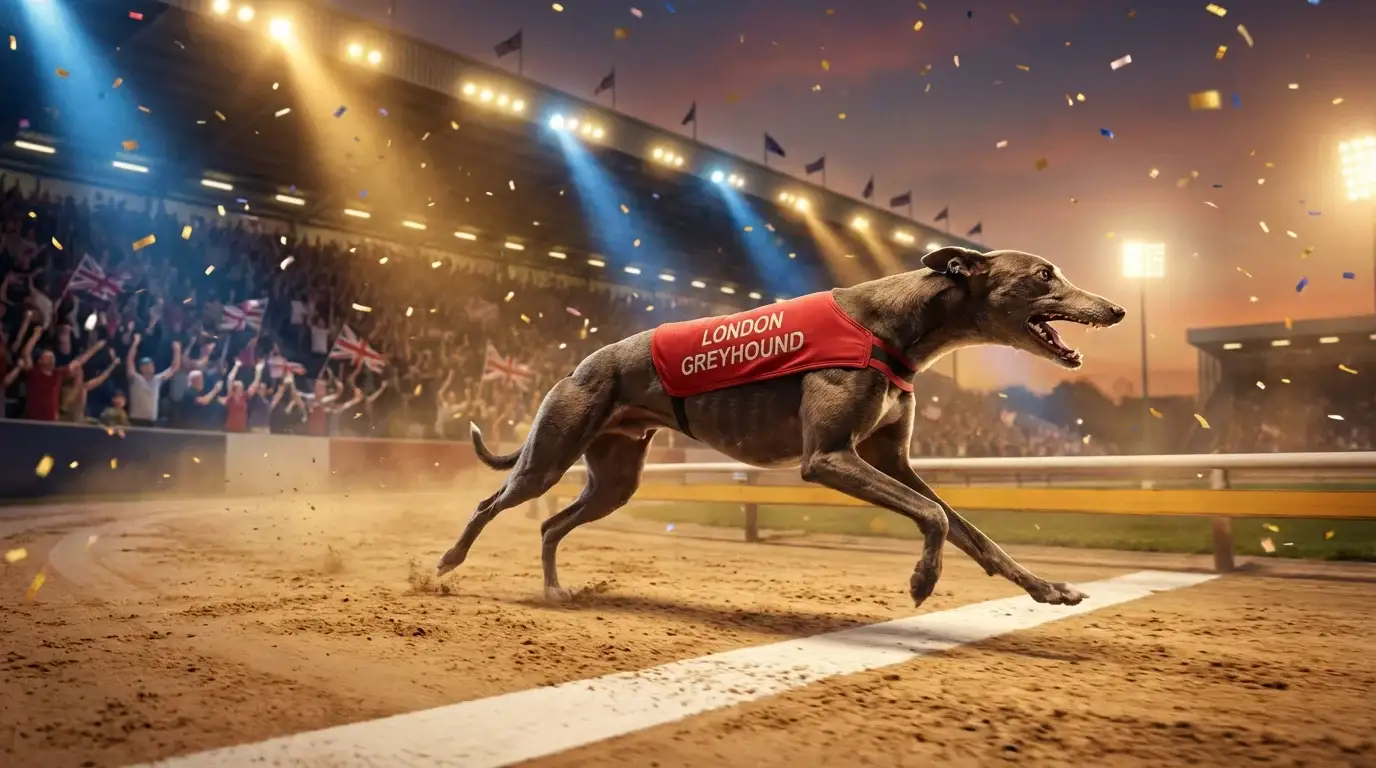
The English Greyhound Derby
The English Greyhound Derby is the single most prestigious event in British greyhound racing — the sport’s equivalent of the Epsom Derby in horse racing or the FA Cup Final in football. First run in 1927 at White City Stadium in London, the Derby has been the race that every owner and trainer aspires to win, and the event that draws the widest public attention to a sport that otherwise operates below the mainstream radar.
The format follows a knockout structure. The competition begins with first-round heats, typically run over consecutive evenings, with the fastest qualifiers progressing to the second round, then quarter-finals, semi-finals, and the final. The total number of entries varies by year, but the competition usually starts with over a hundred dogs and reduces to a final field of six. The progression through the rounds is determined by finishing positions and times, with the fastest losers sometimes earning repechage places.
The Derby is run over a standard middle distance — the specific trip depends on the host track’s dimensions. The event has moved between venues over its history, reflecting the closures that have reshaped the UK greyhound landscape. White City hosted the Derby for decades before its closure. Wimbledon took over and became the Derby’s long-time home until that stadium closed in 2017. The event subsequently moved to Towcester, then to Nottingham, with the host venue subject to ongoing commercial and logistical considerations. The peripatetic history of the Derby mirrors the broader story of the sport — a prestigious event seeking a permanent home in a contracting stadium network.
The prize money for the Derby final is the largest in UK greyhound racing, typically running to tens of thousands of pounds for the winner, with significant purses for the placed dogs. The financial reward, combined with the prestige and the breeding value that a Derby victory confers on the winning greyhound, makes the event the centrepiece of the racing calendar.
For bettors, the Derby offers a different betting experience to regular graded racing. Ante-post markets open weeks before the first heats, and the odds on individual dogs shift dramatically as the competition progresses. The heat results provide real form data on the specific track and conditions of the competition, which makes the later rounds increasingly informative. By the semi-final stage, bettors have extensive current data on every surviving contender, and the market pricing becomes correspondingly sharper. The final itself attracts more betting interest than any other single greyhound race of the year.
Follow all major greyhound races on the kinsleygreyhound homepage.
The Greyhound St Leger
The Greyhound St Leger is the second most prestigious event in the UK greyhound calendar, traditionally run over a staying distance that distinguishes it from the middle-distance Derby. The St Leger tests endurance and tactical intelligence over six bends — a demanding trip that identifies the best stayers in training and rewards dogs with the stamina and competitive resilience to sustain their effort over a longer race.
The name echoes the classic St Leger horse race, and the greyhound version carries similar connotations of quality and heritage within the sport. First run in 1928, just a year after the inaugural Derby, the St Leger quickly established itself as the premier staying event in British greyhound racing. The competition format mirrors the Derby’s knockout structure: heats, quarter-finals, semi-finals, and a final, with progression based on performance.
The staying distance means the St Leger field is drawn from a different population of dogs than the Derby. Sprint specialists and purely pace-dependent middle-distance runners are unsuitable for the trip, and the competition attracts the sport’s best stayers — dogs whose form over six bends demonstrates the endurance and late-race speed that the distance demands. Some trainers specifically target the St Leger as their kennel’s primary championship objective, building their dogs’ fitness and race programmes around the event.
The betting dynamics of the St Leger differ from the Derby because staying form is harder to assess and compare than middle-distance form. Fewer races are run at staying distances in regular graded cards, so the form database for stayers is thinner. This information gap can create value in the St Leger markets — dogs with strong but under-publicised staying form may be overpriced relative to their actual ability over the trip. Conversely, the favourite for the St Leger might attract disproportionate money simply because it’s the most visible stayer, even if its staying form is only marginally better than its rivals’.
Prize money for the St Leger final is substantial, though typically less than the Derby. The event attracts significant betting interest from punters who specialise in staying races and appreciate the different tactical dimensions that the longer distance introduces.
The Puppy Derby and Classic Events
The Puppy Derby is the premier event for young greyhounds — dogs in their first season of racing, typically under two years old. The competition identifies the most talented newcomers in the sport and often provides an early indicator of which dogs will go on to compete at the highest level as they mature. Winning the Puppy Derby is a career-defining moment for a young greyhound and a significant achievement for the trainer and owner.
The format follows the same knockout structure as the senior Derby and St Leger: heats through to a final, with the field narrowed at each stage. The Puppy Derby is run over a middle distance, and the competition tests many of the same attributes as the senior Derby — early pace, tactical awareness, the ability to handle the pressure of competitive racing — but with the additional uncertainty of youth. Puppies are still developing physically and temperamentally, and their form can be volatile. A dog that looks brilliant in the first-round heats might regress in the semi-final, or a slow starter might improve dramatically between rounds as it gains experience.
This developmental volatility makes the Puppy Derby a fascinating betting event. The form from the early rounds is fresh and directly relevant, but the potential for rapid improvement (or regression) among young dogs introduces an extra layer of uncertainty that the market doesn’t always price accurately. Punters who watch the heats closely and assess how each puppy is developing — not just whether it won, but how it ran, how it handled the bends, how it responded to pressure — can sometimes identify value that the odds don’t reflect.
Beyond the Derby, St Leger, and Puppy Derby, the UK greyhound calendar includes several other classic and prestigious events. The Cesarewitch is a marathon championship run over an extended distance. The Gold Collar at Catford was one of London’s most prestigious events before the track’s closure. The Laurels at various host tracks, the Select Stakes, and the Champion Stakes are all competitions that carry significant prize money and prestige within the sport. Each event has its own distance, venue, and competitive character, contributing to a championship calendar that runs from spring through autumn.
TV Trophy, Gymcrack and Other Feature Events
Below the classic championship tier, UK greyhound racing features a layer of televised and sponsored events that punctuate the regular racing schedule and provide competitive highlights beyond the day-to-day graded programme.
The TV Trophy — named for its association with televised greyhound coverage — is one of the most recognisable sub-classic events. Run at various host tracks over the years, the TV Trophy attracts high-quality fields and significant betting interest, partly because the televised coverage (typically on Sky Sports Racing) gives the event a profile that standard graded races don’t receive. The combination of a strong field, a defined competition structure, and broadcast exposure makes the TV Trophy one of the most-bet single greyhound races outside the classics.
The Gymcrack is another established feature event, traditionally associated with sprint racing. The name has been used for competitions at various tracks, and the event targets the best sprinters in training. Sprint championships are less common than middle-distance events in the UK greyhound calendar, which gives the Gymcrack and similar sprint features a distinctive competitive niche. The racing is fast, the fields are sharp, and the betting markets are influenced by the sprint-specific form factors — trap draw, early pace, trap-break consistency — that dominate over two bends.
Individual tracks also stage their own feature events: local derbies, anniversary races, and sponsored competitions that carry enhanced prize funds and attract stronger-than-usual fields. At Kinsley, track-specific feature events bring together the best dogs from the local training pool and occasionally draw entries from further afield. These local features offer bettors a different challenge to regular graded racing: the fields are often more competitive, with several dogs of similar ability rather than the usual mix of fancied runners and makeweights.
Invitation and challenge events add further variety. Some tracks stage invitation races where specific trainers or dogs are invited to compete, creating fields that don’t follow the normal grading structure. These events are harder to assess from standard form data because the dogs may be racing outside their usual grade, at an unfamiliar track, or against opponents they wouldn’t normally meet. For bettors, invitation events are high-uncertainty propositions that reward deep knowledge of the specific dogs and trainers involved.
Ante-Post Betting on Major Events
The major championship events — the Derby, St Leger, Puppy Derby, and the leading feature races — all offer ante-post betting markets that open weeks or even months before the competition begins. Ante-post betting is a distinct discipline within greyhound wagering, with its own risks, rewards, and strategic considerations that differ substantially from betting on individual races.
The fundamental difference is non-runner risk. In ante-post betting, if your selection is withdrawn from the competition — through injury, form decline, trainer decision, or any other reason — your stake is lost. There’s no void bet, no refund, no dead-heat deduction. The dog doesn’t need to lose on the track for you to lose your money; it just needs to not participate. This non-runner risk is the price you pay for the potential reward of securing an early price before the market adjusts.
The reward is value capture. Ante-post prices on greyhound championships are set based on pre-competition assessments of each dog’s chance. These assessments are educated guesses — informed by trial form, graded-race performance, trainer reputation, and competition history — but they lack the precision of a market formed from current, race-specific data. As the competition progresses and heat results provide real information, the market sharpens. A dog priced at 16/1 ante-post might be 4/1 by the semi-final stage after a series of impressive heat victories. The ante-post bettor who backed at 16/1 has captured enormous value — provided the dog remains in the competition.
The strategic approach to ante-post betting on greyhound championships involves balancing the value of early prices against the non-runner risk. One method is to bet small ante-post stakes on several contenders at large prices, accepting that some will be withdrawn but hoping that the survivors include at least one whose price has shortened significantly by the later stages. This portfolio approach spreads the non-runner risk across multiple selections and only needs one to progress for the overall position to be profitable.
Check the full racing schedule in racing schedule.
Another approach is to wait until the first-round heats have been run, which eliminates some non-runner risk (dogs that make it through the first round are at least competing) while still offering prices that haven’t fully converged on the eventual final market. The semi-final stage offers even more information but less value, as the market has tightened to reflect the known form from the competition itself.
For most punters, ante-post betting on greyhound championships is an occasional, supplementary activity rather than a core part of their betting week. The events happen a handful of times per year, the non-runner risk is real and unhedgeable, and the bet sits open for weeks rather than settling in thirty seconds. But for those who enjoy the long-game aspect of following a competition from heats to final with money on the line, ante-post greyhound betting offers a compelling combination of narrative, analysis, and reward.
