
UK Greyhound Track Guide: Distances, Trap Stats & Track Profiles
 Available in US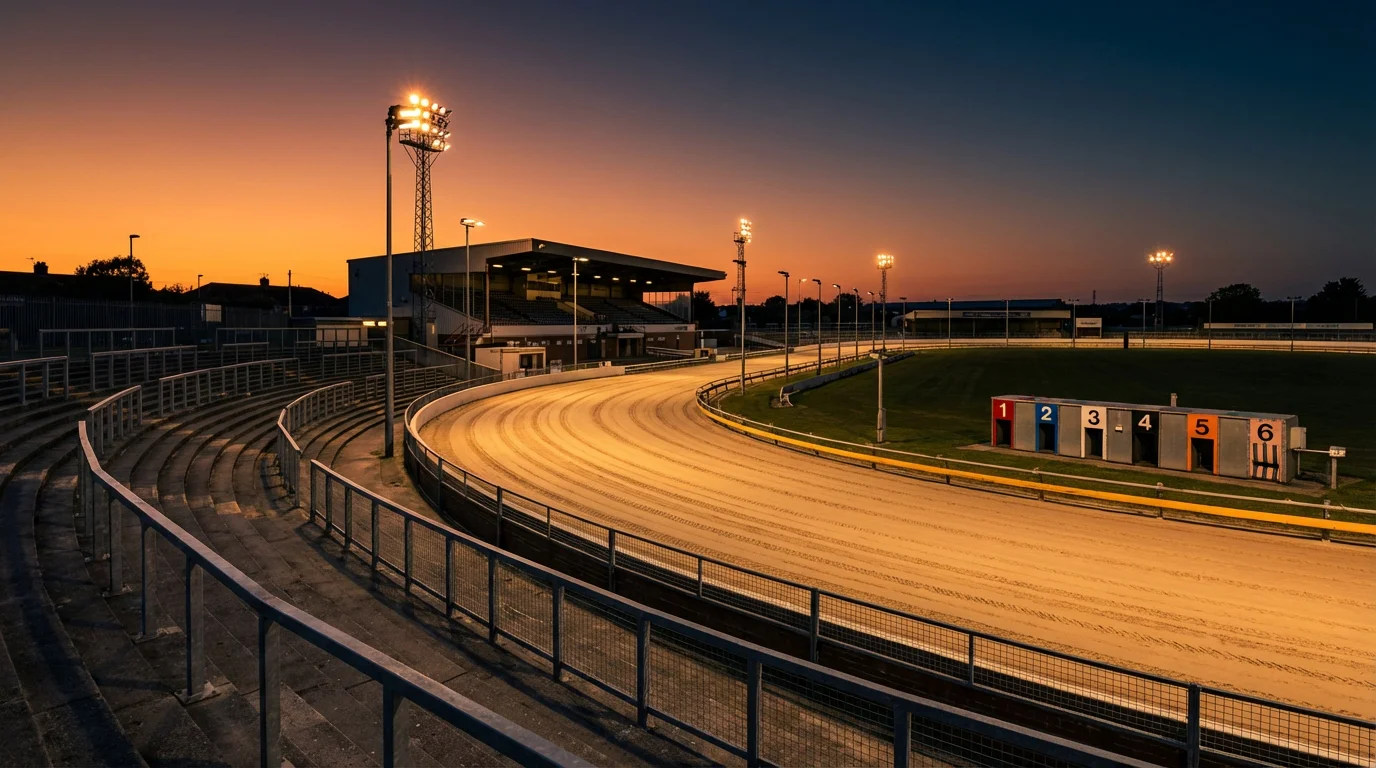
Every UK Track Has a Personality — Here’s How to Read It
Track circumference isn’t a trivial stat — it changes the race. A greyhound running at a 400-metre track experiences wider bends, a longer straight, and more room to manoeuvre around the first turn. The same dog at a 385-metre track faces tighter geometry, a shorter run to the first bend, and a compressed field where positional errors in the opening strides are harder to recover from. These are not marginal differences. They shape which dogs win, which trap draws matter, and which betting approaches hold up across a full card.
The UK currently has 20 GBGB-licensed greyhound stadiums, each with its own physical characteristics. Circumferences range from around 380 metres at the smallest tracks to over 460 metres at the largest. The distances on offer vary too — some tracks run sprints as short as 210 metres, others offer marathon trips beyond 900 metres. The hare type, the surface composition, the bend radius, the camber, the distance from traps to the first bend — all of these differ from venue to venue, and all of them influence race outcomes in measurable ways.
For bettors, this means that form at one track does not automatically transfer to another. A dog with a string of wins at Romford — a busy, well-graded circuit — might struggle at Kinsley, where the tighter bends demand a different kind of agility and the compressed field rewards early pace over raw finishing speed. Trainers know this. Racing managers know this. The bookmakers price it into their markets, at least partially. The question is whether punters know it too, and most don’t — they see a form line of 1-1-2-1 and assume the dog will replicate that performance regardless of where it runs next.
Access the full Kinsley track guide on the kinsleygreyhound homepage.
Track personality is built from a handful of measurable variables. Circumference determines bend geometry: smaller tracks have tighter turns, which favour dogs with good cornering ability and punish those that run wide. Distance to the first bend from the traps determines how much early pace matters — a short run gives front-runners less time to establish position but also less time for wide runners to get crowded. Surface condition, which varies with weather and maintenance, affects grip and therefore times. Even the hare type matters: the Swaffham McGee outside hare used at some tracks runs differently from the McGee inside hare used at others, and dogs can show preferences.
Understanding these variables does not require an engineering degree. It requires paying attention to a few data points before you open the racecard. Which track is this? What is its circumference? What distances does it offer? Does it have a known trap bias? How do times compare to other tracks at similar distances? These questions take seconds to answer and can save you from backing a dog whose form was built on a circuit nothing like the one it is running on tonight.
What follows is a guide to the tracks that matter most for UK greyhound bettors — their dimensions, their tendencies, and the data patterns that distinguish one oval from another.
Track Profiles: The Big Five
Towcester and Kinsley couldn’t be more different if they tried. One is the largest greyhound circuit in the country, set in rolling Northamptonshire countryside, hosting the English Greyhound Derby. The other is a compact West Yorkshire oval where tight bends and a short run to the first turn create a style of racing that rewards tactical speed over raw stamina. Between these two extremes sit the tracks that handle the bulk of UK greyhound betting: Romford, Nottingham, and Sheffield. Together, these five venues illustrate the range of what a UK greyhound track can be.
Kinsley operates on a 385-metre circumference, making it one of the tightest licensed tracks in Britain. It races over four distances: 268, 462, 650, and 844 metres. The hare is a Swaffham McGee outside runner. Racing takes place on Monday, Wednesday, Friday, and Sunday evenings. Kinsley’s defining feature from a betting perspective is its low favourite strike rate — around 31-32% in recent seasons, one of the lowest in UK graded racing. The compact geometry compresses the field into the bends, creating more interference and more unpredictable outcomes. Dogs with clean early pace and the ability to hold a rail position through tight turns tend to outperform here. Stayers face an additional challenge: the 844-metre trip involves multiple laps of a small circuit, which amplifies cornering demands.
Romford sits at the other end of the spectrum in feel if not quite in raw dimensions. Its circumference is approximately 350 metres — actually smaller than Kinsley — but wider bends relative to the track size and a more open configuration give races a different tempo. Romford is one of the busiest tracks in the country by meeting frequency and betting volume, running multiple cards per week including daytime fixtures. Distances range from 225 metres up to 925 metres. The track hosts regular open races and is a common venue for RPGTV-televised fixtures. Its higher betting liquidity means markets are generally more efficient — there is less mispricing — but the volume of racing also means form data is plentiful. Romford’s favourite win rate tends to sit a few points above Kinsley’s, reflecting the slightly more predictable outcomes that wider bends produce.
Towcester is the outlier. At approximately 420 metres in circumference, it is comfortably the largest licensed track in the UK and its wide, sweeping bends reward galloping dogs with stamina rather than quick, agile corner-cutters. The track hosts the English Greyhound Derby, the biggest event in the greyhound racing calendar. Distances range from 260 metres to 906 metres. The going at Towcester is heavily influenced by weather — the track is more exposed than urban venues and drains differently. For bettors, Towcester form is among the hardest to translate to other tracks because the circuit is so physically distinct. A dog that handles Towcester’s long bends may struggle on a tighter oval, and vice versa.
Nottingham operates on a circuit of around 437 metres with distances from 305 to 925 metres. It is a well-maintained track with consistent surface conditions and a reputation as a fair-running circuit — meaning trap bias is less pronounced than at some smaller venues. Nottingham hosts a regular schedule and draws dogs from trainers across the Midlands and North. Its moderate circumference produces racing that sits between the extremes of Kinsley’s compression and Towcester’s expansiveness, making it a useful benchmark track. Dogs that perform consistently at Nottingham tend to be versatile enough to transfer form to other mid-sized venues.
Sheffield, based at the Owlerton Stadium, runs on a circumference of approximately 425 metres with distances from 280 to 934 metres. It is one of the sport’s historic venues and hosts several prestigious events. Sheffield’s track characteristics sit close to the UK average for licensed stadiums, which makes it another solid reference point for form analysis. The track supports a healthy mix of graded and open races, and its location draws from a strong pool of Northern-based trainers. Weather can be a factor — Sheffield’s altitude and exposure to Northern weather systems mean going conditions shift more frequently than at sheltered urban tracks.
Trap Bias by Track: What the Data Shows
Overall, trap 3 edges it. But at individual tracks, the story changes. Across UK greyhound racing as a whole, the middle traps — 3 and 4 — tend to produce marginally more winners than the rails or the wide berths. This is partly a function of seeding: racing managers assign dogs to traps based on running style, and the middle traps receive dogs that are classified as neither strong railers nor committed wide runners. These dogs tend to be more versatile, which gives them a slight statistical advantage in aggregate. But aggregate figures hide the real action, which happens at track level.
Trap bias is the tendency for certain trap positions to win more or less often than chance would predict at a specific track. In a perfectly unbiased six-runner race, each trap would win approximately 16.7% of the time over a large enough sample. In practice, no track hits that number evenly across all six traps. The deviations are caused by physical factors: the angle and distance of the run to the first bend, the tightness of the bends themselves, and the positioning of the hare rail relative to the inside running line.
At tracks with a short run to the first bend, trap 1 tends to outperform. The logic is simple geometry. The dog in trap 1 has the shortest distance to cover to reach the inside rail, and if it gets there first, it holds the shortest route through the bend. Dogs in traps 5 and 6 must either cut across the field — risking interference — or swing wide, adding distance to their run. At compact tracks like Kinsley, this effect is amplified. The 385-metre circumference produces bends that are tighter relative to the field width, which means the advantage of being on the rail through those bends is proportionally greater. Data from recent seasons at Kinsley shows trap 1 consistently winning at a rate above the 16.7% baseline, sometimes pushing into the low 20s as a percentage of all races.
At wider tracks, the bias flattens. When bends are more gradual, the distance penalty for running wide is smaller, and dogs in the outer traps have more room to find their position without colliding with the field. Towcester, with its sweeping bends, shows relatively even trap statistics compared to tighter circuits. This doesn’t mean trap draw is irrelevant at wide tracks — it still matters — but the effect size is smaller and less reliable as a betting factor.
Sprint races amplify trap bias because there are fewer bends to redistribute positions. A 268-metre sprint at Kinsley involves two bends. If a dog secures the rail on the first bend from trap 1, there are only two turns for the field to change order. In a 650-metre race at the same track, four bends give dogs more opportunities to recover from a poor early position. This distance-dependent bias effect is consistent across UK tracks: sprint races show stronger trap bias than middle-distance or staying races at the same venue.
The practical application for bettors is straightforward but underused. Before assessing form for any race, check whether the track has a known trap bias at the relevant distance. If you are looking at a 268-metre sprint at a track where trap 1 wins 22% of sprints and trap 6 wins 12%, that ten-point gap is significant enough to adjust your assessment. A dog with slightly weaker form but a favourable trap draw can be a better bet than the form pick in an unfavourable berth. Most punters skip this step entirely, which is precisely why the edge exists.
Trap bias data is available on several platforms. Sites like greyhoundstats.co.uk publish trap win percentages broken down by track and distance. The sample sizes need to be large enough to be meaningful — a few dozen races can produce misleading patterns — but data spanning a full season or more gives a reliable picture. Checking this data adds less than a minute to your race analysis and provides a structural layer of information that pure form analysis alone cannot replicate.
Race Distances: Sprint, Middle, Stay and Marathon
The prefix on the grade tells you the distance — D for sprint, A for middle, S for stayer. This shorthand is the foundation of how UK greyhound racing organises its competitions, and understanding it tells you immediately what type of race you are looking at and what type of dog is likely to contest it.
Sprint races, designated with a D prefix in the grading system, cover the shortest distances at each track — typically two bends. At Kinsley, the sprint distance is 268 metres. At Romford, it starts at 225 metres. Sprint races are explosions of pure pace: the traps open, the dogs hit full speed within a few strides, and the race is often decided by the first bend. Early pace and trap draw dominate. A dog that breaks fast and corners cleanly will lead into the home straight with little chance for the field to catch it. Sprints are the format where trap bias is strongest and where front-runners have the highest conversion rate. They are also the format where form is most volatile — a slow break, a bump on the first bend, and a dog that won its last three sprints can finish fifth.
Middle-distance races carry the A prefix and cover four bends. This is the bread and butter of UK greyhound racing — the majority of graded races at most tracks fall into this category. At Kinsley, the middle distance is 462 metres. At Nottingham, it is around 500 metres. The extra two bends compared to a sprint introduce more variables: dogs have time to recover from a poor start, closers can make up ground on the final bends, and the race becomes a more complete test of pace, stamina, and tactical ability. Middle-distance form tends to be more reliable than sprint form because the additional distance smooths out the random interference that dominates shorter races. For bettors, this makes middle-distance races the most analysable format — form, times, and trap draw all carry weight, and the better dog wins more often than in sprints.
Staying races use the S prefix and cover six bends or more. Kinsley’s staying distance is 650 metres, with an extended trip at 844 metres. Not all tracks offer staying distances, and those that do often have smaller fields for these races because fewer dogs are bred and trained for the stamina demands. Stayers are a different physical type — typically larger, heavier dogs with the endurance to maintain speed over multiple laps. Going conditions matter more in staying races because the cumulative effect of a soft or heavy surface compounds over six bends. Trap draw, while still relevant, is less decisive than in sprints because there are more bends for positional reshuffling. Staying races also tend to produce less volatile form because the sustained effort required means that class tells — the better dog usually emerges over a longer trip.
Hurdle races, marked with an H prefix, add obstacles to the track. These are not available at every venue and are a niche within the sport, but they offer a distinct betting proposition. Hurdle specialists are dogs that jump cleanly and maintain pace over the barriers. Form in hurdle races is track-specific because the positioning and height of hurdles varies between venues. Some dogs that are moderate over flat distances come alive over hurdles, and vice versa.
Extended races, sometimes carrying an E or M prefix, cover marathon distances that involve multiple laps. These are rare and typically feature at tracks with circuits large enough to make multi-lap races viable without excessive tight-bend stress on the dogs. The betting markets for marathon races are thin and often poorly priced because the sample size of comparable form is small.
Mapping Kinsley’s distances to these categories: 268 metres is a sprint, 462 metres is middle distance, 650 metres is a staying trip, and 844 metres falls into the extended category. A bettor following Kinsley needs to understand that the same track produces very different types of racing depending on the distance, and the dogs that win over 268 metres are rarely the same animals that win over 844.
Surface, Weather and Going Conditions
All UK tracks use sand, but sand after rain behaves nothing like sand in a heatwave. The surface at every GBGB-licensed stadium is a sand-based composition, maintained to provide consistent grip and cushioning for the dogs. In theory, this standardisation should produce predictable conditions. In practice, weather transforms the same surface into something that runs faster, slower, heavier, or grippier depending on moisture content, temperature, and recent maintenance.
Going conditions in UK greyhound racing are typically reported as hard, standard, or wet, though some tracks use more granular descriptions. Hard going occurs on dry, warm evenings when the sand has minimal moisture — times are generally faster because the surface offers firm traction and less resistance. Standard going represents the middle ground and is the baseline against which times are most usefully compared. Wet going, caused by rain before or during a meeting, slows the surface and changes how dogs move through it. A wet track adds drag, particularly on the bends where dogs are decelerating and accelerating simultaneously.
The impact on times is measurable. On a wet evening at a track like Kinsley, times across a card might run 0.15 to 0.30 seconds slower than on a dry standard evening at the same distance. That margin might sound small, but in a sport where winning distances are measured in lengths equivalent to fractions of a second, it reshapes the competitive picture. A dog whose best time was set on hard going may look slower on a wet night despite running an equivalent effort. Conversely, a dog that has consistently posted times on soft ground might be underrated by punters who compare raw numbers without adjusting for conditions.
Running styles interact with going conditions in predictable ways. Front-runners — dogs that break fast and lead from the traps — tend to handle firm going well because the surface supports their acceleration. On wet ground, the grip advantage diminishes, deceleration into bends is sharper, and closers gain a relative benefit because the front-runner expends more energy maintaining pace through heavier sand. Stayers handle wet conditions better than sprinters for a related reason: the sustained effort of a six-bend race on a heavy surface favours dogs with stamina reserves, while sprinters racing on pure pace find the surface resistance harder to overcome in a short, explosive effort.
Temperature also plays a role, though it is less directly measurable. Very cold evenings can firm up the surface even without rain, while warm evenings after light rain might produce standard going rather than the wet conditions the rainfall alone would suggest. Wind direction affects exposed tracks more than urban stadiums — a headwind on the home straight slows times and can disproportionately affect lightweight dogs or those running in the outside traps where wind exposure is greatest.
For bettors, the practical takeaway is to check the going report before analysing times and to know whether your selected dogs have form on the relevant surface. A dog with a string of fast times on hard going facing its first run on a rain-soaked evening is an uncertainty, not a certainty. The going report is usually available on the track’s website or through racecard providers in the hours before a meeting. It is one of the easiest pre-race checks to perform and one of the most commonly overlooked.
Choosing Your Track: How to Match Venue to Betting Approach
Your betting strategy should flex depending on which track you’re looking at. This is not an abstract principle — it has direct implications for which bet types to favour, how much weight to give the favourite, and whether to prioritise form analysis or structural factors like trap draw.
At tracks with a high favourite strike rate — typically wider circuits with fewer interference incidents — the market tends to be more efficient. The favourite wins more often, the prices are shorter, and value is harder to find in the win market. At these tracks, a bettor’s best approach is either to be selective, waiting for races where the favourite looks vulnerable, or to explore forecast and tricast markets where the predictability of the top positions can be channelled into more rewarding bet structures. If you can reliably identify the first and second dog at a high-strike-rate track, a forecast offers a better return than a win bet on the favourite at short odds.
At tracks with low favourite strike rates — Kinsley is the standout example in UK racing — the dynamics shift. The market is wrong about the most likely winner more often than it is right. This is a value-hunting ground. Dogs at 4/1 or 5/1 that would be second or third favourites at a more predictable track can represent genuine value at Kinsley because the compressed field and tight bends create more opportunities for upsets. Each-way betting becomes more attractive at these tracks because the place leg has a higher expected return when the field is open and competitive. Trap bias also carries more weight at tight tracks, so bettors who check positional data before analysing form gain a structural edge that is less meaningful at wider venues.
Multi-track betting evenings present a different challenge. On a typical weekday evening, several UK tracks run simultaneously, and most bookmakers stream all of them. The temptation is to bet on every track, every race. The discipline is to specialise. Bettors who know one or two tracks well — who understand the trap bias, recognise the trainers, and can contextualise the times — will consistently outperform those who spread their attention across five tracks with only surface-level knowledge of each.
If you must bet across multiple tracks in an evening, apply a simple filter: only bet on races where you can identify a clear form standout with a favourable trap draw, or a clear structural mismatch that the market has not priced in. This eliminates the majority of races from your betting card, which is the point. Selectivity is the single most effective strategy in multi-track betting, not because it guarantees winners, but because it prevents you from betting on races where you have no edge.
Track specialisation also helps with the long-term development of pattern recognition. If you follow Kinsley consistently for three months, you will start to notice which trainers peak at which times of year, which trap positions produce winners at which distances, and how the track runs differently in winter wet versus summer hard going. This accumulated knowledge is a genuine competitive advantage — the kind that casual punters, who flit between tracks with no long-term tracking, never build.
Beyond the Oval: What Track Data Can’t Capture
Data gives you an edge — not a certainty. Everything in this guide so far has been about measurable factors: circumference, distances, trap statistics, surface conditions, going reports. These are the building blocks of informed greyhound betting, and they separate serious punters from casual ones. But they are not the complete picture, and pretending otherwise would be dishonest.
Greyhound racing involves living animals with variable temperaments, physical conditions that change from week to week, and a race environment where half a second of interference on the first bend can override every data point you have analysed. A dog that is perfect on paper — strong form, ideal trap draw, trainer with a high strike rate at the venue, best time faster than the rest of the field — can still lose. It can miss the break. It can clip heels on the first bend. It can decide, for reasons no racecard will ever explain, that today is not the day. This is not a flaw in the analysis. It is the nature of the sport.
Check how weather affects the track in racing weather.
Track data tells you about the stage, not the actors. It tells you that trap 1 wins more often at a particular track, but it cannot tell you whether the dog in trap 1 tonight is in the mood to use the advantage. It tells you that wet going slows times, but it cannot tell you whether a specific dog hates getting sand kicked in its face in the rain. These are individual-level variables that no aggregate statistic can capture, and they are the reason that even the most data-literate punters should maintain a healthy respect for uncertainty.
The value of track knowledge is not that it eliminates risk. It is that it reduces the number of decisions you make blindly. A bettor who understands the track is still going to lose races — plenty of them — but they will lose for different reasons than the bettor who ignores the track entirely. They will lose because the dog didn’t run to form, not because they backed a wide runner in trap 6 at a sprint distance on a tight circuit where trap 6 wins 11% of the time. One of those is bad luck. The other is avoidable ignorance. Track data does not guarantee winners. It eliminates the losing bets that never should have been placed.
