Greyhound Racing Explained: Rules, Grades, Race Types & How the Sport Works
 Available in US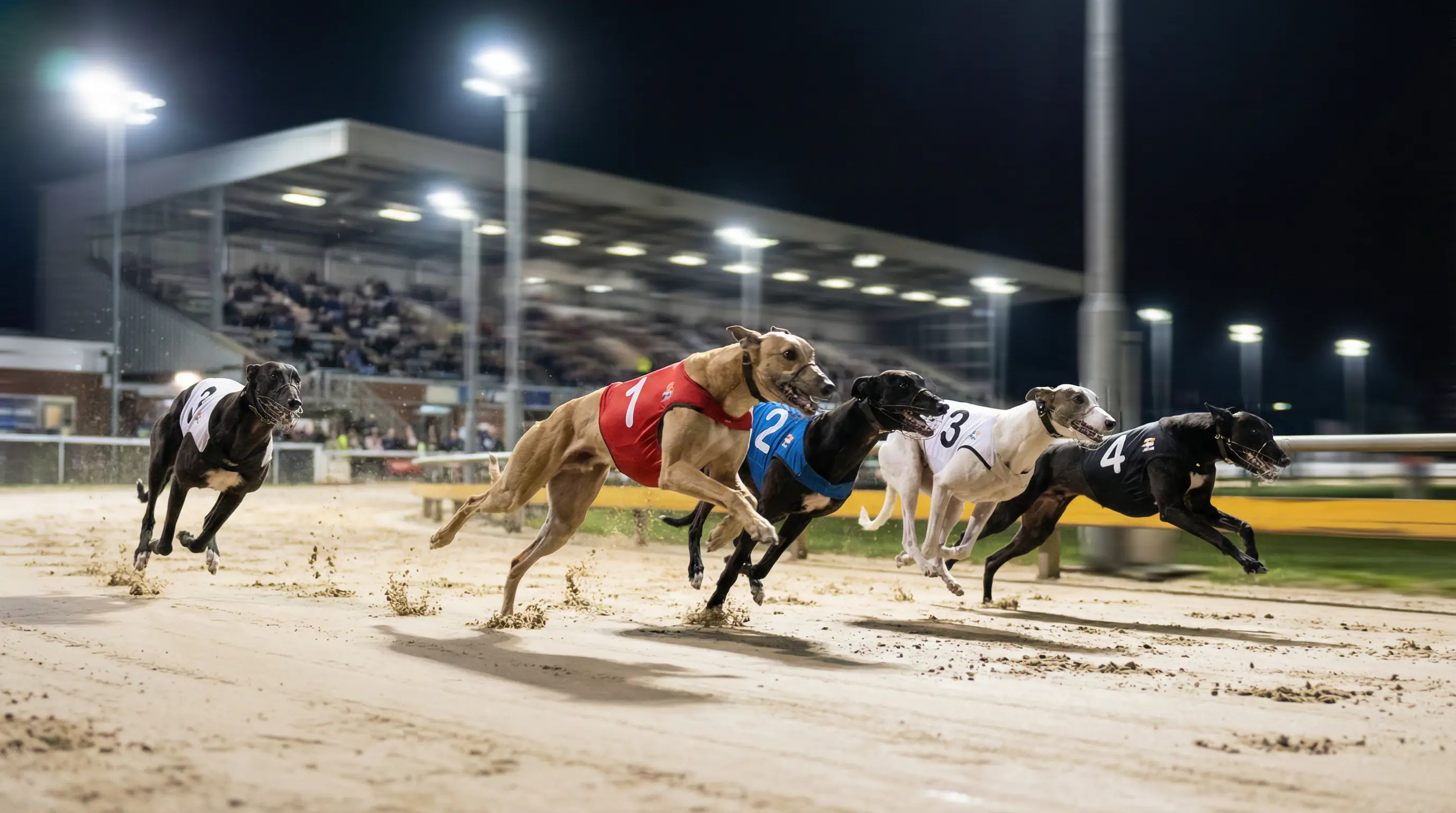
Greyhound Racing in the UK: The Structure Behind the Speed
Behind every 30-second race is a system that takes months to navigate. A greyhound doesn’t arrive at the track and run. Before it reaches the starting traps, it has been bred for racing lines, reared in a kennel environment, schooled on a track, trialled against other dogs, assessed by a racing manager, graded into a competitive category, and passed fit by a veterinarian. The race itself is the shortest part of a process that involves breeders, trainers, racing managers, vets, stewards, and an industry-wide regulatory body. Understanding that structure is not optional background — it shapes the form, the grading, and the data that every bettor relies on.
UK greyhound racing operates under the authority of the Greyhound Board of Great Britain, known as GBGB. This is the regulatory body that licences tracks, trainers, and racing officials, sets the rules of racing, and enforces welfare and integrity standards. There are currently 20 GBGB-licensed stadiums across England and Wales, from Kinsley in West Yorkshire to Romford in East London to Towcester in Northamptonshire. There are no active GBGB-licensed tracks in Scotland. Unlicensed racing — known historically as “flapping” — operated at some venues outside the GBGB framework, with no standardised regulation, no official form records, and no integration with the licensed betting market, though the last independent track closed in March 2025.
The licensed network is the world that matters for bettors. Every GBGB race produces official results, recorded times, and in-running comments that feed into the form database used by racecards, tipsters, and statistical services. The integrity of that data depends on the regulatory structure: drug testing, veterinary inspections, standardised distance measurement, and calibrated timing equipment. Without GBGB regulation, the form figures on a racecard would be unreliable, and the betting market built on top of them would be unstable. This is not an abstract governance point — it directly affects the quality of the information you use to make betting decisions.
Explore all greyhound racing guides on the kinsleygreyhound homepage.
The industry structure from breeding to retirement follows a recognisable pattern. Racing greyhounds in the UK are typically sired by proven stud dogs and bred by specialist breeders, many based in Ireland. Puppies are reared until around twelve to fifteen months of age, then begin schooling — learning to chase the hare, navigate bends, and break from starting traps. Dogs that show sufficient ability move to a licensed trainer, who registers them with the GBGB and enters them for trials at specific tracks. Trials are assessed by the racing manager, who determines the dog’s starting grade based on its trial times and running style. From there, the dog enters the grading system and begins its racing career, typically between the ages of eighteen months and two years.
A racing career usually spans two to four years, depending on the dog’s ability, fitness, and injury record. During that time, a dog might compete at multiple tracks, move up and down the grading ladder, switch between distances, and accumulate a form record that tells the story of its competitive life. At the end of its career, the dog enters the retirement and rehoming process — a subject we will address separately. The point here is that the racing career is a defined chapter, and every data point on the racecard reflects a specific moment within it.
How a Greyhound Race Works — Start to Finish
Traps open, the hare moves, and thirty seconds later it’s over. But a lot happens in those seconds, and a lot happens before them too. A greyhound race is a compact event with a precise sequence of stages, each of which produces data that experienced bettors use to assess form.
Before the race, every competing dog undergoes a veterinary inspection. The track vet checks for signs of injury, illness, or any condition that would make racing unsafe. Dogs that fail this inspection are withdrawn — they become non-runners, and bets on them are voided. After the vet check, dogs are placed in the kennels, where they wait under the supervision of kennel staff until they are called for the parade. The kennelling process is controlled to prevent any interference with the dogs’ condition, and GBGB rules govern who can access the kennels and when.
The pre-race parade brings the dogs onto the track in their numbered jackets. This is the moment when spectators and bettors at the track get their first visual impression of each runner — how the dog carries itself, whether it appears calm or agitated, how it looks physically compared to its recent outings. On-course bettors factor these observations into their late betting decisions. For remote bettors watching on a screen, the parade is less informative but still offers some visual cues.
The dogs are then loaded into the starting traps, one per box, in order from trap 1 to trap 6. The trap handler ensures each dog is facing forward and ready. The hare — a mechanical lure running on a rail around the outside of the track — is activated and begins its circuit. When the hare passes the traps and reaches a predetermined point, the traps open simultaneously and the race begins.
The first strides out of the trap are critical. Dogs that break quickly — those described as QAw (Quick Away) in in-running comments — gain an immediate positional advantage. Dogs that are slow to react — SAw (Slow Away) — lose ground they may never recover. The run to the first bend is where the race begins to take shape. Dogs converge from their six starting positions toward the bends, and the first turn is typically the point of highest interference. Bumping, crowding, and checking all occur most frequently at the first bend because six dogs travelling at high speed are funnelled into a tighter space. The running comments from this phase — Crd (Crowded), Bmp (Bumped), FcdToCk (Forced to Check) — tell the story of whether a dog had a clean passage or encountered trouble.
Through the bends and along the straights, the dogs settle into running positions. Front-runners aim to maintain their lead. Closers look for opportunities to make ground on the outside or through gaps. The middle phase of the race is where running style becomes visible: does the dog lead, chase, or come from behind? At the final bend, the field often reshuffles as dogs with finishing pace make their move. The home straight is the last opportunity to change positions before the finishing line.
The finish itself is recorded by electronic timing equipment and, where necessary, a photo finish camera. The official result confirms the order of finish, the distances between runners (expressed in lengths and fractions — short head, head, neck, half a length, and so on), and the time of the winner. Sectional times may also be recorded depending on the track’s timing infrastructure. After the race, the official result is confirmed by the stewards, and any objections or inquiries — for example, if a dog caused interference — are resolved before the result is finalised and payouts are authorised.
The Grading System: A1 to A11 and Beyond
Grading isn’t just a ranking — it’s a matchmaking system. The purpose of the grading structure in UK greyhound racing is to ensure that dogs of similar ability race against each other. Without grading, the fastest dogs would win every time, slower dogs would never compete, and the racing and betting product would be unworkable. Grading creates competitive balance, and competitive balance creates uncertainty — which is exactly what makes greyhound racing interesting for bettors.
The system works through a series of lettered categories that denote distance, combined with numbered tiers that denote ability within that distance. The main categories are A (middle distance), D (sprint), S (stayer), H (hurdles), and E (extended). Within each category, dogs are ranked by grade number, with 1 being the highest and the numbers descending from there. So A1 is the top grade for middle-distance dogs at a particular track, A2 is the next level down, and so on through A3, A4, A5, A6, and further. Some tracks grade as deep as A10 or A11, depending on the size of their racing population. D1 is the top sprint grade, D2 is below that, and the same pattern applies to S grades for stayers.
A dog’s grade is determined and adjusted by the racing manager at its home track. The initial grade is set based on trial times: a dog that trials fast enough for A3 starts racing at A3. From there, movement between grades is governed by results. A dog that wins moves up a grade — from A5 to A4, for instance. A dog that finishes in the lower positions over a sustained run of races may be dropped down — from A4 to A5. The precise promotion and demotion rules vary slightly between tracks, but the principle is consistent: winning raises your grade, losing lowers it. The system is self-correcting, designed to move dogs toward a grade where they are competitive but not dominant.
This has a direct implication for form interpretation. A dog that has just been graded up is moving into stronger company. Its form at A5 — winning three of its last five — does not guarantee it will perform the same way at A4, where the other five dogs are all recent winners from A5 or droppers from A3. The form figure of “1” at A5 and “1” at A3 look identical on the racecard, but they represent different levels of achievement. Bettors who recognise grade changes in a dog’s recent history can avoid the trap of treating all form figures equally.
Open races sit above the graded system. Designated as OR1, OR2, or OR3, open races are not restricted by track-based grading. They invite entries from multiple tracks, bringing together dogs that may never have raced against each other before. Open races are the prestige events of greyhound racing — the cup competitions to the graded system’s league programme. The English Greyhound Derby, the Puppy Derby, the St Leger, the TV Trophy, and the Gymcrack are all open competitions. Betting on open races is different from graded races because the form lines are harder to compare. A dog graded A1 at Kinsley may not be equivalent to an A1 at Romford because the grading populations and track characteristics differ. Open races expose these discrepancies.
The trial process for new racers is worth understanding because it explains why some dogs appear on the racecard with limited form. When a dog first arrives at a track — either as a young dog beginning its career or as a transfer from another venue — it must complete a satisfactory trial before the racing manager will assign a grade. Trial runs do not appear in the dog’s form record in the same way as competitive races, though some racecards show a “T” in the form line to indicate a trial. A dog with recent trial entries is one that is either new to the track or returning from a break, and its assigned grade is based on the racing manager’s assessment of trial performance rather than a proven competitive record at the venue.
Puppy races are graded separately. Dogs under two years of age compete in puppy events, which allow young dogs to gain racing experience against peers of similar maturity. Puppy form can be exciting but unreliable — young dogs improve rapidly, and a dog that looked moderate in its early puppy races can develop into a strong open-class performer within months. Equally, early puppy promise does not always translate to senior racing success.
Trap Allocation and Seeding
Trap position in greyhound racing isn’t drawn from a hat. It is assigned by the racing manager based on the dog’s observed running style, and the assignment follows a logic designed to produce safer, more competitive races. Understanding this logic explains why certain dogs appear in certain traps and why the trap number on the racecard carries more information than a casual glance suggests.
The six traps are divided into three pairs. Traps 1 and 2 are the rail berths, allocated to dogs that naturally run close to the inside of the track. These are railers — dogs that break from the trap, move toward the inside line, and race along the rail through the bends. Traps 5 and 6 are the wide berths, given to dogs that prefer to run on the outside. Wide runners swing to the outer part of the track and take the bends with a wider arc, relying on their speed to compensate for the additional distance. Traps 3 and 4 are the middle berths, assigned to dogs with no strong preference for rail or wide — versatile runners that can adapt their line depending on the pace of the race around them.
This seeding system exists for two reasons. The first is safety. If a railer is placed in trap 6 and a wide runner in trap 1, both dogs will attempt to cross the field at the first bend — the railer cutting in from the outside, the wide runner pushing out from the inside. This creates a collision course that endangers the dogs and produces chaotic, low-quality racing. By placing each dog near its preferred running line, the racing manager reduces the likelihood of dangerous first-bend interference.
The second reason is competitive fairness. A railer in trap 1 has the shortest run to the inside line and the most direct path through the first bend. A railer forced to start from trap 5 must navigate across the field to reach its preferred position, losing ground and potentially encountering interference. By seeding appropriately, the racing manager gives each dog a fair opportunity to race in its natural style, which in turn produces races where ability — not trap disadvantage — determines the outcome.
The racing manager’s assessment of a dog’s running style is based on observation. After trials and early races, the manager categorises each dog as a railer, a middle runner, or a wide runner, and assigns traps accordingly for future races. This categorisation can change. A young dog might start its career running wide but develop into a more efficient railer as it gains experience and confidence. When the manager reclassifies a dog, it moves to a different set of traps. These reclassifications can create betting opportunities: a dog that has always been drawn in 5 or 6 suddenly appearing in trap 2 is a signal that its running style has been reassessed, and its form from wide draws may not reflect how it will perform from the rail.
For bettors, trap allocation is not merely logistical. It tells you what the racing manager thinks about a dog’s running style. When you combine this with in-running comments from recent races, you can assess whether tonight’s draw helps or hinders.
Race Types: Graded, Open, Handicap & Hurdles
Graded races are local leagues. Open races are the cup competitions. That analogy captures the essential difference between the two main categories of UK greyhound racing, but the full picture includes handicaps, hurdles, and several event formats that each create distinct betting propositions.
Graded races are the backbone of the sport. Every GBGB-licensed track runs a card of graded races as its standard programme, with dogs competing against others of similar ability at the same track. The grading system ensures competitive balance: a dog in grade A4 races against other A4 dogs, not against A1 dogs or A8 dogs. This creates races that are, in theory, competitive and unpredictable within each grade. In practice, some grades are more competitive than others — the middle grades at busy tracks tend to produce the tightest fields, while the very top and very bottom grades can be more lopsided. Graded racing is where form is most reliable because the dogs are racing regularly against familiar opposition at a track they know.
Open races break the grading boundaries. An open race invites entries from across the licensed circuit, attracting the best dogs from multiple tracks. Open events are numbered OR1, OR2, and OR3, with OR1 being the highest class. The major events in UK greyhound racing — the English Greyhound Derby at Towcester, the Puppy Derby, the St Leger, the TV Trophy, the Gymcrack, the Cesarewitch, and others — are all open competitions. They carry the largest prize funds, the most media coverage, and the most active betting markets. For bettors, open races present a different challenge. The dogs are coming from different tracks with different grading structures, and direct form comparison is harder. A dog graded A1 at Kinsley is not necessarily the same standard as A1 at Romford. Open races test whether a dog’s ability is track-specific or genuinely transferable.
Handicap races introduce a staggered start to compensate for ability differences. Instead of all six dogs starting from the same line, weaker dogs are given a head start — additional metres of advantage — based on the racing manager’s assessment of relative ability. The aim is to produce a race where all six dogs reach the finish line at roughly the same time if they run to their expected ability. Handicap racing is less common in greyhounds than in horse racing, but it does feature at some tracks and creates its own betting dynamics. The handicapper’s assessment may not always be accurate, and dogs that have recently improved — but haven’t yet been reassessed — can carry an advantageous handicap mark.
Hurdle races add obstacles to the track. Not every track offers hurdles, but those that do provide a distinct racing experience. The hurdles are low barriers that dogs jump during the race, testing their athleticism and willingness to clear obstacles at speed. Some dogs take to hurdling naturally and produce their best form over jumps. Others are clumsy or hesitant, and their flat form does not translate. Hurdle form is highly track-specific because the positioning, spacing, and height of hurdles varies between venues. A dog that clears hurdles smoothly at one track may struggle at another where the barriers are placed differently relative to the bends.
For bettors, recognising the race type before analysing form prevents you from applying the wrong framework. Graded races reward familiar-track form analysis. Open races require broader assessment and comfort with less certainty. Handicaps demand an opinion on the manager’s ability rating. Hurdles need specialist knowledge. Each favours a different analytical approach.
Trap Colours, Jackets and How to Identify Runners
Red for 1, blue for 2 — and it never changes. The jacket colour system in UK greyhound racing is standardised across every licensed track, every meeting, and every race. Trap 1 wears red. Trap 2 wears blue. Trap 3 wears white. Trap 4 wears black. Trap 5 wears orange. Trap 6 wears black and white stripes. This consistency is not an aesthetic choice — it is a functional requirement that allows spectators, commentators, officials, and bettors to identify every runner instantly at any point during the race.
The jackets are fitted before the parade and removed after the race. Each jacket displays the trap number prominently alongside the colour. For bettors watching live or on screen, the colour system is the primary means of tracking your selection through thirty seconds of high-speed racing. At a glance, you can tell whether the red jacket is leading on the rail, whether the orange jacket is running wide, and whether the white jacket has been caught in traffic at the first bend. Without the standardised colours, following a race in real time would be almost impossible — the dogs move too fast and the field is too tightly bunched for names or numbers to be read.
Reserve runners are identified by a letter R on their jacket. If a listed runner is withdrawn shortly before the race, a reserve dog may be substituted. The reserve enters the race from its designated trap and wears the corresponding jacket colour, but the R marking signals to bettors that this is not the originally carded runner. Reserve runners can affect betting calculations significantly — a well-drawn favourite being replaced by a reserve with different form and a different running style changes the complexion of the race. Always check for late changes and reserve substitutions before confirming a bet, particularly if you are betting close to the off time.
GBGB, Welfare and What Regulation Means for Bettors
Regulation isn’t just about fair racing — it protects the dogs and the punters. The Greyhound Board of Great Britain oversees every aspect of licensed racing in England and Wales, from trainer licensing to drug testing to retirement policy. For bettors, GBGB regulation is the infrastructure that makes informed wagering possible. Without it, there would be no standardised form records, no reliable timing data, no veterinary integrity checks, and no enforceable rules against manipulation. The betting market exists because the regulatory framework exists.
GBGB’s role in ensuring racing integrity operates on several levels. At the track level, stewards officiate every meeting, monitoring races for interference, ruling on objections, and ensuring that the rules of racing are followed. Veterinary officers inspect every dog before racing and are present throughout the meeting to respond to injuries. Random drug testing is conducted to ensure that no performance-enhancing or performance-inhibiting substances are administered to racing dogs. Positive tests result in sanctions for the trainer, which can include fines, suspensions, and exclusion from licensed racing.
For trainers, GBGB licensing requires adherence to a code of conduct that covers kennel standards, training practices, record-keeping, and the welfare of dogs in their care. Regular kennel inspections are carried out by GBGB officials. Trainers must declare any veterinary treatments administered to their dogs, and there are withdrawal periods for certain medications before a dog can race. This system is designed to ensure that every dog competing at a licensed track is healthy, untreated by prohibited substances, and fit to race.
What does this mean in practical terms for bettors? It means the form data is trustworthy. When a racecard shows a dog’s last five finishing positions, those results were recorded under regulated conditions with official timing, veterinary oversight, and steward supervision. When the in-running comments describe a dog as “Slow Away” or “Crowded on the first bend,” those observations were made by officials watching the race in real time. The integrity of this information is what allows bettors to make informed decisions. At an unregulated track, none of these guarantees exist, which is why licensed racing and unlicensed racing are fundamentally different products.
GBGB also operates the Injury Recovery Scheme, which mandates recovery protocols before a dog can return to competition. Gaps in racing, trial entries after a break, and changes in performance level can often trace back to injury recovery periods managed under this framework.
The broader welfare framework includes the GBGB Greyhound Retirement Scheme, which funds and facilitates the rehoming of retired racing greyhounds. A percentage of bookmaker contributions to the sport is directed toward welfare, including retirement, rehoming, and injury treatment. This welfare infrastructure has expanded significantly in recent years, driven by public scrutiny and the sport’s recognition that long-term viability depends on demonstrating responsible stewardship of the animals at its centre.
After the Finish Line: Life Beyond Racing
Most racing greyhounds end their careers between three and five years old. A dog that began racing at eighteen months and retires at four has spent roughly two and a half years on the track. It has potentially many more years of life ahead — greyhounds typically live to twelve or thirteen — and what happens after racing matters both ethically and, increasingly, to the sport’s social licence to operate.
The GBGB Greyhound Retirement Scheme requires that every dog retiring from licensed racing is accounted for. Trainers must notify the GBGB when a dog’s racing career ends and provide details of the dog’s destination — whether it is being rehomed through a charity, returned to its owner, or kept by the trainer. This tracking system is designed to ensure that no dog disappears from the record without a documented outcome. The scheme is funded partly through the sport’s own revenue and partly through partnerships with rehoming organisations.
Learn about race distances at Kinsley in racing distances.
The Greyhound Trust is the largest charity dedicated to rehoming retired racing greyhounds in the UK. It operates a network of branches across the country that take in retired dogs, assess their temperament and health, and match them with adoptive families. Greyhounds are widely regarded as excellent companion animals — despite their racing speed, they are typically calm, gentle, and adaptable dogs in a domestic setting. The popular image of a greyhound as an animal that needs hours of daily exercise is largely a myth. Most retired greyhounds are content with moderate walks and long stretches on a sofa.
For the sport, the welfare and retirement question is existential. Public attitudes toward animal sports have shifted significantly, and greyhound racing faces ongoing scrutiny about injury rates, welfare standards, and post-career outcomes. The industry’s response — expanded welfare funding, the retirement scheme, investment in kennel standards, and greater transparency about injury and retirement data — reflects a recognition that the future of the sport depends on demonstrating that the dogs are treated well throughout their lives, not just during their competitive years.
As a bettor, understanding this context is not about making a moral judgement on the sport. It is about recognising that the regulatory and welfare framework affects the racing product. Tracks and trainers operating under stricter welfare standards produce more consistent data, healthier dogs, and more reliable form. The sport’s welfare infrastructure is, in a practical sense, part of the information environment that makes informed betting possible.
