
History of Greyhound Racing in the UK
 Available in US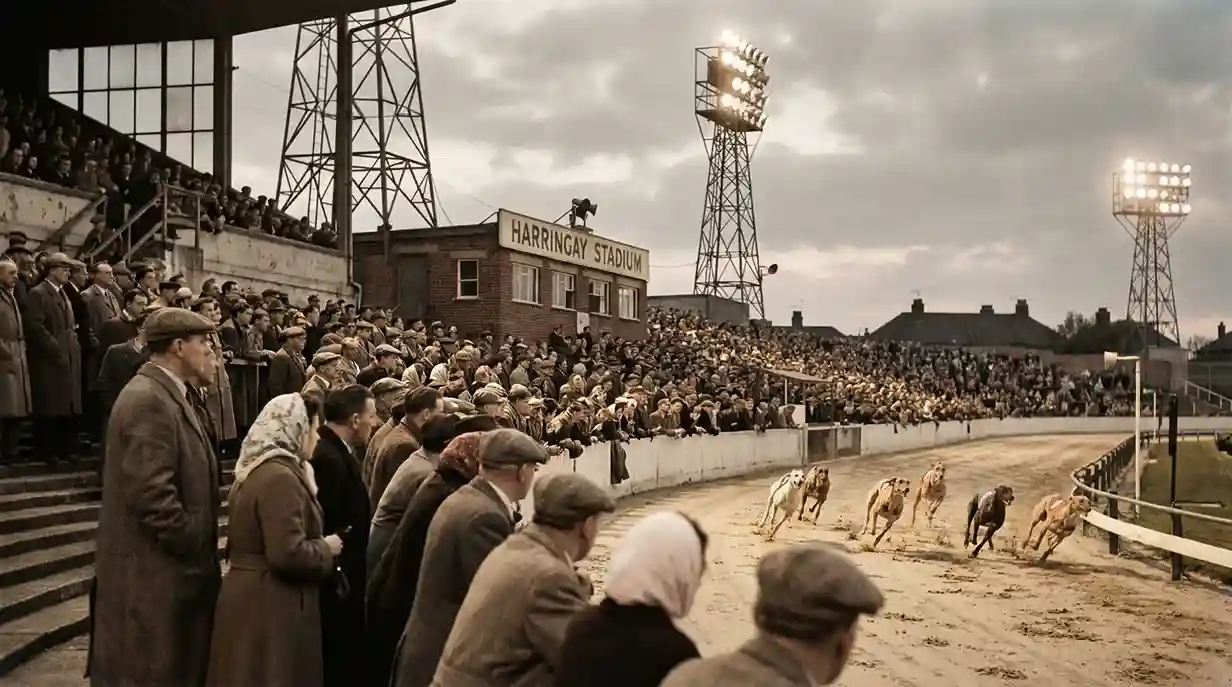
Origins and Early Tracks
Greyhound racing as an organised sport began in the UK in 1926, though coursing — using greyhounds to chase live hares across open countryside — had been a popular pastime for centuries before that. The transition from coursing to track racing was driven by a single innovation: the mechanical hare. An American engineer named Owen Patrick Smith had developed an artificial lure mounted on a rail system around 1912, and when the concept crossed the Atlantic, it found fertile ground in post-war Britain, where working-class communities were hungry for accessible entertainment and a new form of affordable gambling.
The first purpose-built greyhound track in the UK opened at Belle Vue in Manchester on 24 July 1926. The event attracted a crowd estimated at 1,700 people, modest by later standards but significant enough to prove the concept. The racing was crude by modern standards — the mechanical hare was unreliable, the track surface was basic, and the rules were rudimentary — but the public response was immediate and enthusiastic. Within months, promoters across the country were building tracks, and by the end of 1927, greyhound racing had established itself as a genuine mass-participation sport.
The speed of expansion was remarkable. By the late 1920s, greyhound tracks were operating in London (White City, Wimbledon, Harringay, Catford), Manchester, Birmingham, Glasgow, Edinburgh, Cardiff, and dozens of smaller towns. The sport’s appeal was rooted in accessibility: meetings were held in the evening under floodlights, which meant working people could attend after their shifts. Admission was cheap. The racing was exciting — six dogs, thirty seconds of action, a clear winner. And the betting was straightforward, handled by on-course bookmakers and the newly established totalisator (tote) pools.
The early tracks were often converted from existing venues — running tracks, football grounds, disused industrial sites — and the quality varied enormously. The National Greyhound Racing Club was founded in 1928 to bring order to the chaotic growth, establishing a licensing system for tracks and a set of racing rules that formed the foundation of the regulatory framework still recognisable today. The NGRC’s formation marked the moment greyhound racing became a governed sport rather than an unregulated novelty.
Explore greyhound racing history on the kinsleygreyhound homepage.
The Golden Age: 1930s to 1960s
The three decades from the 1930s through the 1960s represent greyhound racing’s peak as a mass-spectator and mass-betting sport in Britain. During this period, “the dogs” was not a niche pursuit — it was mainstream entertainment, rivalling football for attendance figures and generating betting turnover that funded stadiums, prize money, and a nationwide infrastructure of tracks.
Annual attendance at licensed greyhound meetings reached extraordinary levels. In 1946, the peak year, total attendance across UK greyhound tracks was estimated at over 70 million — a figure that made greyhound racing one of the most attended sports in the country. The post-war boom reflected a combination of factors: the return of servicemen looking for affordable evening entertainment, the absence of television as a competing leisure activity, and the enduring appeal of on-course betting in an era when off-course cash betting was still illegal.
The major tracks became landmarks in their cities. White City in London hosted the English Greyhound Derby and attracted a record crowd of 92,000 for the sport’s premier event. Wimbledon Stadium became synonymous with London greyhound racing. Belle Vue in Manchester, the sport’s birthplace, remained a powerhouse. Tracks like Perry Barr in Birmingham, Shelbourne Park in Dublin, and Hall Green drew devoted local followings that sustained regular racing throughout the year.
The betting economy around greyhound racing was substantial. The introduction of legal off-course betting shops in 1961, following the Betting and Gaming Act of 1960, expanded the sport’s reach beyond trackside punters. People who never visited a greyhound track could now bet on the dogs at their local bookmaker, and the sport’s betting turnover grew accordingly. The tote pools at major tracks generated significant revenue, and the on-course bookmakers’ market was lively and competitive.
It was also during this period that the sport developed its competitive structure and traditions. The English Greyhound Derby, first run in 1927 at White City, became the sport’s most coveted prize. The Greyhound St Leger, the Puppy Derby, the Gold Collar, and other prestigious events established a calendar of championship racing that gave the sport narrative and seasonal rhythm. The great racing greyhounds of this era — Mick the Miller, Ballyregan Bob, Scurlogue Champ — became nationally known figures whose exploits were covered in the mainstream press.
Decline and Consolidation
The decline of greyhound racing from its golden-age peak was gradual, driven by structural changes in British society rather than any single catastrophic event. Television arrived, offering free entertainment in the living room. Car ownership expanded, giving families leisure options beyond the local stadium. Football grew more commercial and professionalised, competing directly for the working-class entertainment pound. And the character of urban Britain changed as the post-industrial economy shifted populations and priorities.
Attendance fell steadily from the 1960s onward. The 70-million annual figure of 1946 had halved by the late 1960s and continued to decline through each subsequent decade. Tracks that had been profitable on gate receipts alone found themselves losing money. Stadiums located on valuable urban land became more attractive to property developers than to racing promoters. One by one, the iconic venues closed: White City in 1984, Hackney Wick in 1997, Wimbledon in 2017, Hall Green in 2017. Each closure removed a historic track from the map and concentrated racing into fewer surviving venues.
The financial model shifted. Where golden-age tracks funded themselves from attendance, tote pools, and catering revenue, modern greyhound racing became dependent on media rights and the payments received from bookmakers for the right to broadcast races and offer betting. The BAGS (Bookmakers’ Afternoon Greyhound Service) contract, which paid tracks to stage daytime meetings specifically for bookmaker betting shop coverage, became a critical revenue stream. Racing existed partly to serve the betting industry rather than the other way around, which changed the economic dynamics and, some argued, the sporting priorities of the tracks.
Welfare concerns added pressure from another direction. Animal welfare organisations questioned the treatment of racing greyhounds — the conditions in which they were housed, the injuries sustained on the track, the fate of dogs whose racing careers ended. These concerns, amplified by media investigations and campaigning, led to increased regulatory scrutiny and public debate about the sport’s ethics. The GBGB’s welfare standards, introduced and tightened over successive years, were partly a response to this external pressure.
The consolidation was relentless. By the 2020s, the number of GBGB-licensed tracks in the UK had fallen from seventy-seven licensed tracks in the 1940s to around twenty. The surviving tracks were a mix of long-established venues with loyal local followings, commercially viable stadiums with strong media-rights income, and tracks in areas where alternative development pressures were less intense. The sport was smaller, leaner, and less visible in the public consciousness — but it hadn’t disappeared.
The Modern GBGB Era
The establishment of the Greyhound Board of Great Britain in 2009, replacing the National Greyhound Racing Club, marked the beginning of greyhound racing’s modern regulatory era. The GBGB was designed to govern the sport with greater professionalism, transparency, and accountability than its predecessor — reflecting both the sport’s need to modernise and the external pressure from welfare groups, government, and the betting industry.
Under the GBGB, the regulatory framework tightened considerably. Anti-doping testing became more rigorous, with a wider range of prohibited substances and more frequent sampling. Welfare standards were codified and enforced, covering everything from kennel conditions to injury management to retirement and rehoming. The integrity programme was expanded, with dedicated staff monitoring betting markets and investigating suspicious activity. Disciplinary proceedings became more transparent, with outcomes published and accessible to the public.
Read about GBGB regulation that governs the sport today in GBGB regulation.
The commercial landscape continued to evolve. Online betting transformed the economics of the sport, as punters shifted from betting shops to smartphones and laptops. Live streaming through bookmaker platforms gave greyhound racing a new distribution channel — invisible to non-bettors but highly accessible to anyone with a funded account. The sport’s visibility in the mainstream culture declined, but its availability to engaged bettors arguably increased.
Arena Racing Company (ARC) emerged as a major commercial player, acquiring and operating multiple greyhound stadiums and controlling the media rights for their meetings. The consolidation of track ownership under corporate entities changed the relationship between individual tracks and the sport’s national structure, creating efficiencies of scale but also raising questions about the diversity and independence of the racing programme.
Kinsley Greyhound Stadium operates within this modern landscape — a GBGB-licensed venue in West Yorkshire that races regularly, draws local training talent, and contributes to the national racing schedule. Tracks like Kinsley represent the sport’s present reality: smaller than the golden-age stadiums, less publicly prominent, but functioning within a regulated framework that provides competitive racing and reliable betting markets for the sport’s dedicated audience.
Future Outlook
The future of greyhound racing in the UK sits at an intersection of commercial viability, welfare standards, regulatory pressure, and public perception. None of these forces are moving in a single direction, and the sport’s trajectory will be shaped by how they interact over the coming years.
On the commercial side, the sport’s revenue base is increasingly dependent on the betting industry. Media rights payments from bookmakers — for the right to broadcast races and offer betting markets — are the primary income source for most tracks. As long as greyhound racing generates sufficient betting turnover to justify those payments, the financial model holds. If betting turnover declines — through competition from other sports, regulatory restrictions on gambling advertising, or a shift in punter preferences — the revenue base contracts, and more tracks become financially unviable.
Welfare will continue to be a defining issue. The GBGB has made significant progress in raising standards — injury rates have fallen, rehoming programmes have expanded, and the sport’s welfare narrative has improved compared to two decades ago. But the fundamental tension remains: greyhound racing involves athletic animals running at high speed on a track, with an inherent risk of injury. Critics argue that no welfare framework can fully mitigate this risk and that the sport should be phased out on ethical grounds. Supporters argue that regulated racing with enforced welfare standards provides better outcomes for greyhounds than any realistic alternative, including the unregulated racing that would likely continue without a licensed framework.
Technology is reshaping the betting experience. Mobile streaming, in-play betting, data analytics, and AI-assisted form analysis are changing how punters engage with greyhound racing. The sport’s compact format — six runners, thirty seconds, twelve races per evening — is well-suited to mobile consumption and data-driven betting. If the technology evolution continues to favour accessible, data-rich, fast-turnaround sports, greyhound racing’s structural characteristics could work in its favour.
The most likely near-term future is continued consolidation: a stable but smaller number of tracks, sustained by media-rights income and online betting, operating under increasingly rigorous welfare and integrity standards, with a dedicated but niche audience of regular bettors and racing enthusiasts. The mass-spectator era is not returning. The sport’s future is as a specialist betting product with a live-attendance community — smaller than its past, but resilient within its niche.
